
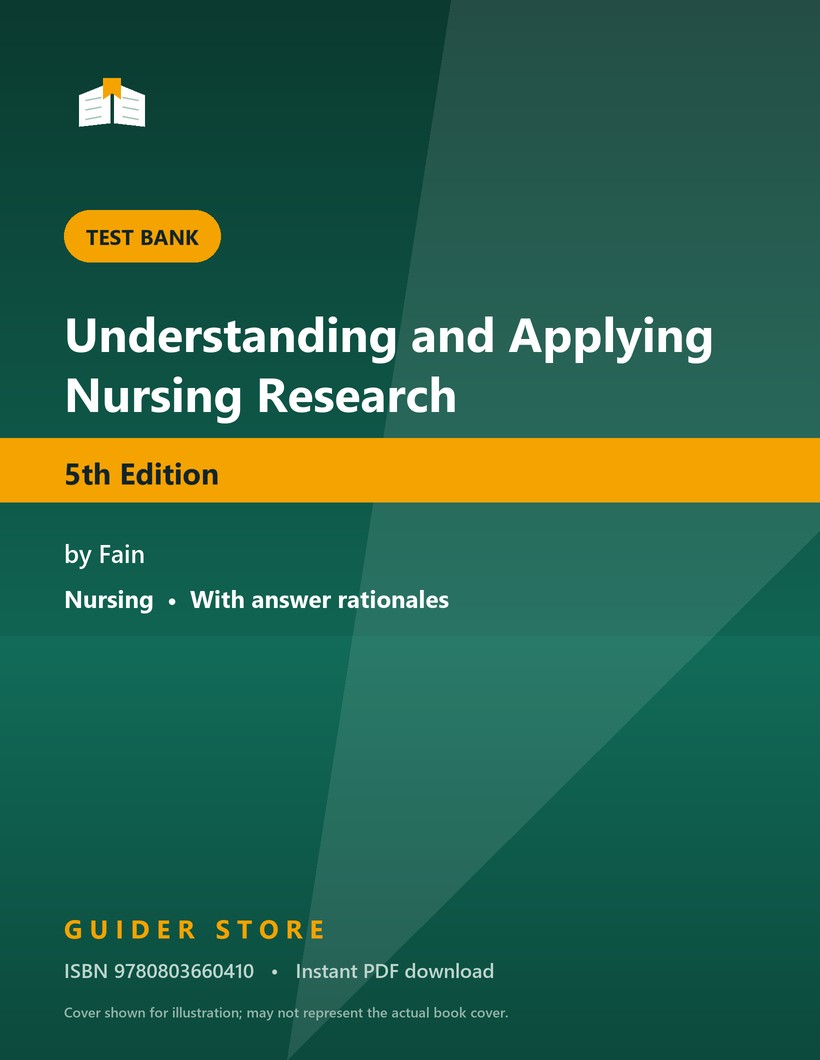



Research courses tend to be the ones nursing students dread — not because they lack interest in evidence, but because the language of research (null hypotheses, sampling error, levels of measurement, internal validity) feels abstract next to the hands-on clinical work they came for. Understanding and Applying Nursing Research is built to make that leap, and this matched test bank is designed to help you rehearse exactly the way your instructor will test you: with questions that ask you not just to recall a definition, but to apply it to a study scenario and defend your reasoning.
Why this test bank helps
Every item comes with an answer rationale, which matters enormously in a research course. Knowing that an answer is “C” teaches you nothing durable; understanding why a study used a quasi-experimental design instead of a true experiment, or why a p-value of 0.04 lets you reject the null hypothesis, is what carries over to your exam and, later, to reading evidence in practice. Rationale-first review turns rote memorization into genuine conceptual understanding.
What’s inside
- Questions organized to follow the flow of a typical research-methods course, from framing a problem through disseminating findings
- Multiple-choice and application-style items in the format used on nursing exams, including scenario-based questions that describe a study and ask you to evaluate it
- A written rationale for every question — explaining the correct choice and the reasoning behind it
- Coverage of both quantitative and qualitative approaches, plus the statistics students find hardest
- Instant PDF download — searchable, printable, and ready the moment checkout completes
Topics covered
- The research process and framing researchable problems and questions
- Reviewing the literature and building a theoretical or conceptual framework
- Quantitative designs — experimental, quasi-experimental, and non-experimental
- Qualitative traditions such as phenomenology, grounded theory, and ethnography
- Sampling methods, sample size, and populations
- Data-collection methods, measurement, reliability, and validity
- Descriptive and inferential statistics, including hypothesis testing
- Critical appraisal of studies and evidence-based practice
- Ethics in research, informed consent, and protection of human subjects
Who it’s for
This is aimed at undergraduate and graduate nursing students working through a nursing-research or evidence-based-practice course that uses Fain’s text, as well as anyone preparing for course exams, comprehensive finals, or the research-related content that appears on NCLEX and many program benchmark assessments. If your syllabus lists this title, the vocabulary and emphasis here should feel familiar.
How to use it (the right way)
Read the relevant chapter first, then attempt a block of questions closed-book to simulate exam conditions. Afterward, study every rationale — including for the items you answered correctly — because the explanation often clarifies a concept you only half-understood. Keep a running list of terms you keep missing (for example, confusing reliability with validity) and revisit them. A brief but important note: this is a study and self-assessment aid, not the graded material for your class. Use it to learn and to check your own understanding, never to gain an unfair advantage, and always follow your institution’s academic-integrity policy.
Sample question
(Shows the format — your download contains the full set.)
Q. A researcher randomly assigns participants to either a new pain-education program or usual care, then compares pain scores after four weeks. Which design does this describe?
- A. Quasi-experimental design
- B. True experimental design
- C. Correlational design
- D. Descriptive design
Answer: B. A true experimental design requires manipulation of an independent variable, a control or comparison group, and random assignment — all three are present here. Option A is wrong because a quasi-experimental design lacks random assignment. Option C describes examining relationships among variables without manipulation, and option D simply portrays characteristics of a group without an intervention, so neither fits.
Edition & format
- Matches: Test Bank for Understanding and Applying Nursing Research 5th Edition by Fain
- ISBN-13: 9780803660410
- Format: Digital PDF, delivered instantly after checkout
- Access: Lifetime — re-download anytime from your account
Please confirm the edition and ISBN match your course before buying — message us and we’ll check.
Frequently asked questions
Does this include answer explanations, or just the correct letters? Every question is paired with a written rationale that explains why the answer is correct, so you understand the concept rather than memorizing a key.
Will this help with the statistics chapters specifically? Yes — the set covers descriptive and inferential statistics and hypothesis testing, which are typically the hardest sections of the course.
How is it delivered? As a digital PDF available to download immediately after checkout, with lifetime re-download access from your account.
Is this the same as my textbook? No. It is a separate self-assessment resource matched to the 5th edition; it does not replace the textbook or your course materials.
Explore more Nursing Test Banks test banks — all with instant PDF delivery and answer rationales.

Reviews
There are no reviews yet.