
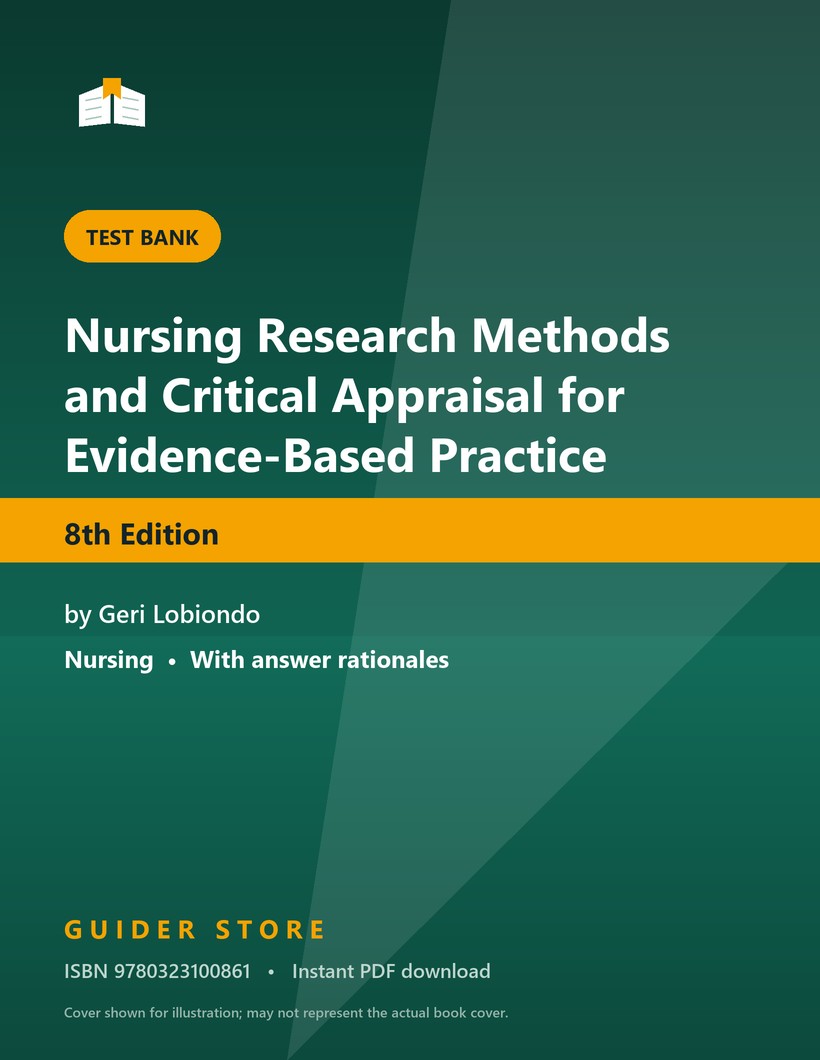



Nursing research is where many students feel they hit a wall — suddenly the vocabulary shifts from care plans and pathophysiology to sampling frames, levels of evidence, and statistical significance. LoBiondo-Wood & Haber’s Nursing Research: Methods and Critical Appraisal for Evidence-Based Practice, 8th Edition is built to translate that world for practising and student nurses, and this matched test bank gives you the retrieval practice needed to actually retain it. Instead of re-reading dense chapters on quantitative and qualitative design, you test what you know, see where the gaps are, and close them fast.
Why this test bank helps
Research methods stick only when you can explain why one design, sample, or statistic is appropriate and another is not. Every question here comes with a written rationale, so you are not just memorising that a study is quasi-experimental — you understand what makes it so, and why the alternatives fail. That rationale-first approach mirrors how research and EBP concepts are actually examined and how you will need to reason at the bedside when appraising a study.
What’s inside
- Questions mapped to the book’s chapters and units, covering the research process from problem statement through dissemination
- Exam-style multiple-choice items in the format used for nursing research and EBP courses, with NCLEX-style application and analysis questions where relevant
- A clear, written rationale for every single question — correct and incorrect options explained
- Coverage of both quantitative and qualitative appraisal, plus the critical-appraisal skills the title emphasises
- Instant PDF download so you can start reviewing the moment you check out
Topics covered
- The research process and developing research questions, problems, and hypotheses
- Quantitative designs: experimental, quasi-experimental, and non-experimental
- Qualitative approaches: phenomenology, grounded theory, ethnography, and case study
- Sampling methods, populations, and sample size considerations
- Reliability, validity, and measurement of study variables
- Data collection methods and descriptive and inferential statistics
- Levels of evidence, critical appraisal, and evaluating rigour
- Evidence-based practice: translating findings into clinical decisions
- Ethical and legal issues in research, including consent and IRB review
Who it’s for
This is for undergraduate and graduate nursing students taking a nursing research or evidence-based practice course that uses the LoBiondo-Wood & Haber 8th edition, as well as RN-to-BSN learners revisiting research literacy. It is especially useful before midterms, finals, and any assessment that asks you to appraise a study or defend a design choice.
How to use it (the right way)
Treat it as a self-assessment tool, not an answer key. Read the relevant chapter first, attempt a block of questions closed-book, then study every rationale — including the ones you answered correctly by luck. Re-test after a few days to check real retention. Use it to diagnose weak areas so your reading time goes where it matters. Academic-integrity note: this resource is for personal study and preparation only. It is not a substitute for your coursework, and you should never present its content as your own submitted work or use it during a graded exam. Always follow your institution’s academic-honesty policy.
Sample question
(Shows the format — your download contains the full set.)
Q. A researcher randomly assigns participants to either a new discharge-teaching program or standard teaching and measures 30-day readmission rates. Which design does this study represent?
- A. Quasi-experimental design
- B. True experimental (randomized controlled) design
- C. Correlational design
- D. Descriptive design
Answer: B. Random assignment to an intervention and a comparison group, combined with researcher-controlled manipulation of the independent variable, defines a true experimental design. Option A is wrong because quasi-experimental studies lack random assignment. Option C is wrong because correlational designs examine relationships without manipulating variables. Option D is wrong because descriptive designs only characterise variables and do not test an intervention.
Edition & format
- Matches: Test Bank for Nursing Research Methods and Critical Appraisal for Evidence-Based Practice, 8th Edition by Geri Lobiondo
- ISBN-13: 9780323100861
- Format: Digital PDF, delivered instantly after checkout
- Access: Lifetime — re-download anytime from your account
Please confirm the edition and ISBN match your course before buying — message us and we’ll check.
Frequently asked questions
Does this include answer rationales, or just the correct letter? Every question includes a written rationale explaining why the correct answer is right and why the others are wrong, so it doubles as a study guide.
Will this help me learn statistics if that is my weak spot? Yes — the set includes items on descriptive and inferential statistics with explanations, which is one of the most useful ways to build confidence in that area. Pair it with your textbook chapters for best results.
How and when do I receive the file? It is a digital PDF delivered instantly after checkout, and you can re-download it anytime from your account.
Is buying and using a test bank allowed? Using one for private self-study and self-testing is a legitimate way to prepare. Just follow your school’s academic-integrity policy and never use it during a graded exam.
Explore more Nursing Test Banks test banks — all with instant PDF delivery and answer rationales.


Reviews
There are no reviews yet.