
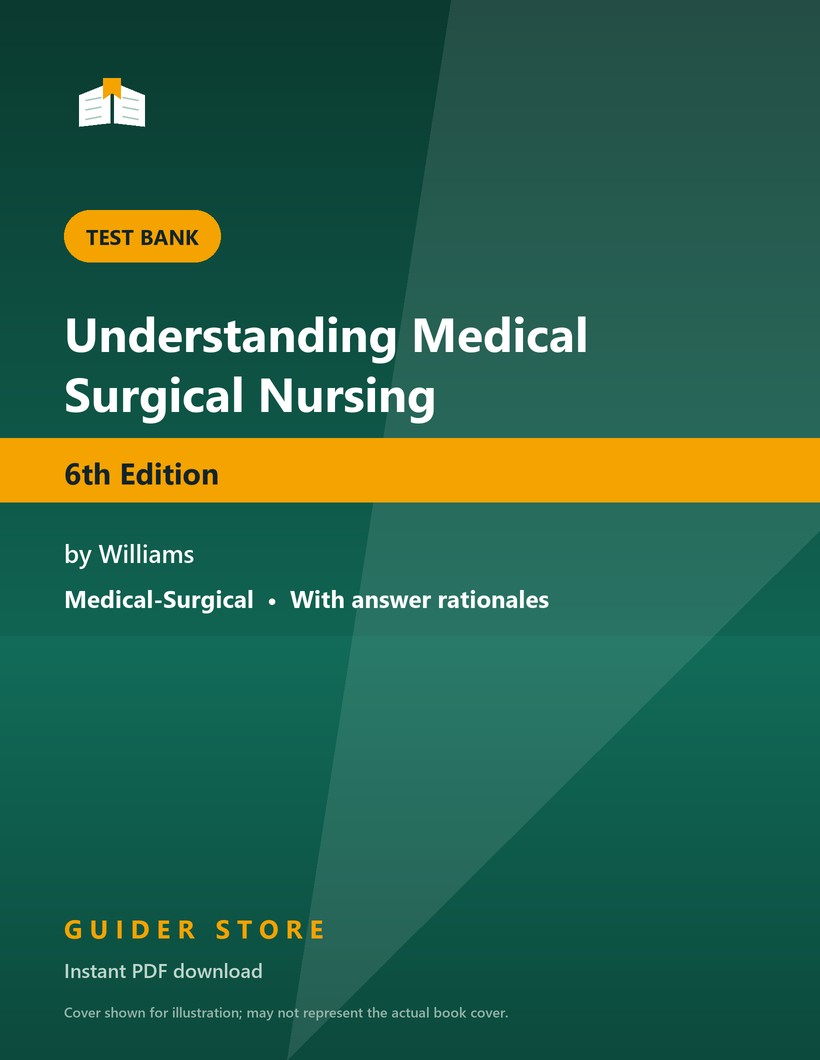


Medical-surgical nursing asks you to hold a huge amount of material in your head at once — fluid and electrolyte balance, cardiac and respiratory disorders, endocrine and renal problems, perioperative care, and the assessments that tie them together. Practical-nursing and associate-degree students working through Understanding Medical Surgical Nursing, 6th Edition by Williams often know the content but still lose marks on application questions that ask, “What would you do first, and why?” This test bank is built to close that gap with practice questions matched to the flow of the Williams textbook, each one paired with a clear rationale.
Why this test bank helps
Memorising facts is not the same as being able to use them under exam pressure. Every question here comes with a rationale that explains not only why the correct answer is right, but why the tempting distractors are wrong. That rationale-first approach trains the clinical reasoning your instructors and licensure exam are actually testing — prioritisation, safe delegation, recognising complications, and connecting a patient’s signs and symptoms to the underlying pathophysiology you studied in each chapter.
What’s inside
- Practice questions mapped to the chapters and body-system units of the Williams 6th Edition text, so you can study alongside your reading.
- NCLEX-PN and exam-style formats relevant to med-surg: multiple choice, select-all-that-apply, prioritisation, and dosage/calculation-style items.
- A written rationale for every question, covering both the correct choice and the reason each other option fails.
- Questions spanning assessment, nursing interventions, patient teaching, and evaluation across the medical-surgical spectrum.
- Instant digital PDF — downloadable the moment your checkout completes.
Topics covered
- Fluid, electrolyte, and acid–base balance and imbalance
- Cardiovascular disorders and perfusion problems
- Respiratory conditions and oxygenation management
- Gastrointestinal, hepatic, and nutritional disorders
- Endocrine disorders, including diabetes management
- Renal and urinary system problems
- Musculoskeletal, neurological, and sensory conditions
- Perioperative care, wound healing, and infection control
- Pain management, cancer care, and end-of-life considerations
Who it’s for
This resource is aimed at practical and vocational nursing students (LPN/LVN pathways) and associate-degree students using Understanding Medical Surgical Nursing, 6th Edition as a course text. It suits learners preparing for course examinations and for the medical-surgical content areas of the NCLEX-PN, as well as anyone reviewing adult health nursing before clinical rotations.
How to use it (the right way)
Read the matching chapter first, then attempt a block of questions closed-book. For every item — right or wrong — read the full rationale before moving on, and jot down any concept you could not explain in your own words. Revisit weak areas after a day or two so the material sticks. Please use this as a study and self-assessment aid to deepen your understanding, not as a substitute for your own coursework or during any graded assessment. Following your school’s academic-integrity policy is your responsibility, and honest practice is what actually prepares you for the exam and the bedside. No study tool can guarantee a grade; consistent, reflective practice is what moves the needle.
Sample question
(Shows the format — your download contains the full set.)
Q. A nurse is caring for a client with heart failure who has developed increasing shortness of breath, crackles in both lung bases, and a weight gain of 2 kg over two days. Which action should the nurse take first?
- A. Encourage the client to increase oral fluid intake.
- B. Place the client in a high-Fowler’s position and assess oxygen saturation.
- C. Prepare the client for immediate discharge teaching.
- D. Withhold the prescribed diuretic until the next scheduled dose.
Answer: B. The client is showing signs of worsening fluid overload and pulmonary congestion, so the priority is to improve oxygenation and breathing effort; high-Fowler’s position and checking oxygen saturation address airway/breathing first and guide next steps. A is unsafe because added fluid worsens overload. C ignores an acute change that needs assessment, not discharge. D is inappropriate because the diuretic is likely needed — and withholding a medication is outside independent nursing judgment without a provider order.
Edition & format
- Matches: for Understanding Medical Surgical Nursing 6th Edition Williams
- Format: Digital PDF, delivered instantly after checkout
- Access: Lifetime — re-download anytime from your account
Please confirm the edition and ISBN match your course before buying — message us and we’ll check.
Frequently asked questions
Does this include answer explanations or just the answer key? Every question includes a written rationale explaining the correct answer and why the other options are incorrect, so you learn the reasoning, not just the letter.
Is this the actual exam my instructor will give me? No. This is an independent study and self-assessment resource built to match the textbook’s topics; it is not affiliated with any school and is not a copy of any live exam.
How and when do I receive it? It is a digital PDF delivered instantly after checkout, and you can re-download it anytime from your account.
Will this guarantee I pass? No honest resource can promise a grade. Used consistently alongside your reading and coursework, it is designed to strengthen your understanding and test-taking confidence.
Explore more Medical-Surgical (Med-Surg) Test Banks — all with instant PDF delivery and answer rationales.



Reviews
There are no reviews yet.