
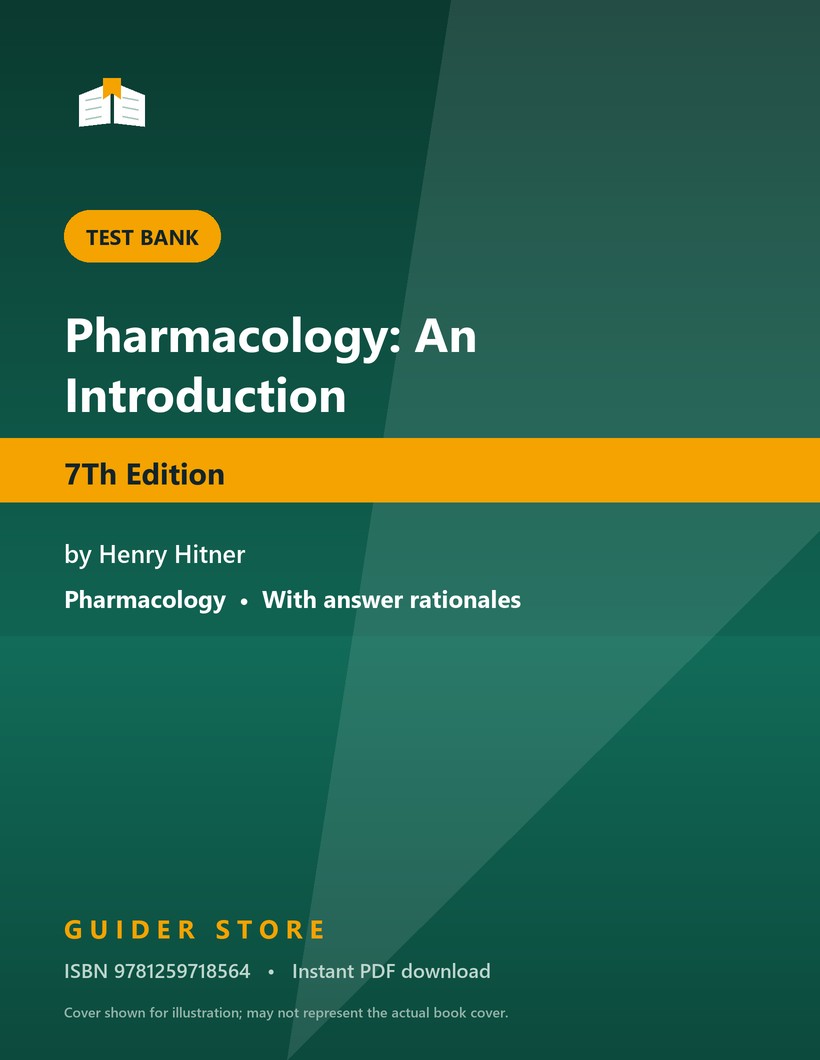

Pharmacology is where classroom theory and bedside safety collide. You are not just memorizing drug names — you are learning mechanisms of action, therapeutic classes, dosing logic, adverse effects, contraindications, and the drug interactions that decide whether a medication heals or harms. The Test Bank for Pharmacology: An Introduction, 7th Edition by Henry Hitner gives you exam-style practice matched to that textbook, so you can pressure-test what you actually understand before an instructor does.
Why this test bank helps
Passive re-reading feels productive but rarely sticks. Active recall does. Every item here comes with a written rationale, so you don’t just find out that an answer was wrong — you learn why a particular mechanism, class effect, or contraindication makes one option correct and the others distractors. That rationale-first approach is what turns scattered drug facts into durable, transferable clinical reasoning.
What’s inside
- Practice questions organized to follow the chapter flow of Hitner’s Pharmacology: An Introduction, 7th Edition
- Multiple-choice and application-style items reflecting how pharmacology is tested on course exams and NCLEX-style questions
- A clear rationale for every question — correct answer explained, common distractors addressed
- Coverage spanning drug classes, mechanisms, indications, adverse effects, and interactions
- Delivered as an instant, searchable PDF you can study on any device
Topics covered
- Principles of pharmacology: pharmacokinetics and pharmacodynamics
- Autonomic nervous system drugs (cholinergic, adrenergic, and their blockers)
- Central nervous system agents: sedatives, antipsychotics, antidepressants, and analgesics
- Cardiovascular and renal drugs, including antihypertensives, diuretics, and antiarrhythmics
- Anti-infective therapy: antibiotics, antivirals, and antifungals
- Endocrine pharmacology, including diabetes and thyroid medications
- Respiratory, gastrointestinal, and anti-inflammatory agents
- Drug interactions, adverse effects, and principles of safe medication administration
Who it’s for
This is built for students using Hitner’s Pharmacology: An Introduction, 7th Edition — nursing, allied health, pharmacy technician, and health-science learners preparing for course exams, midterms, and finals, as well as anyone reinforcing drug knowledge ahead of NCLEX-style assessments. If pharmacology is a required course in your program, this gives you targeted, chapter-aligned practice.
How to use it (the right way)
Read a chapter, then attempt the matching questions before checking answers. Mark every miss, read the rationale carefully, and revisit that section of your textbook — the goal is understanding the mechanism, not memorizing a lettered answer. Use it as a self-assessment and study aid to complement your lectures and required reading, never as a substitute for them or for any graded, assessment. Always follow your institution’s academic-integrity policy.
Sample question
(Shows the format — your download contains the full set.)
Q. A patient taking a nonselective beta-adrenergic blocker such as propranolol develops hypoglycemia. Why is this clinically concerning?
- A. Beta blockers directly raise blood glucose to dangerous levels
- B. Beta blockers can mask the adrenergic warning signs of hypoglycemia, such as tachycardia and tremor
- C. Beta blockers prevent insulin from binding to its receptors
- D. Beta blockers eliminate the risk of hypoglycemia entirely
Answer: B. Nonselective beta blockade suppresses the sympathetic (adrenergic) responses — tachycardia, palpitations, tremor — that normally alert a patient to falling blood glucose, so hypoglycemia may go unrecognized until it is severe. A is wrong because beta blockers do not reliably raise glucose. C misstates the mechanism; beta blockers do not act on insulin receptors. D is dangerously false — the risk is not eliminated but rather harder to detect.
Edition & format
- Matches: Test Bank for Pharmacology: An Introduction, 7th Edition by Henry Hitner
- ISBN-13: 9781259718564
- Format: Digital PDF, delivered instantly after checkout
- Access: Lifetime — re-download anytime from your account
Please confirm the edition and ISBN match your course before buying — message us and we’ll check.
Frequently asked questions
Does this include an answer rationale for every question? Yes. Each question comes with an explanation of why the correct answer is right and why the distractors are wrong, so you learn the reasoning, not just the letter.
Is this the actual textbook or the instructor’s official test bank? No. This is a study and self-assessment resource matched to the 7th edition to help you practice. It is not the textbook and is not affiliated with the publisher.
Will this guarantee a better grade? No honest resource can promise a grade. Used consistently as active-recall practice, it can strengthen your understanding — but your results depend on your study effort.
How do I receive it? Instantly. After checkout you download the PDF right away, and you can re-download it anytime from your account.
Explore more Pharmacology Test Banks — all with instant PDF delivery and answer rationales.



Reviews
There are no reviews yet.