
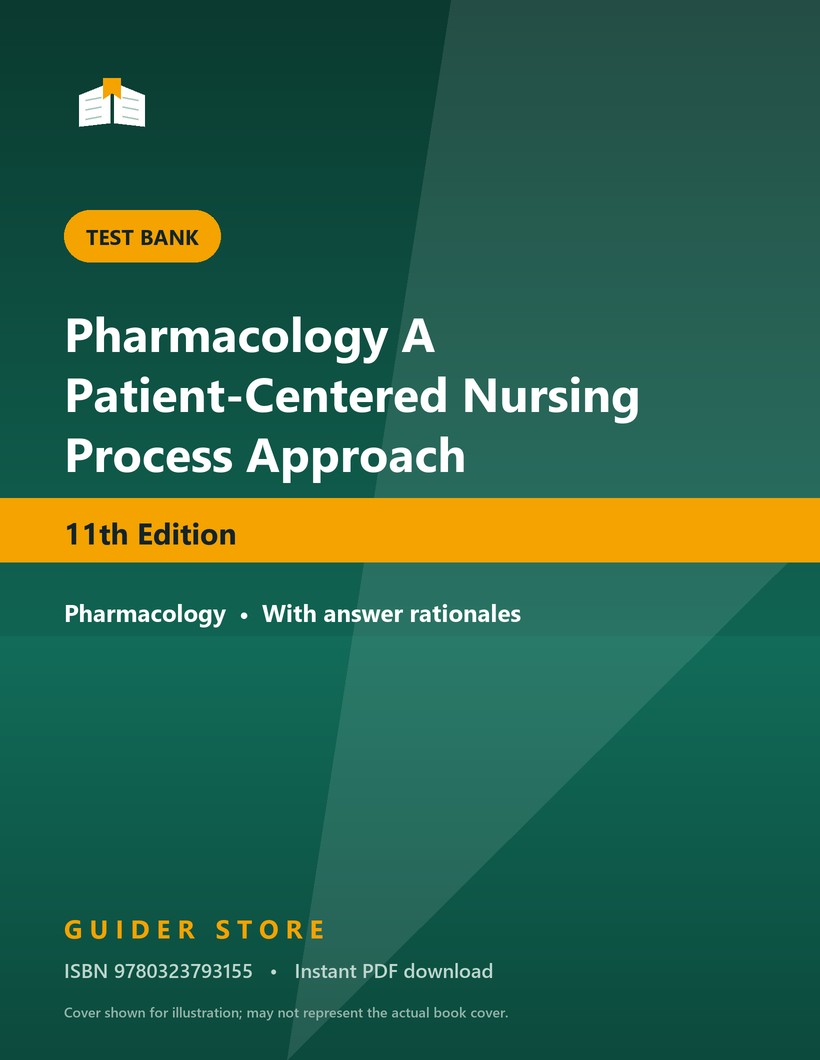
Pharmacology is the course where nursing gets unforgiving: drug classes blur together, mechanisms of action feel abstract, and one misread on a dosage or contraindication can cost real points — or, later, real patient safety. A patient-centered approach raises the stakes, because you are not just memorizing drugs, you are learning to apply them across the nursing process for real people. This test bank, matched to Pharmacology: A Patient-Centered Nursing Process Approach, 11th Edition, gives you exam-style practice that mirrors how instructors test: through clinical reasoning, not recall.
Why this test bank helps
Getting an answer right is only half the point. Every question comes with an answer rationale that explains why the correct option is correct and why the tempting distractors are wrong. That rationale-first design turns practice into learning — you start to recognize why a beta-blocker is held for a low heart rate, or why a nurse checks renal function before an aminoglycoside, instead of just guessing. Over repeated sessions, you build the pattern recognition that timed exams reward.
What’s inside
- Questions organized to follow the textbook’s chapter flow, so you can study alongside your current unit
- NCLEX-style item formats: multiple-choice, select-all-that-apply, dosage-calculation, and priority/“first action” items
- Questions built around the nursing process — assessment, planning, implementation, and evaluation of drug therapy
- A written rationale for every question, not just an answer key
- Coverage of high-yield safety themes: contraindications, adverse effects, and patient teaching
- Instant PDF download — start reviewing within minutes of checkout
Topics covered
- Pharmacokinetics, pharmacodynamics, and the nurse’s role in medication administration
- Autonomic nervous system drugs — adrenergics, cholinergics, and their blockers
- Cardiovascular agents: antihypertensives, diuretics, antidysrhythmics, and anticoagulants
- Antimicrobials, antivirals, and antifungals, including safe-handling and resistance concepts
- Pain management: analgesics, opioids, NSAIDs, and anti-inflammatory therapy
- Endocrine drugs, including antidiabetic agents and thyroid medications
- Respiratory, gastrointestinal, and central nervous system pharmacology
- Antineoplastics, immunologics, and reproductive-system drugs
- Fluid, electrolyte, and nutritional pharmacology across the lifespan
Who it’s for
This is built for nursing students working through a pharmacology course that uses the 11th edition — ADN, BSN, and accelerated students preparing for course exams and building a foundation for the pharmacology-heavy sections of the NCLEX-RN. It also suits LPN-to-RN bridge students reviewing drug therapy from a nursing-process perspective.
How to use it (the right way)
Use it as a self-assessment tool, not a shortcut. After you read a chapter, work the matching questions closed-book, then read every rationale — including the ones you got right. Keep a list of the drug classes you keep missing and re-drill only those. This is a study and practice aid to help you understand the material and gauge readiness; it is not a substitute for lectures, the textbook, or assigned coursework. Always follow your institution’s academic-integrity policy, and never use practice materials during a live exam.
Sample question
(Shows the format — your download contains the full set.)
Q. A nurse is preparing to administer intravenous furosemide to a patient with heart failure. Which assessment finding would be the priority to report to the provider before giving the dose?
- A. Blood pressure of 128/76 mm Hg
- B. Serum potassium of 2.9 mEq/L
- C. Urine output of 60 mL over the past hour
- D. Respiratory rate of 20 breaths per minute
Answer: B. Furosemide is a loop diuretic that causes potassium loss, and a serum potassium of 2.9 mEq/L is below the normal range (roughly 3.5–5.0 mEq/L). Giving more furosemide would worsen the hypokalemia and raise the risk of cardiac dysrhythmias, so this must be reported first. Option A is a normal blood pressure, option C is adequate urine output, and option D is a normal respiratory rate.
Edition & format
- Matches: Test Bank for Pharmacology A Patient-Centered Nursing Process Approach 11th Edition
- ISBN-13: 9780323793155
- Format: Digital PDF, delivered instantly after checkout
- Access: Lifetime — re-download anytime from your account
Please confirm the edition and ISBN match your course before buying — message us and we’ll check.
Frequently asked questions
Does every question really include a rationale? Yes. Each question is paired with a written explanation of the correct answer and why the other options are wrong.
Is this the same as the actual exam I’ll take? No. It is an independent study and self-assessment resource matched to the textbook’s topics and common exam formats. We do not promise any specific grade or outcome.
How and when do I get it? It is a digital PDF delivered instantly after checkout, and you can re-download it anytime from your account.
How do I know it matches my course? Check that your syllabus lists the 11th edition with ISBN 9780323793155. If unsure, message us and we will verify before you buy.
Explore more Pharmacology Test Banks — all with instant PDF delivery and answer rationales.
Other editions of this book: 9th Edition · 8th Edition



Reviews
There are no reviews yet.