
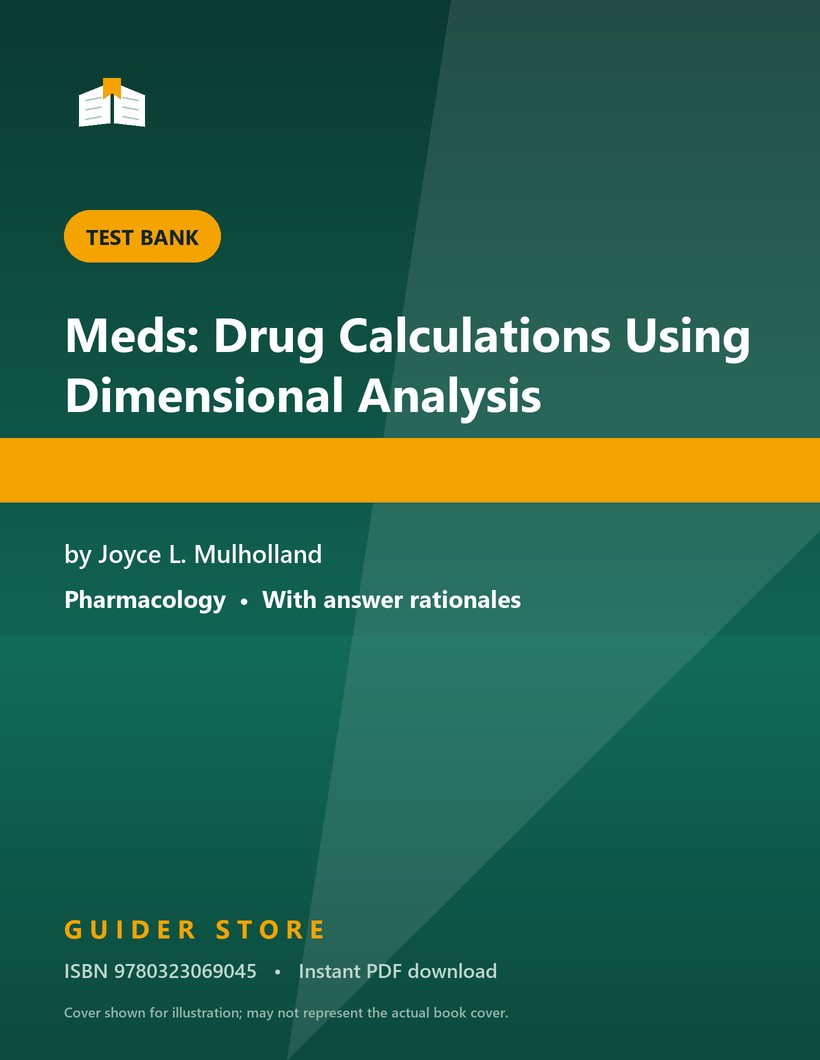
Dosage calculation is one of the few places in nursing where a single misplaced decimal can harm a patient — and the dimensional-analysis method taught in Mulholland’s Meds: Drug Calculations Using Dimensional Analysis is designed to make those errors far less likely by forcing every unit to cancel cleanly. The hard part isn’t the arithmetic; it’s setting up the equation correctly, tracking units, and staying accurate under exam pressure. This test bank gives you repeated, low-stakes practice at exactly that skill so the setup becomes automatic before you ever face a graded exam or a real medication order.
Why this test bank helps
Getting a calculation right once is luck; getting it right every time is a habit built on understanding why the setup works. Every item here includes a worked rationale that shows how the conversion factors are arranged, which units cancel, and how the final answer is rounded and labeled. Instead of just checking a number, you learn to audit your own setup — the single most transferable skill in medication math.
What’s inside
- Practice questions mapped to the book’s progression, from basic math review and unit conversions through oral, parenteral, IV, and weight-based dosing.
- Calculation-style items that mirror how dosage math appears on nursing exams and the NCLEX (fill-in-the-blank numeric answers and applied clinical scenarios).
- A clear, step-by-step rationale for every question — showing the dimensional-analysis setup, not just the result.
- Rounding, labeling, and safe-dose-range reasoning woven into the explanations.
- Instant PDF download you can open on any device and revisit as often as you like.
Topics covered
- Math foundations: fractions, decimals, ratios, and metric/household/apothecary conversions
- The dimensional-analysis method: building equations and cancelling units
- Oral medication dosages (tablets, capsules, and liquids)
- Parenteral and injectable dosages, including reconstitution
- Intravenous flow rates, drip factors, and infusion time calculations
- Weight-based dosing and body-surface-area considerations
- Pediatric and safe-dose-range calculations
- Reading and interpreting medication orders and drug labels
Who it’s for
This is built for nursing and allied-health students working through a dosage-calculation or pharmacology math course, anyone whose program uses the dimensional-analysis approach, and NCLEX-RN or NCLEX-PN candidates who want to stop losing points on medication-math items. It is equally useful for students retaking a “dosage competency” exam or brushing up before clinical rotations.
How to use it (the right way)
Work each problem on paper before looking at the answer — write out the full setup, cancel the units, then compare your reasoning to the rationale. When you miss one, don’t just note the right number; find the exact step where your setup broke down. Treat this as a self-assessment and study tool that builds genuine competence, not a shortcut. It is not a substitute for your assigned coursework, and it should never be used to gain an unfair advantage on a live assessment — follow your school’s academic-integrity policy at all times.
Sample question
(Shows the format — your download contains the full set.)
Q. An order reads: heparin 5,000 units subcutaneously. The vial on hand is labeled 10,000 units/mL. How many milliliters should the nurse administer?
- A. 0.25 mL
- B. 0.5 mL
- C. 1 mL
- D. 2 mL
Answer: B. Using dimensional analysis, multiply the ordered dose by the vial concentration as a conversion factor: 5,000 units × (1 mL / 10,000 units) = 0.5 mL, with the “units” cancelling to leave mL. Option A halves the correct value (a 10,000-into-5,000 error), option C ignores that the vial is twice as concentrated as the dose, and option D inverts the ratio — a classic sign the conversion factor was set up upside down.
Edition & format
- Matches: Test Bank for Meds: Drug Calculations Using Dimensional Analysis, 2nd Edition by Joyce L. Mulholland
- ISBN-13: 9780323069045
- Format: Digital PDF, delivered instantly after checkout
- Access: Lifetime — re-download anytime from your account
Please confirm the edition and ISBN match your course before buying — message us and we’ll check.
Frequently asked questions
Is this the textbook itself? No. This is a test bank of practice questions with answer rationales meant to accompany your studying — it is not the Mulholland textbook and does not replace it.
Does it use the dimensional-analysis method specifically? Yes. The explanations are written around the unit-cancelling setup this book teaches, so the reasoning matches how your course presents dosage math.
Will this guarantee I pass my dosage exam? No honest resource can promise a grade. What it can do is give you focused, repeatable practice with full rationales so you understand the method rather than memorize answers.
How do I get it after paying? The PDF is delivered instantly at checkout, and you can re-download it anytime from your account.
Explore more Pharmacology test banks — all with instant PDF delivery and answer rationales.



Reviews
There are no reviews yet.