
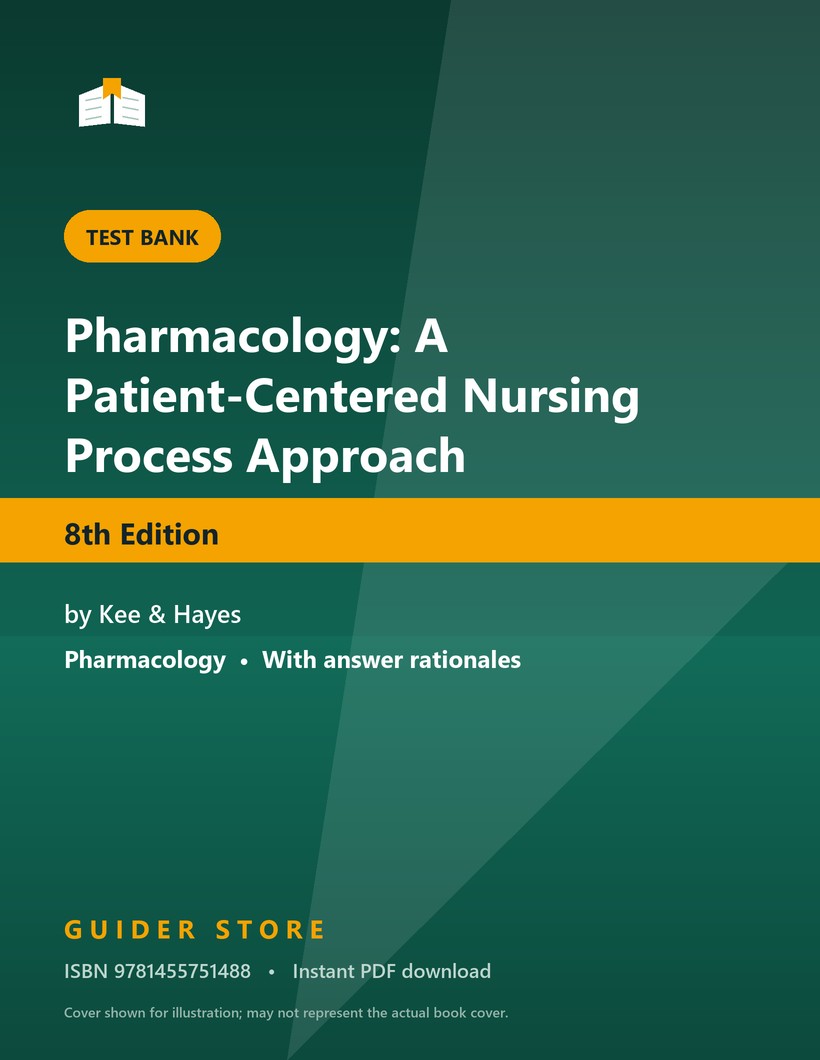

Pharmacology often separates students who memorize from students who truly understand nursing care. Drug names blur together, dosage math trips people up under time pressure, and the leap from “what the drug does” to “what I do for this patient” is exactly what exams test. This test bank is matched to Pharmacology: A Patient-Centered Nursing Process Approach, 8th Edition by Kee & Hayes, so your practice questions follow the same drug classes, prototypes, and nursing-process framing you meet in the chapters.
Why this test bank helps
The real value here is the rationale behind every answer. Instead of just confirming a letter, each item explains why the correct option is right and why the tempting distractors are wrong — the mechanism of action, the priority nursing assessment, the contraindication, or the patient-teaching point you were expected to catch. Pharmacology rewards pattern recognition (recognize the class, predict the effect, anticipate the adverse reaction), and rationale-first practice is how that thinking gets built.
What’s inside
- Questions organized to follow the textbook’s chapter and unit flow, so you can study alongside your reading week by week.
- NCLEX-style formats relevant to pharmacology: multiple-choice, select-all-that-apply, and applied dosage-calculation items.
- A written rationale for every question — correct answer explained, distractors ruled out.
- Coverage spanning mechanism of action, therapeutic use, adverse effects, nursing implications, and patient teaching.
- Instant digital PDF, downloadable the moment checkout completes.
Topics covered
- Pharmacokinetics and pharmacodynamics, plus the nursing process and drug administration foundations
- Dosage calculation and safe medication administration principles
- Autonomic and central nervous system drugs (cholinergics, adrenergics, analgesics, sedatives, antipsychotics, anticonvulsants)
- Cardiovascular and diuretic agents (antihypertensives, antianginals, antidysrhythmics, anticoagulants)
- Respiratory, gastrointestinal, and endocrine drugs (including insulin and antidiabetic therapy)
- Anti-infectives: antibiotics, antivirals, antifungals, and antitubercular agents
- Antineoplastic and immune-modulating drugs
- Fluid, electrolyte, and nutritional therapies
- Drug therapy across the lifespan and in specialty populations
Who it’s for
This is written for nursing students working through a pharmacology course that uses the Kee & Hayes 8th edition text, and for candidates reinforcing pharmacology ahead of the NCLEX-RN. It also suits practical/vocational nursing students who want targeted, class-by-class drug practice with explanations rather than a wall of unexplained answer keys.
How to use it (the right way)
Read the chapter first, then attempt the matching questions closed-book to simulate exam conditions. Mark every miss, and don’t move on until you can say aloud why the right answer is right and why each wrong option failed. Revisit weak drug classes after a day or two to test real retention. One honest note on academic integrity: this is a study and self-assessment aid to deepen understanding — it is not a copy of any live exam and should never be used to gain an unfair advantage. Follow your institution’s academic-honesty policy.
Sample question
(Shows the format — your download contains the full set.)
Q. A client is started on furosemide for heart failure. Which laboratory value should the nurse monitor most closely for a common adverse effect of this drug?
- A. Serum sodium only
- B. Serum potassium
- C. Serum calcium
- D. Blood glucose only
Answer: B. Furosemide is a loop diuretic that promotes potassium excretion, so hypokalemia is a common, clinically important adverse effect the nurse must watch for. Sodium can shift, but potassium loss carries the greater risk of cardiac dysrhythmias, especially if the client also takes digoxin (A is incomplete and not the priority). Loop diuretics tend to lower, not raise, calcium, so C is not the concern. Glucose may rise modestly, but it is not the most closely monitored value for this drug’s classic adverse effect (D).
Edition & format
- Matches: Test Bank for Pharmacology: A Patient-Centered Nursing Process Approach 8th Edition by Kee & Hayes
- ISBN-13: 9781455751488
- Format: Digital PDF, delivered instantly after checkout
- Access: Lifetime — re-download anytime from your account
Please confirm the edition and ISBN match your course before buying — message us and we’ll check.
Frequently asked questions
Does every question include an explanation? Yes. Each item comes with a rationale covering why the correct answer is right and why the other options are wrong, so you learn the reasoning, not just the letter.
Will this guarantee me a better grade? No honest resource can promise a grade. What it can do is give you focused, rationale-based practice that helps you understand pharmacology more deeply — the rest depends on your study.
Is this the same as my actual exam? No. This is an independent study and self-assessment aid, not a copy of any live test. Use it to master the material within your school’s academic-integrity rules.
How do I receive it? It is a digital PDF delivered instantly after checkout, and you can re-download it anytime from your account.
Explore more Pharmacology Test Banks — all with instant PDF delivery and answer rationales.
Other editions of this book: 9Th Edition · 11Th Edition




Reviews
There are no reviews yet.