
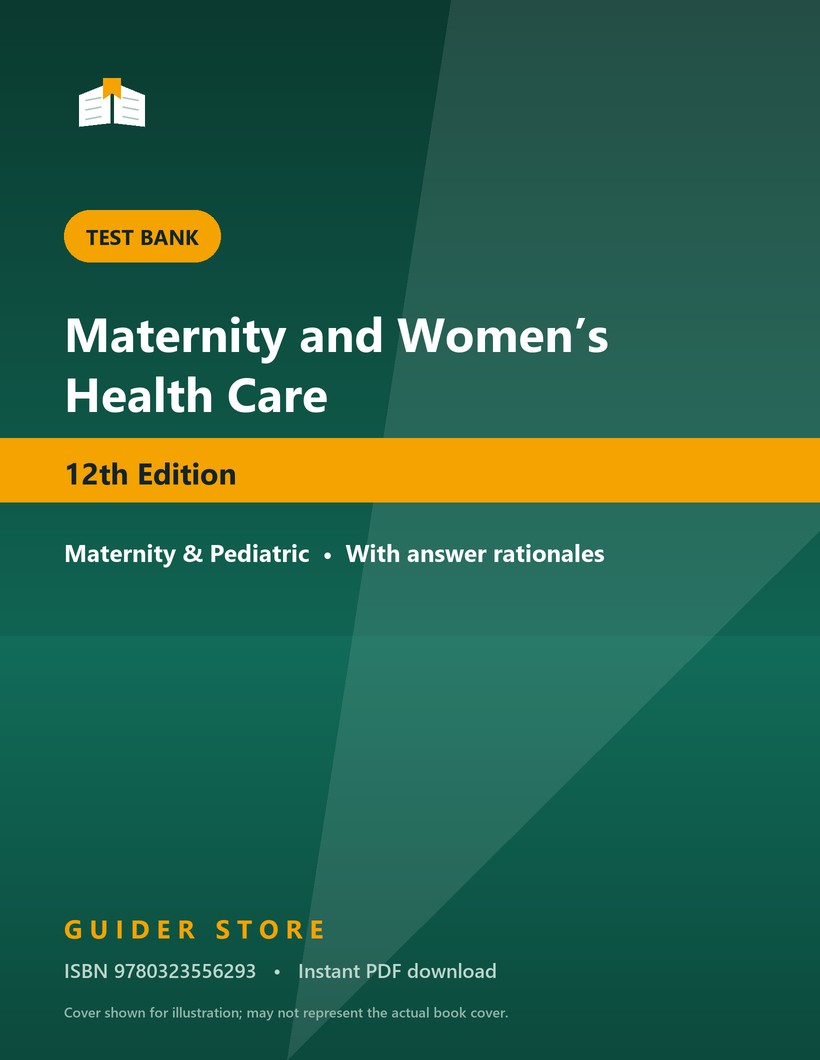



Maternity and women’s health nursing asks you to hold two patients in mind at once — the childbearing person and the fetus or newborn — while decoding fetal heart rate strips, staging labor, and catching postpartum hemorrhage before it becomes an emergency. The volume of normal-versus-abnormal distinctions is huge, and exams rarely reward memorization alone. This test bank, matched to Maternity and Women’s Health Care, 12th Edition, gives you exam-style practice questions with a full rationale for every answer so you can rehearse the clinical reasoning your instructors and the NCLEX actually test.
Why this test bank helps
Recall gets you partial credit; reasoning gets you the answer. Each item here is built around why — why a late deceleration signals uteroplacental insufficiency, why magnesium sulfate toxicity shows up first in the deep tendon reflexes, why a boggy fundus outranks a slow trickle of lochia as your first concern. Working the rationales trains you to eliminate distractors and defend a choice, which is exactly the skill that transfers from a study PDF to a real clinical decision.
What’s inside
- Questions organized to follow the textbook’s flow, from women’s health and reproduction through pregnancy, labor, birth, postpartum, and the newborn
- NCLEX-style formats relevant to maternity: multiple choice, select-all-that-apply, priority and “first action” items, and dosage and calculation practice
- A written rationale for every question — correct answer explained plus why each distractor is wrong
- Fetal assessment and monitoring scenarios that ask you to interpret and act, not just define
- Instant PDF download — open it on any device and start practicing right away
Topics covered
- Women’s health, reproductive anatomy, contraception, and common gynecologic conditions
- Antepartum care: physiologic changes of pregnancy, prenatal assessment, and nutrition
- High-risk pregnancy: gestational diabetes, hypertensive disorders and preeclampsia, and bleeding complications
- Intrapartum care: stages and mechanisms of labor, comfort and pain management, and fetal heart rate monitoring
- Obstetric emergencies and interventions, including induction, operative and cesarean birth
- Postpartum physiology, hemorrhage, infection, and psychosocial adaptation
- Newborn transition, assessment, thermoregulation, feeding, and common neonatal complications
- Pharmacology relevant to maternity, from oxytocics and tocolytics to magnesium sulfate
Who it’s for
This is for nursing students working through a maternity, obstetric, or women’s health course that uses the 12th edition — especially those preparing for course exams, ATI or HESI maternity assessments, and the maternity content on the NCLEX-RN. It also suits returning nurses and internationally educated nurses refreshing childbearing-family content before a bridging exam.
How to use it (the right way)
Study first, then test yourself. Read the chapter, then answer a block of questions closed-book, and only afterward check the rationales — write down the reason you missed anything so you can spot your own patterns. Revisit weak topics until the reasoning feels automatic. Use this as a self-assessment and study aid, not a substitute for your textbook, lectures, or clinical practice. Please follow your school’s academic-integrity policy: this is for personal exam preparation, not for use during graded assessments. No study tool can promise a grade — consistent, honest practice is what moves the needle.
Sample question
(Shows the format — your download contains the full set.)
Q. A laboring client at 39 weeks has continuous external fetal monitoring. The nurse observes decelerations that begin after the peak of each contraction and return to baseline after the contraction ends. What is the nurse’s priority action?
- A. Document the reassuring pattern and continue routine monitoring
- B. Reposition the client to a lateral side-lying position
- C. Increase the rate of the oxytocin infusion to speed labor
- D. Prepare the client for immediate amniotomy
Answer: B. The pattern described is a late deceleration, which suggests uteroplacental insufficiency and is nonreassuring, so repositioning to improve placental perfusion is an appropriate first intervention. A is wrong because late decelerations are not reassuring. C is wrong because oxytocin should be reduced or stopped, not increased, since more contractions worsen the problem. D is wrong because amniotomy does not correct uteroplacental insufficiency and is not the priority.
Edition & format
- Matches: Test Bank for Maternity and Women’s Health Care 12th Edition
- ISBN-13: 9780323556293
- Format: Digital PDF, delivered instantly after checkout
- Access: Lifetime — re-download anytime from your account
Please confirm the edition and ISBN match your course before buying — message us and we’ll check.
Frequently asked questions
Does every question include a rationale? Yes. Each item explains why the correct answer is right and why the other options are wrong, so you learn the reasoning rather than just the letter.
Is this the same as the textbook? No. It is a companion self-assessment resource of practice questions and rationales. You still need the textbook for full content coverage.
Will this guarantee I pass my exam? No honest resource can promise a grade. It is a study aid designed to strengthen your reasoning and highlight weak areas through practice.
How do I receive it? Instantly as a downloadable PDF after checkout, with lifetime access to re-download from your account.
Explore more Maternity & Pediatric Test Banks — all with instant PDF delivery and answer rationales.



Reviews
There are no reviews yet.