

Maternal-child nursing asks you to care for two patients at once — the childbearing woman and the developing fetus or newborn — while tracking normal physiology, high-risk complications, and rapidly changing clinical pictures. Ward & Hisley’s Maternal-Child Nursing Care covers a large body of women’s health, obstetric, and pediatric content, and it is easy to feel buried by antepartum assessments, labor stages, and postpartum warning signs. This test bank turns that material into focused, exam-style practice so you can find the weak spots before your instructor does.
Why this test bank helps
Recognition is not the same as understanding. Reading a chapter on preeclampsia or fetal heart-rate patterns can leave you confident until a question reframes the scenario. Every item comes with a written rationale explaining why the correct answer is right and why the tempting distractors are wrong — so you build clinical reasoning that carries from a course exam to the bedside, rather than memorizing isolated facts.
What’s inside
- Questions organized to follow the chapter flow of the Ward & Hisley text, covering women’s health, antepartum, intrapartum, postpartum, newborn, and pediatric units
- NCLEX-style formats relevant to this subject: multiple choice, select-all-that-apply, prioritization, and dosage/calculation-oriented items where appropriate
- A clear, referenced-style rationale for every question — correct answer explained plus why the other options fail
- Scenario-based stems that mirror how this content is tested
- Instant PDF download you can study on any device
Topics covered
- Women’s health, the reproductive cycle, contraception, and common gynecologic concerns
- Antepartum care: prenatal assessment, maternal adaptations, and nutrition in pregnancy
- High-risk pregnancy: gestational hypertension and preeclampsia, gestational diabetes, bleeding disorders, and preterm labor
- Intrapartum care: stages of labor, fetal heart-rate monitoring, and pain management
- Postpartum recovery, hemorrhage, infection, and maternal role adaptation
- Newborn transition, assessment, feeding, and thermoregulation
- Pediatric growth and development across infancy through adolescence
- Common childhood conditions: respiratory, cardiovascular, and communicable illnesses
- Family-centered care, safety, and health promotion
Who it’s for
This resource is built for nursing students working through a maternal-child, OB, or women’s health course who are using the Ward & Hisley text, as well as students reviewing this content ahead of the NCLEX-RN. It also suits accelerated and second-degree students who need efficient, high-yield self-testing across a wide subject area in limited time.
How to use it (the right way)
Use it as a self-assessment tool, not a shortcut. Read the assigned chapter first, attempt a block of questions closed-book, then study every rationale — especially for items you missed. Re-test after a few days to confirm retention. A quick integrity note: this is a study aid to deepen your own understanding, not your school’s actual exam, and it should never be used to violate your program’s academic-honesty policy. We make no promises about grades; the payoff comes from the reasoning practice.
Sample question
(Shows the format — your download contains the full set.)
Q. A nurse is caring for a client at 34 weeks’ gestation who reports a severe headache, blurred vision, and epigastric pain. Blood pressure is 168/110 mm Hg. Which nursing action is the priority?
- A. Encourage the client to ambulate to reduce dependent edema
- B. Institute seizure precautions and notify the provider
- C. Restrict all fluids to prevent further fluid overload
- D. Reassure the client that these are normal third-trimester changes
Answer: B. Severe headache, visual changes, epigastric pain, and a blood pressure of 168/110 signal severe preeclampsia with a high risk of eclamptic seizure, so protecting the client’s safety and alerting the provider is the priority. A is unsafe and does not address the risk. C is incorrect because fluid management is individualized and abrupt restriction is not indicated. D is dangerous because these are warning signs, not normal findings.
Edition & format
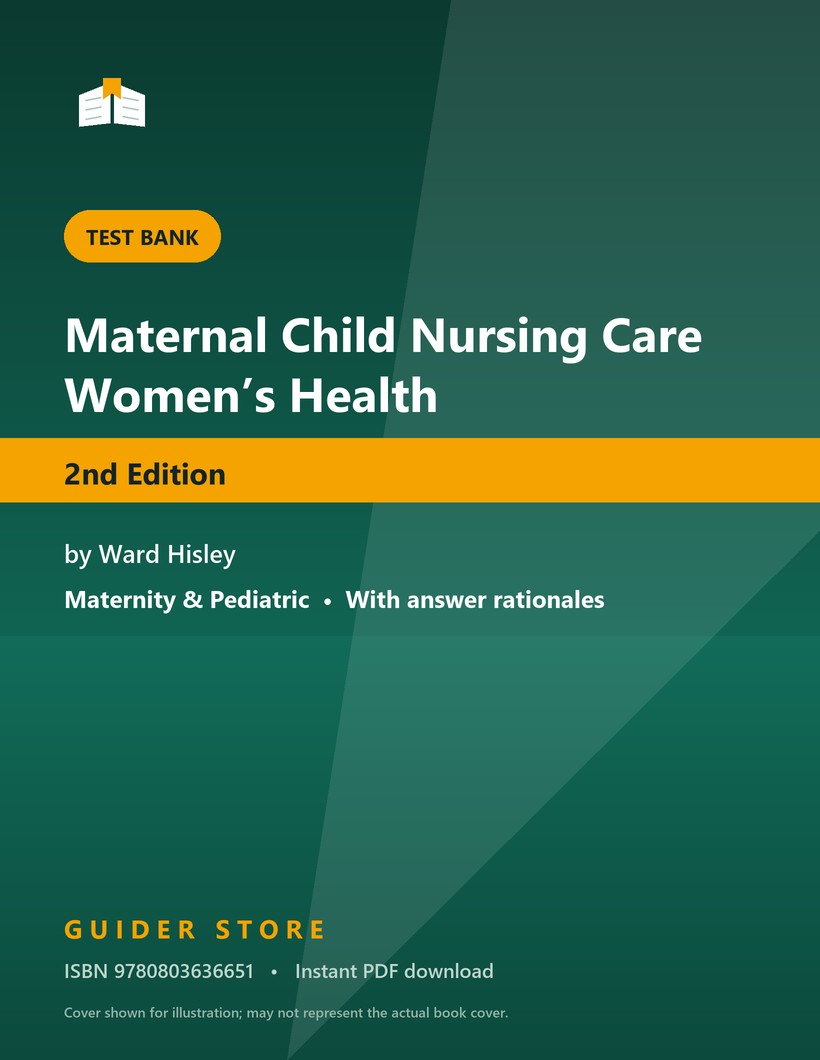
- Matches: Test Bank for Maternal Child Nursing Care Women’s Health 2nd Edition By Ward Hisley
- ISBN-13: 9780803636651
- Format: Digital PDF, delivered instantly after checkout
- Access: Lifetime — re-download anytime from your account
Please confirm the edition and ISBN match your course before buying — message us and we’ll check.
Frequently asked questions
Does every question include a rationale? Yes. Each item explains why the correct choice is right and why the distractors are wrong, so you learn the reasoning, not just the answer.
Is this the same as my school’s exam? No. It is an independent study and self-assessment resource for practice. Always follow your program’s academic-integrity rules.
How do I receive the file? It is a digital PDF delivered instantly after checkout, and you can re-download it anytime from your account.
Will it help me prepare for the NCLEX? It reinforces maternal-child concepts using NCLEX-style formats, which supports your review, though it is not an official NCLEX product and cannot guarantee results.
Explore more Maternity & Pediatric Test Banks — all with instant PDF delivery and answer rationales.



Reviews
There are no reviews yet.