
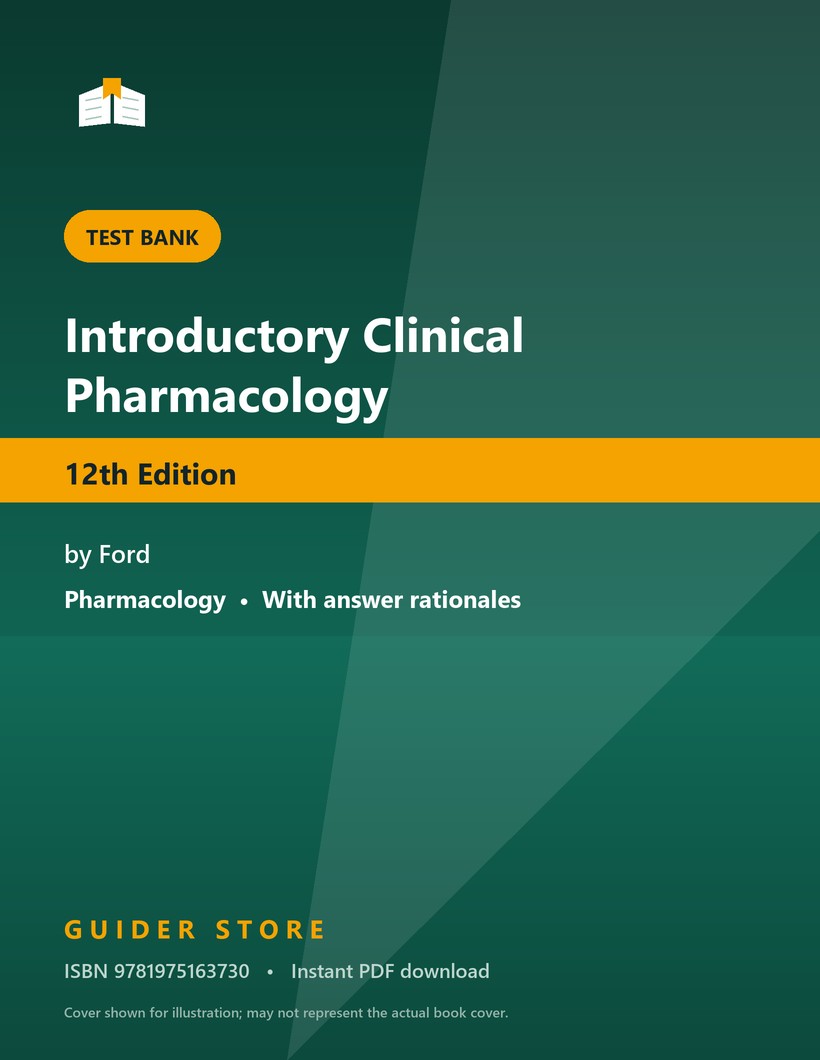

Introductory clinical pharmacology asks you to hold two things at once: the “why” of how a drug works and the “what to do” of giving it safely at the bedside. Ford’s Introductory Clinical Pharmacology, 12th Edition builds that bridge, and this test bank is matched to it — turning dense drug-class chapters into practice questions that force you to recall mechanisms, doses, adverse effects, and nursing responsibilities under exam pressure.
Why this test bank helps
Memorizing drug names rarely survives a real exam. What sticks is understanding why a beta blocker slows the heart, why you hold digoxin at a low apical pulse, or why an ACE inhibitor can trigger a dry cough. Every question here comes with a written rationale that explains the correct answer and the thinking behind the distractors, so you learn the reasoning pattern — not just the letter. That rationale-first approach converts passive reading into recall you can use on test day and on the unit.
What’s inside
- Questions mapped to the book’s drug-class and body-system chapters, so you study alongside the exact material your course assigns
- NCLEX-style and course-exam formats: multiple choice, select-all-that-apply, and dosage-calculation items
- A clear rationale for every question — why the answer is right and why each other option is wrong
- Focus on the nursing process: assessment, safe administration, monitoring, and patient teaching
- Instant PDF download — searchable, printable, and ready the moment you check out
Topics covered
- Pharmacology foundations: pharmacokinetics, pharmacodynamics, drug interactions, and the medication order
- Safe dosage calculation, routes of administration, and the rights of medication administration
- Anti-infectives — antibiotics, antivirals, antifungals, and antitubercular agents
- Drugs affecting the cardiovascular system: antihypertensives, diuretics, cardiac glycosides, and anticoagulants
- Respiratory drugs: bronchodilators, antihistamines, and decongestants
- Central nervous system agents: analgesics, opioids, sedatives, antiseizure, and antipsychotic drugs
- Endocrine agents: insulin, oral antidiabetics, and thyroid and adrenal hormones
- Gastrointestinal, urinary, antineoplastic, immunologic, and fluid-and-electrolyte agents
Who it’s for
This set is built for practical/vocational nursing students (LPN/LVN) and early associate-degree students taking an introductory clinical pharmacology course keyed to Ford’s 12th edition. It also suits students preparing for pharmacology-heavy NCLEX-PN items and returning nurses wanting a structured refresher on core drug classes and safe administration.
How to use it (the right way)
Read the matching chapter first, then answer a block of questions closed-book. Score yourself, but spend most of your time on the rationales — especially for items you got right by guessing. Re-test weak drug classes a few days later so the reasoning sticks. Treat this as a self-assessment and study aid, not a shortcut: it is meant to deepen understanding, not to be used dishonestly during graded or supervised work. Follow your institution’s academic-integrity policy, and verify every drug and dose against current clinical references before applying anything in practice.
Sample question
(Shows the format — your download contains the full set.)
Q. A nurse is preparing to administer oral digoxin to a client with heart failure. Before giving the dose, which assessment finding should prompt the nurse to hold the medication and notify the prescriber?
- A. Apical pulse of 52 beats per minute
- B. Blood pressure of 128/78 mm Hg
- C. Respiratory rate of 18 breaths per minute
- D. Oral temperature of 37.0°C (98.6°F)
Answer: A. Digoxin slows the heart rate, so the nurse assesses the apical pulse for a full minute and holds the dose if it is below 60 beats per minute in an adult, because further slowing risks dangerous bradycardia; a rate of 52 meets that criterion. The blood pressure (B), respiratory rate (C), and temperature (D) are all within normal limits and are not parameters used to withhold digoxin.
Edition & format
- Matches: Test Bank for Introductory Clinical Pharmacology 12th Edition by Ford
- ISBN-13: 9781975163730
- Format: Digital PDF, delivered instantly after checkout
- Access: Lifetime — re-download anytime from your account
Please confirm the edition and ISBN match your course before buying — message us and we’ll check.
Frequently asked questions
Is this the textbook itself? No. This is a test bank — a collection of practice questions with answer rationales designed to help you study. It does not include the Ford textbook.
Will these be the exact questions on my exam? No, and we never claim that. Instructors write their own exams. This set helps you practice the concepts and question styles so you understand the material, not memorize an answer key.
How and when do I get the file? You receive a digital PDF immediately after checkout and can re-download it anytime from your account.
Does it match the 12th edition specifically? It is prepared to align with Ford’s 12th edition chapter structure. If you are unsure your course uses this edition, message us and we will confirm.
Explore more Pharmacology Test Banks — all with instant PDF delivery and answer rationales.



Reviews
There are no reviews yet.