
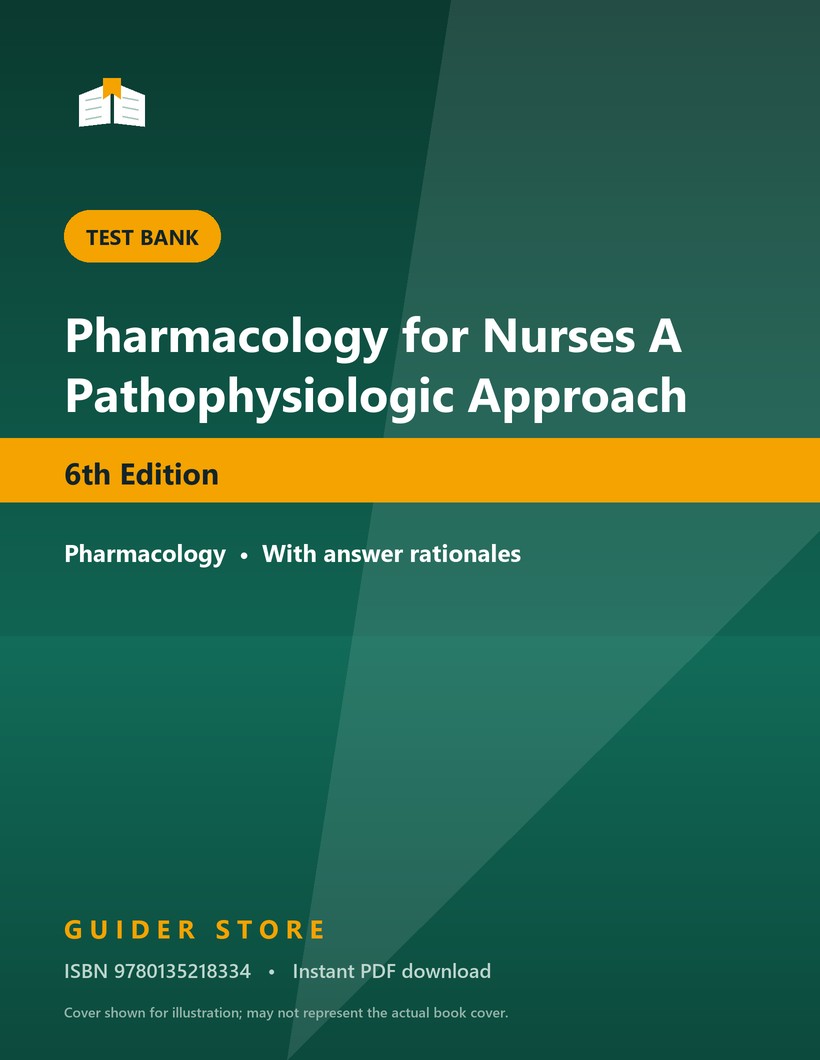


Pharmacology is where nursing theory meets bedside consequence: one miscalculated dose or missed interaction is not an abstract error, it is a patient outcome. Pharmacology for Nurses: A Pathophysiologic Approach asks you to connect the disease process to the drug that treats it — and that “why” is exactly what timed exams punish you for missing. This test bank is built to match the 6th Edition chapter by chapter, so you can drill the pathophysiology-to-pharmacology link until it becomes reflex.
Why this test bank helps
Rote memorising of drug names collapses under NCLEX-style application questions. Every item here leads with a rationale, not just a letter. You learn why a beta blocker is contraindicated in a given patient, why the answer hinges on a lab value, and why the three distractors are tempting but wrong. That reasoning transfers to new questions you have never seen — which is the whole point of a pathophysiologic approach.
What’s inside
- Questions mapped to the chapters and drug classifications of the 6th Edition, so your review tracks your syllabus.
- NCLEX-style formats used in real pharmacology exams: multiple choice, select-all-that-apply (SATA), and dosage-calculation items.
- A written rationale for every question — correct answer explained and distractors dismantled.
- Prioritisation and safety-focused items (assessment, monitoring parameters, patient teaching) rather than trivia.
- Instant PDF download you can revise from on any device, offline, the night before an exam.
Topics covered
- Principles of pharmacology: pharmacokinetics, pharmacodynamics, and the nursing process applied to drug therapy
- Autonomic nervous system drugs — cholinergics, adrenergics, and their blockers
- Cardiovascular and renal pharmacology: antihypertensives, diuretics, antidysrhythmics, and drugs for heart failure
- Drugs affecting coagulation, lipids, and the hematopoietic system
- Anti-infectives: antibiotics, antivirals, antifungals, and antineoplastic agents
- Central nervous system agents — analgesics, anesthetics, anxiolytics, antidepressants, and antipsychotics
- Endocrine pharmacology, including insulin, oral antidiabetics, and thyroid and adrenal drugs
- Respiratory, gastrointestinal, and immune-system medications
- Pain management, fluid and electrolyte therapy, and patient safety in medication administration
Who it’s for
Nursing students taking a pharmacology course that uses the 6th Edition, students preparing for the pharmacology-heavy sections of the NCLEX-RN, and RN-to-BSN or accelerated learners who need dense, rationale-driven review. It is equally useful for instructors and tutors building formative quizzes aligned to this text.
How to use it (the right way)
Attempt each question before reading the rationale, then treat the explanation as a mini-lesson — note the underlying pathophysiology, not just the correct letter. Work chapter by chapter alongside your textbook and lecture notes, and re-test weak drug classes until your reasoning is fast and consistent. Academic-integrity note: this is a self-assessment and study aid to build understanding. Do not present these items as your own graded work, and do not use them during any assessment where that is prohibited. Always follow your institution’s honour code and defer to your instructor and current clinical guidelines for safe practice.
Sample question
(Shows the format — your download contains the full set.)
Q. A nurse is preparing to administer digoxin to a client with heart failure. Which finding should the nurse address before giving the dose?
- A. Blood pressure of 128/78 mm Hg
- B. Serum potassium of 2.9 mEq/L
- C. Apical heart rate of 72 beats per minute
- D. Respiratory rate of 18 breaths per minute
Answer: B. Hypokalemia (potassium of 2.9 mEq/L is below the normal 3.5–5.0 range) increases myocardial sensitivity to digoxin and raises the risk of digoxin toxicity and dysrhythmias, so the low potassium must be corrected and the provider notified before dosing. A is a normal blood pressure. C is a normal apical rate; the nurse withholds digoxin for an apical rate below 60, so 72 is acceptable. D is a normal respiratory rate and does not affect digoxin safety.
Edition & format
- Matches: Test Bank Pharmacology for Nurses A Pathophysiologic Approach, 6th Edition
- ISBN-13: 9780135218334
- Format: Digital PDF, delivered instantly after checkout
- Access: Lifetime — re-download anytime from your account
Please confirm the edition and ISBN match your course before buying — message us and we’ll check.
Frequently asked questions
Does this include answer rationales, or just the correct letters? Every question comes with a full rationale explaining why the answer is correct and why the other options are wrong.
Is this the same as the textbook? No. This is a separate study and self-assessment resource of exam-style questions designed to match the 6th Edition’s structure; it is not the textbook itself.
Will it guarantee a better grade? No honest resource can promise a grade. It is a practice tool — your results depend on how you study and apply it alongside your course materials.
How soon do I get it? Immediately. You download the PDF right after checkout and can re-download it anytime from your account.
Explore more Pharmacology Test Banks — all with instant PDF delivery and answer rationales.


Reviews
There are no reviews yet.