
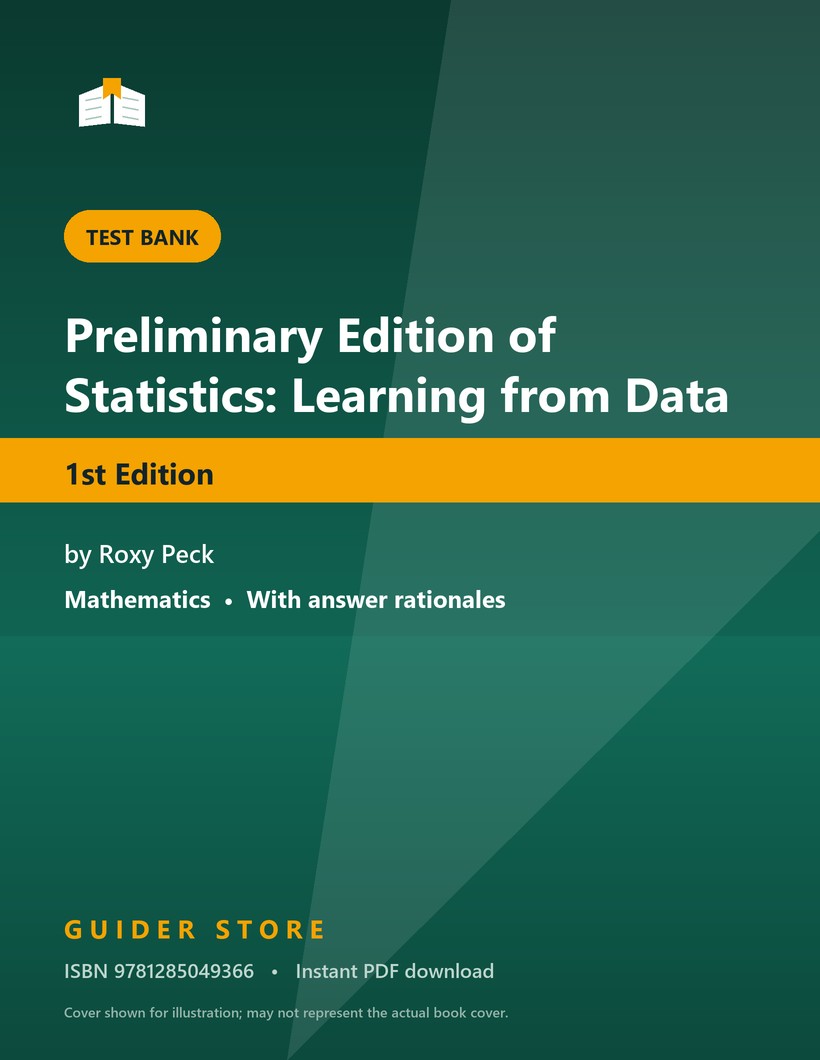


What separates this text from an ordinary formula-first statistics book is the order of the argument. The Preliminary Edition of Statistics: Learning from Data, 1st Edition by Roxy Peck is built around a four-step process — ask a question, collect data, analyze, interpret — and the assessment follows suit. Students who can compute a confidence interval still lose marks explaining what an observational study permits them to conclude, because that is the skill the book is actually teaching.
Why this test bank helps
Selecting the correct option is only half the exercise; the other half is seeing why a fluent-sounding conclusion is not supported by the data in front of you. Every question here carries a rationale that names the study design, states what that design licenses, and explains the overreach behind each distractor — inferring cause from association, generalizing beyond the sampled population, or reading a P-value as the probability that the null hypothesis is true.
What’s inside
- Questions grouped chapter by chapter, following the book’s ask-collect-analyze-interpret structure.
- Multiple-choice, true or false and interpretation items built on described studies and small data sets.
- A rationale for every question that explains the correct reading and each unsupported conclusion.
- Distinctive emphasis on data collection and study design, which this text treats as a topic in its own right.
- Digital PDF, downloadable immediately once checkout is complete.
Topics covered
- Collecting data sensibly — sampling methods, bias, observational studies versus experiments, random assignment and confounding.
- Graphical displays — dotplots, histograms, boxplots and describing shape, center and spread.
- Numerical summaries — mean and median, standard deviation, quartiles and resistance to outliers.
- Probability — basic rules, conditional probability, independence and probability distributions.
- Sampling variability — sampling distributions of a proportion and a mean, and the central limit theorem.
- Estimation — confidence intervals for proportions and means, margin of error and interval interpretation.
- Hypothesis testing — the logic of the test, P-values, significance level and the two kinds of error.
- Comparisons and relationships — two-sample procedures, chi-square tests for categorical data, correlation and least-squares regression.
Who it’s for
Students taking a first course in statistics with this text, commonly in psychology, health sciences, business, education or a general-education quantitative stream, and anyone who needs to be able to read a study critically rather than only compute from a formula sheet.
How to use it (the right way)
For each question, write down the study design and the population before you look at the options, then check whether the conclusion you favor stays inside what that design supports. Work sets closed-book and timed, and read every rationale, since in this course the wording of a conclusion is graded as closely as the calculation. This is a study aid, to be used in keeping with your institution’s academic-integrity policy and not as a substitute for assigned work.
Sample question (shows the format — your download contains the full set)
Q. In a large observational study, adults who reported walking at least 30 minutes a day had lower average blood pressure than those who did not. Which conclusion is justified?
- A. Walking 30 minutes a day lowers blood pressure.
- B. There is an association between reported walking and blood pressure, but confounding variables prevent a cause-and-effect conclusion.
- C. Nothing can be concluded, because the study did not include the whole population.
- D. The relationship would be causal if the sample had been larger.
Answer: B. Because the participants chose their own activity level, the two groups may differ systematically in diet, weight, age or general health, so any of those could explain the gap. Only random assignment in an experiment supports a causal claim, which rules out option A. Option C is too strict: a well-designed sample supports inference about the population it was drawn from. Option D confuses sample size with study design; a larger observational sample estimates the association more precisely but never converts it into causation.
Edition & format
- Matches: Preliminary Edition of Statistics: Learning from Data, 1st Edition, by Roxy Peck (ISBN 9781285049366).
- Format: Digital PDF, delivered instantly after checkout.
- Access: Lifetime access, with re-download available anytime.
Please confirm the edition and ISBN match the book your course has set before ordering, as the preliminary edition and later editions differ in chapter order.
Frequently asked questions
Is this the current edition? This file is prepared for the preliminary first edition. Check the ISBN above against your syllabus before ordering.
How do I receive it? A download link is shown on the confirmation page immediately after checkout and sent to your email address.
Do all questions include rationales? Yes. Each item explains the supported conclusion and why each alternative claims more than the data allow.
Is using a test bank allowed? Practice questions are ordinary revision material. Use this file for self-assessment, within your institution’s academic-integrity policy and your instructor’s rules.
Browse more titles like this in Mathematics Test Banks.




Reviews
There are no reviews yet.