
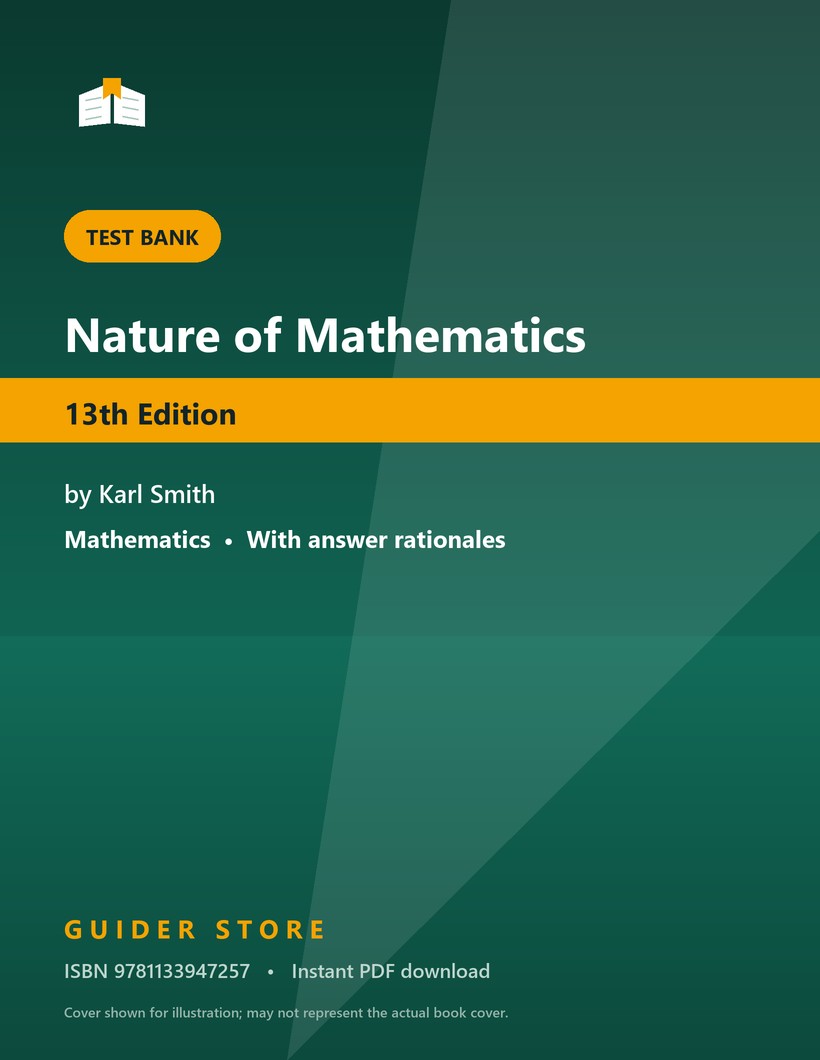


A liberal-arts mathematics course is difficult for a reason students rarely expect: breadth, not depth. Nature of Mathematics, 13th Edition by Karl Smith moves from Polya’s problem-solving steps to truth tables, then to tessellations, Euler circuits, apportionment paradoxes and amortization schedules, each with its own vocabulary and its own conventions. Nothing is deep enough to be impossible, but almost nothing carries over from last week’s chapter to this one.
Why this test bank helps
In a survey course the marks are lost to half-remembered definitions, so recognizing an answer is not enough — you need to know why the near-miss option fails. Each question here is followed by a rationale that restates the definition being tested, applies it to the question, and explains the confusion each distractor is designed to catch: converse for contrapositive, Hamilton circuit for Euler circuit, simple interest for compound.
What’s inside
- Questions organized chapter by chapter across the whole survey, so revision follows the course.
- Multiple-choice, true or false and short computational items, matching the mix used in this course.
- A rationale for every question, naming the definition or rule the item is testing.
- Attention to the vocabulary traps that dominate a breadth course, from logical connectives to voting methods.
- Instant PDF download, available as soon as your checkout completes.
Topics covered
- Problem solving — Polya’s four steps, inductive and deductive reasoning, and estimation.
- Sets and Venn diagrams — operations, complements and survey problems with overlapping categories.
- Symbolic logic — connectives, truth tables, conditionals, converse, inverse, contrapositive and argument validity.
- Numbers and numeration — prime factorization, number systems in other bases and properties of the real numbers.
- Geometry — polygons, similar triangles, the Pythagorean relationship, area and volume, and tessellations.
- Graph theory and networks — Euler and Hamilton circuits, trees and the traveling salesman idea.
- Voting and apportionment — plurality, Borda count, runoff methods, fairness criteria and apportionment paradoxes.
- Financial mathematics and probability — simple and compound interest, annuities, amortization, expected value and descriptive statistics.
Who it’s for
Undergraduates taking a general-education or liberal-arts mathematics course, often non-science majors meeting a quantitative requirement, plus education students preparing to teach across this same range of topics.
How to use it (the right way)
Because the chapters are independent, revise in blocks: finish a chapter, work its questions closed-book the same week, and return to that block a fortnight later, when the vocabulary has had time to fade. Read the rationale even for correct answers, since in this course the reasoning is often the graded part. This is a study aid, to be used in line with your institution’s academic-integrity policy and not as a way around the work you are assigned.
Sample question (shows the format — your download contains the full set)
Q. Which statement is the contrapositive of “If a figure is a square, then it is a rectangle”?
- A. If a figure is a rectangle, then it is a square.
- B. If a figure is not a square, then it is not a rectangle.
- C. If a figure is not a rectangle, then it is not a square.
- D. A figure is a square and it is not a rectangle.
Answer: C. The contrapositive negates both parts of a conditional and reverses their order, and it is logically equivalent to the original statement, which is why it can be used in place of it in a proof. Option A is the converse, obtained by swapping only; it is false here, since a rectangle need not be a square. Option B is the inverse, obtained by negating only; it is equally false. Option D is the negation of the conditional itself, the form used to show a conditional is false, not an equivalent restatement.
Edition & format
- Matches: Nature of Mathematics, 13th Edition, by Karl Smith (ISBN 9781133947257).
- Format: Digital PDF, delivered instantly after checkout.
- Access: Lifetime access, with re-download available anytime.
Please confirm the edition and ISBN match the book your course is using before ordering, as chapter selection in this survey text varies between editions.
Frequently asked questions
Is this the current edition? This file is prepared for the 13th edition. Check the ISBN above against the one on your course outline.
How do I receive it? A download link appears on the confirmation page immediately after checkout, and the same link is emailed to you.
Do all questions include rationales? Yes. Each item is followed by an explanation of the correct answer and of what each incorrect option confuses it with.
Is using a test bank allowed? Practice questions are ordinary revision material. Use this file for self-assessment, in line with your institution’s academic-integrity policy and your instructor’s rules.
Browse more titles like this in Mathematics Test Banks.

Reviews
There are no reviews yet.