
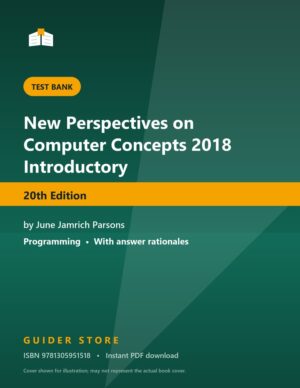
The trap in this subject is that every answer sounds plausible when you read it and none of them do when you have to choose. New Perspectives on Computer Concepts 2018, Introductory, 20th Edition by June Jamrich Parsons covers a very wide surface in a single term — storage, file systems, networking, the web, security — and the exam tests whether you can apply a rule under time pressure, not whether you have met the word before.
Why this test bank helps
An answer on its own teaches almost nothing; the reasoning behind it is what carries to the next question. That matters here because a single mechanism, such as how a file system limits file size or how a router decides where a packet goes, generates a dozen different exam questions. Every item in this set is followed by a written rationale that spells the mechanism out, so working through a block of questions builds a model you can reuse instead of a list of facts you hope to recall.
What’s inside
- Practice items covering every module of the introductory edition, in the order the book teaches them.
- Multiple-choice, true or false and completion formats, matching how instructors build a paper.
- A written rationale for every question, explaining why the outcome follows.
- Applied scenarios that hand you a situation and ask what will happen.
- Instant PDF download, easy to search when you only have one module left to revise.
Topics covered
- Data representation — binary, encoding schemes, and how file size is measured.
- Storage and file systems — drive types, formatting, capacity limits and fragmentation.
- Processors and memory — clock speed, cores, cache and the effect of insufficient RAM.
- Software installation and updates — local applications, web apps and licensing terms.
- Local networks — routers, IP addressing, Wi-Fi standards and shared bandwidth.
- Internet services — domain names, HTTP and HTTPS, cookies and cloud storage.
- Digital media — bitmap and vector graphics, compression trade-offs, streaming.
- Security practices — malware, social engineering, authentication and backup routines.
Who it’s for
Undergraduates and community college students in an introductory computing course using this edition, adult learners returning to study through a technology fundamentals requirement, and students revising for a cumulative final that reaches across every module.
How to use it (the right way)
Start with the module, not the questions. Once you have read it, take a block closed-book and time yourself, because pace is half the difficulty in a multiple-choice paper. Then go through the rationales slowly, particularly for the questions where you narrowed it to two options and picked wrong — that pair is usually testing one specific distinction, and naming that distinction is what stops it catching you again. This is a study aid, to be used in line with your institution’s academic-integrity policy, never as a shortcut around the coursework.
Sample question (shows the format — your download contains the full set)
Q. A student tries to copy a single 6 GB video file onto a 32 GB USB flash drive formatted as FAT32. The drive shows plenty of free space, but the copy fails. Why?
- A. FAT32 cannot store an individual file larger than 4 GB, regardless of free space.
- B. USB flash drives cannot hold video files, only documents and images.
- C. The drive is full, and the reported free space is inaccurate.
- D. Video files must be compressed before any file system will accept them.
Answer: A. FAT32 stores file size in a 32-bit field, which caps a single file at just under 4 GB; the limit applies per file, not to the volume, so a 32 GB drive with free space still refuses a 6 GB file. Reformatting to exFAT or NTFS removes the restriction. B is wrong because a file system does not distinguish between file types. C contradicts the scenario, which states the space is available. D is wrong because no file system requires compression — compressing the video would only work here as a side effect of dropping it under the 4 GB cap.
Edition & format
- Matches: New Perspectives on Computer Concepts 2018, Introductory, 20th Edition, by June Jamrich Parsons.
- Format: Digital PDF, delivered instantly after checkout.
- Access: Lifetime — re-download from your account whenever you need it.
This book is published in introductory and comprehensive versions with different module counts. Please confirm the edition above matches the book your course assigned before you buy.
Frequently asked questions
Is this the current edition? This set is prepared against the 2018 Introductory, 20th Edition specifically. If your syllabus names a different year or version, choose that listing instead, because module coverage moves between editions.
How do I receive it? The download appears on your order confirmation page and in your account the moment checkout completes. Nothing is shipped.
Do all the questions include rationales? Yes. Every item is followed by a written explanation of the mechanism behind the answer, which is the part worth studying.
Is using a test bank allowed? As a study aid it works like any other practice resource. Follow your institution’s academic-integrity policy, and never take the material into a graded assessment.
More titles for this course are in Web & Programming Test Banks.

Reviews
There are no reviews yet.