
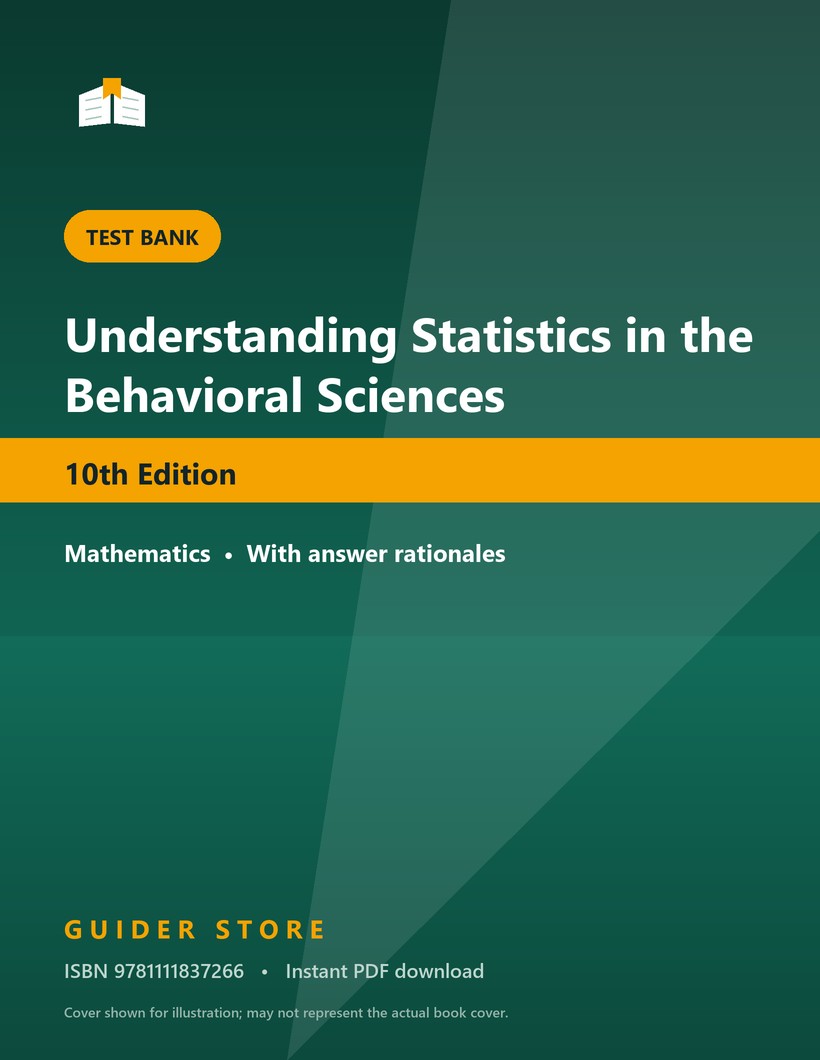

In a behavioral statistics course the arithmetic is the smaller problem. Understanding Statistics in the Behavioral Sciences, 10th Edition spends its energy on inference logic: what a significant result entitles a psychologist to say, why a nonsignificant result is not evidence of no effect, and how the scale a variable was measured on quietly determines which test is legitimate. Exam questions here are usually about that reasoning, and the numbers are only the setting.
Why this test bank helps
Marking an option correct is half the exercise. The other half is being able to say why the other three are wrong, which in this subject means naming the misconception: treating alpha as the probability the null is true, calling a failure to reject proof of no difference, or running a parametric test on ordinal data. Every question here is followed by a rationale that states the underlying principle and traces each distractor to the specific misunderstanding it represents.
What’s inside
- Questions arranged chapter by chapter, matching the order the textbook develops the material.
- Multiple-choice, true or false and computational items, including scenario questions from behavioral research.
- A rationale for every question, covering both the calculation and the inference it supports.
- Sustained emphasis on test selection, the assumptions behind each test, and error types and power.
- Digital PDF, downloadable as soon as your checkout is complete.
Topics covered
- Measurement and description — nominal, ordinal, interval and ratio scales, and the tests each permits.
- Distributions and central tendency — frequency distributions, graphs, mean, median, mode and variability.
- Standard scores and the normal curve — z-scores, percentiles and areas under the curve.
- Correlation and regression — Pearson r, Spearman rho, the regression line and the standard error of estimate.
- Probability and sampling distributions — the binomial model, random sampling and the distribution of a statistic.
- Hypothesis testing logic — null and alternative hypotheses, alpha, one- and two-tailed tests, Type I and Type II errors, and power.
- t tests and analysis of variance — single-sample, correlated-groups and independent-groups t tests, one-way and two-way ANOVA, and post hoc comparisons.
- Nonparametric methods — the sign test, Mann-Whitney U, Kruskal-Wallis and chi-square tests for goodness of fit and independence.
Who it’s for
Undergraduate psychology, sociology, education and other behavioral science students taking a required statistics course, and graduate students revising inferential logic before a research methods or thesis-design unit.
How to use it (the right way)
Before computing anything, write down the design: how many groups, whether the observations are independent or paired, and what scale the dependent variable uses. That note determines the test, and it is what most exam questions are really probing. Attempt sets closed-book, then read every rationale. This is a study aid, to be used in line with your institution’s academic-integrity policy rather than as a way around the assignments you are set.
Sample question (shows the format — your download contains the full set)
Q. A researcher sets alpha at .05, rejects the null hypothesis, and concludes that a training program changed performance. If the program in fact has no effect, the researcher has made:
- A. a Type I error
- B. a Type II error
- C. no error, because alpha was specified in advance
- D. an error that would be avoided by increasing the sample size
Answer: A. Rejecting a null hypothesis that is actually true is a Type I error, and its long-run probability is exactly the alpha the researcher chose, here 5 percent. Option B reverses the definition: a Type II error is failing to reject a null hypothesis that is false. Option C confuses setting a rate with preventing an event, since alpha caps how often this happens across many studies but says nothing about the single study in hand. Option D describes power, which reduces Type II errors; a larger sample does not lower the Type I rate, because that rate is fixed by alpha.
Edition & format
- Matches: Understanding Statistics in the Behavioral Sciences, 10th Edition (ISBN 9781111837266).
- Format: Digital PDF, delivered instantly after checkout.
- Access: Lifetime access, with re-download available anytime.
Please confirm the edition and ISBN match the textbook your course has set before ordering, as chapter numbering and worked examples change between editions.
Frequently asked questions
Is this the current edition? This file is prepared for the 10th edition. Compare the ISBN above with the one printed on your course outline.
How do I receive it? A download link is issued on the confirmation page immediately after checkout, and the same link is emailed to you.
Do all questions include rationales? Yes. Every item explains the correct answer and the misconception behind each incorrect option.
Is using a test bank allowed? Practice testing is ordinary revision. Use this file for self-assessment, in line with your institution’s academic-integrity policy and your instructor’s rules.
Browse more titles like this in Mathematics Test Banks.


Reviews
There are no reviews yet.