
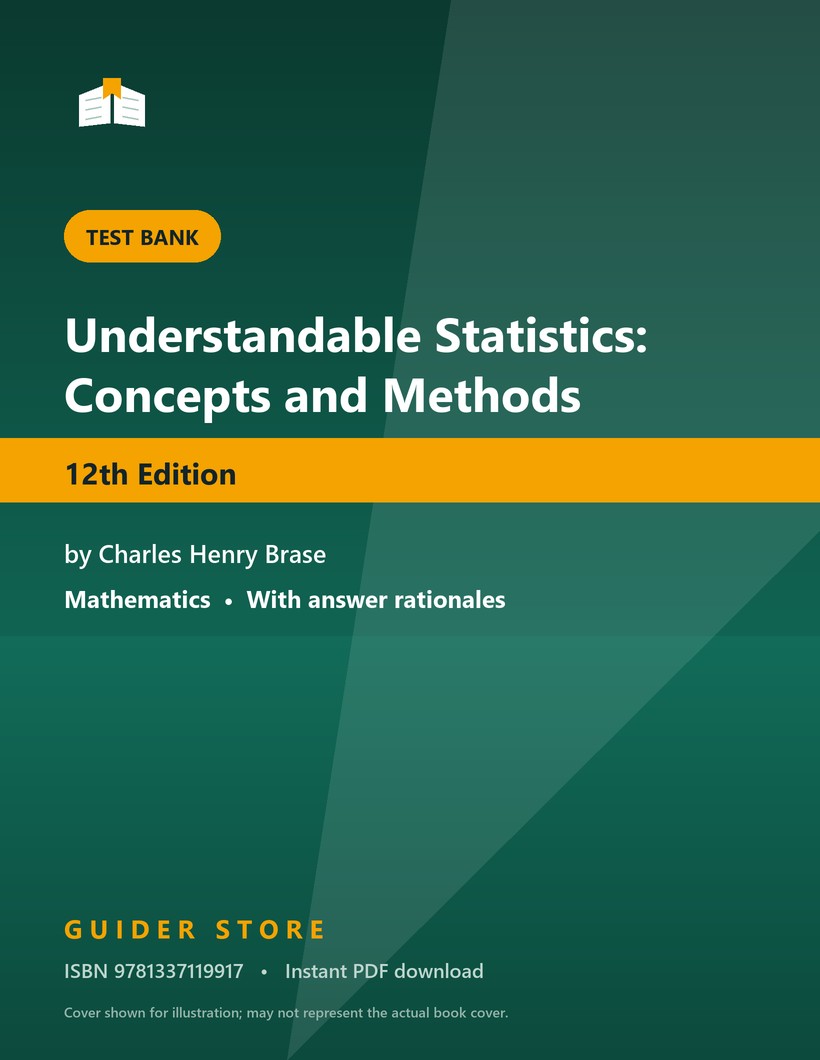


Introductory statistics has an unusual failure mode: each new chapter looks like the previous one with a different table, so students who are keeping up feel fine until an exam mixes the chapters together. Understandable Statistics: Concepts and Methods, 12th Edition by Charles Henry Brase deliberately teaches the conditions attached to each procedure, and the questions that follow test whether you can pick the right one when nothing on the page tells you which chapter it came from.
Why this test bank helps
The answer is half of what a practice question is worth. The other half is the reasoning that rules out the three alternatives, which in statistics usually means checking a condition: is the population standard deviation known, are the samples independent, is the sample large enough for the normal approximation. Every question here comes with a rationale that identifies the procedure, checks its conditions, and explains the specific confusion behind each distractor.
What’s inside
- Questions organized chapter by chapter so they track your course schedule.
- Multiple-choice, true or false and computational items using realistic data sets and table lookups.
- A rationale for every question, including the conditions that had to hold before the procedure applied.
- Emphasis on distinguishing procedures that look alike, such as z versus t and paired versus independent samples.
- Digital PDF, available for download immediately after checkout.
Topics covered
- Getting started — variables and levels of measurement, sampling methods and experimental design.
- Organizing data — frequency tables, histograms, stem-and-leaf displays, bar graphs and time series.
- Averages and variation — mean, median, mode, standard deviation, percentiles, the empirical rule and Chebyshev’s theorem.
- Correlation and regression — scatter diagrams, the least-squares line, the coefficient of determination and prediction.
- Probability and the binomial distribution — probability rules, counting, binomial mean and standard deviation.
- Normal curves and sampling distributions — z-scores, areas under the normal curve, the central limit theorem and normal approximation to the binomial.
- Estimation and hypothesis testing — confidence intervals for means and proportions, sample size, P-values, and the two types of error.
- Further inference — two-population comparisons, paired data, chi-square, F distributions, analysis of variance and nonparametric tests.
Who it’s for
Undergraduates in a first statistics course across the social sciences, business, health sciences, education and general-education streams, plus students revising before a research methods course that assumes this toolkit.
How to use it (the right way)
Work mixed sets rather than one chapter at a time once you are a few weeks in, because choosing the procedure is the skill an exam actually measures. For every question, write the conditions you checked next to your answer, then compare that note with the rationale. This is a study aid, to be used in line with your institution’s academic-integrity policy and not as a substitute for the coursework you are asked to complete.
Sample question (shows the format — your download contains the full set)
Q. Adult heights in a population are approximately normal with a mean of 68 inches and a standard deviation of 3 inches. Approximately what percentage of adults are taller than 71 inches?
- A. 2.28%
- B. 15.87%
- C. 34.13%
- D. 84.13%
Answer: B. Convert to a standard score first: z equals 71 minus 68, divided by 3, which is 1.00. The area to the right of z = 1.00 is about 0.1587, so roughly 15.87 percent of adults exceed 71 inches. Option C is the area between the mean and z = 1.00, an answer that forgets the lower half of the distribution is not part of the question. Option D is the area below z = 1.00, the complement of what was asked. Option A is the area above z = 2.00, which would correspond to a height of 74 inches.
Edition & format
- Matches: Understandable Statistics: Concepts and Methods, 12th Edition, by Charles Henry Brase (ISBN 9781337119917).
- Format: Digital PDF, delivered instantly after checkout.
- Access: Lifetime access, with re-download available anytime.
Please confirm the edition and ISBN match the textbook your course is using before ordering, since data sets and section numbering are revised between editions.
Frequently asked questions
Is this the current edition? This file is prepared for the 12th edition. Check the ISBN above against the book named on your syllabus.
How do I receive it? Instantly. The link is displayed on the confirmation page after checkout and emailed to you.
Do all questions include rationales? Yes. Each item explains the correct procedure, the conditions behind it, and the error each distractor represents.
Is using a test bank allowed? Self-testing is normal preparation. Use this file within your institution’s academic-integrity policy and any rules your instructor sets for graded work.
Browse more titles like this in Mathematics Test Banks.


Reviews
There are no reviews yet.