
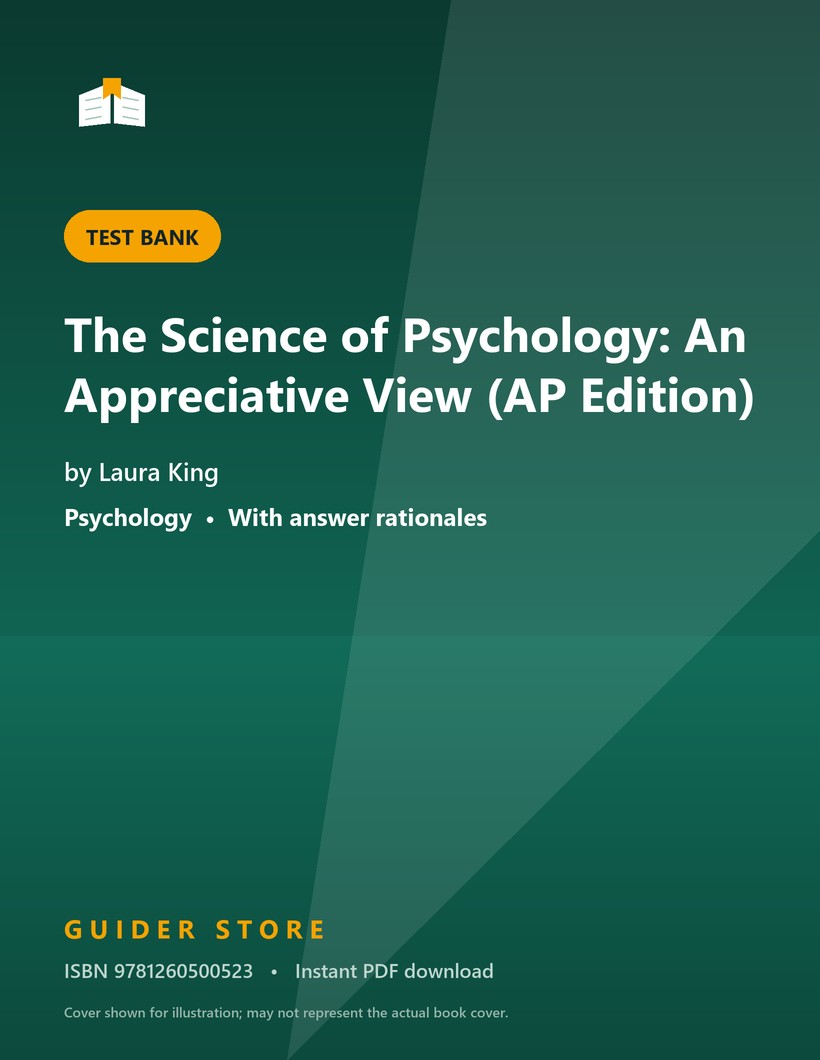


An advanced placement psychology class compresses a full college survey into a single high school year, and the pace is the problem long before the content is. The Science of Psychology: An Appreciative View, AP Edition by Laura King moves from neurons to social influence to clinical disorders in a few months, and each unit brings its own vocabulary that will not be revisited. Students keep up with the reading, feel fine, and then meet a cumulative assessment that asks them to tell reinforcement from punishment, or a correlation from a cause, using material covered in September. Retention, not comprehension, is what breaks down.
Why this test bank helps
Recognizing a term on a page is a much weaker skill than retrieving it cold, and this course is graded on the second one. Working practice items forces retrieval, and the written rationale beneath each question does the teaching part: it explains why the keyed answer follows from the concept and what the other three options are actually describing, which is usually a neighboring term from the same unit that is easy to blur.
What’s inside
- Questions arranged chapter by chapter across the whole survey, so each unit has its own practice block.
- Multiple-choice items in the style the course uses, plus true/false and short free-response prompts.
- A written rationale for every question, distinguishing the keyed term from the ones it is confused with.
- Coverage weighted toward research methods and the biological bases of behavior, the two units students lose most points on.
- A single organized PDF, ready to download the moment checkout completes.
Topics covered
- Science and method — experiments, correlational studies, sampling, operational definitions and the ethics of research with people and animals.
- Biological bases of behavior — neurons and neurotransmission, the divisions of the nervous system, brain structures and the endocrine system.
- Sensation, perception and consciousness — transduction, thresholds, perceptual organization, sleep stages, dreaming and altered states.
- Learning — classical and operant conditioning, schedules of reinforcement, and observational learning.
- Memory and cognition — encoding, storage and retrieval, forgetting, problem solving, language and theories of intelligence.
- Development and motivation — life-span physical, cognitive and moral development, attachment, hunger and achievement motivation, and theories of emotion.
- Personality and social psychology — psychodynamic, trait and humanistic accounts, attribution, conformity, obedience, attitudes and group behavior.
- Disorders, treatment and well-being — classification of psychological disorders, major therapeutic approaches, stress and coping, and the positive psychology strand that gives the book its appreciative view.
Who it’s for
High school students taking advanced placement psychology from this edition, and first-year college students in an introductory psychology course whose instructor has assigned the same King text.
How to use it (the right way)
Read the chapter, then attempt questions closed-book and space the practice out — return to September’s units in November, because that is when the material will actually be needed. Read the rationale for every miss and every lucky guess. This is a study aid, to be used in line with your school’s academic-integrity policy: for preparation and self-testing, never as a substitute for the coursework or as material carried into a graded assessment.
Sample question (shows the format — your download contains the full set)
Q. A student’s car alarm chimes continuously until the seat belt is fastened. Fastening the belt stops the chime, and the student now buckles up immediately. The buckling behavior has been strengthened through:
- A. Positive reinforcement.
- B. Negative reinforcement.
- C. Positive punishment.
- D. Negative punishment.
Answer: B. The behavior increases, so this is reinforcement rather than punishment, and it increases because an unpleasant stimulus was removed, which makes it negative reinforcement. A would require adding something desirable after the behavior; nothing is added here, the chime is taken away. C is wrong because punishment reduces behavior and the buckling is becoming more frequent, not less. D likewise describes a decrease, produced by removing something valued, which is the opposite of what happens in this example.
Edition & format
- Matches: The Science of Psychology: An Appreciative View, AP Edition, by Laura King (ISBN 9781260500523).
- Format: Digital PDF, delivered instantly after checkout.
- Access: Lifetime — re-download from your account whenever you need it.
The AP edition is paginated and organized differently from the standard college printing. Please confirm the edition and ISBN above match the book your class is using before buying.
Frequently asked questions
Is this the current edition? This set is prepared against the AP Edition identified above. If your class uses a different printing of the King text, choose that listing instead.
How do I receive it? The download link appears on the order confirmation page and in your account as soon as checkout completes. Nothing ships.
Do all the questions include rationales? Yes. Every item is followed by an explanation of the reasoning and of what the remaining options describe.
Is using a test bank allowed? As a study aid it works like any other practice resource. Follow your school’s academic-integrity policy, and never take the material into a graded assessment.
More titles for this course are in Psychology Test Banks.



Reviews
There are no reviews yet.