
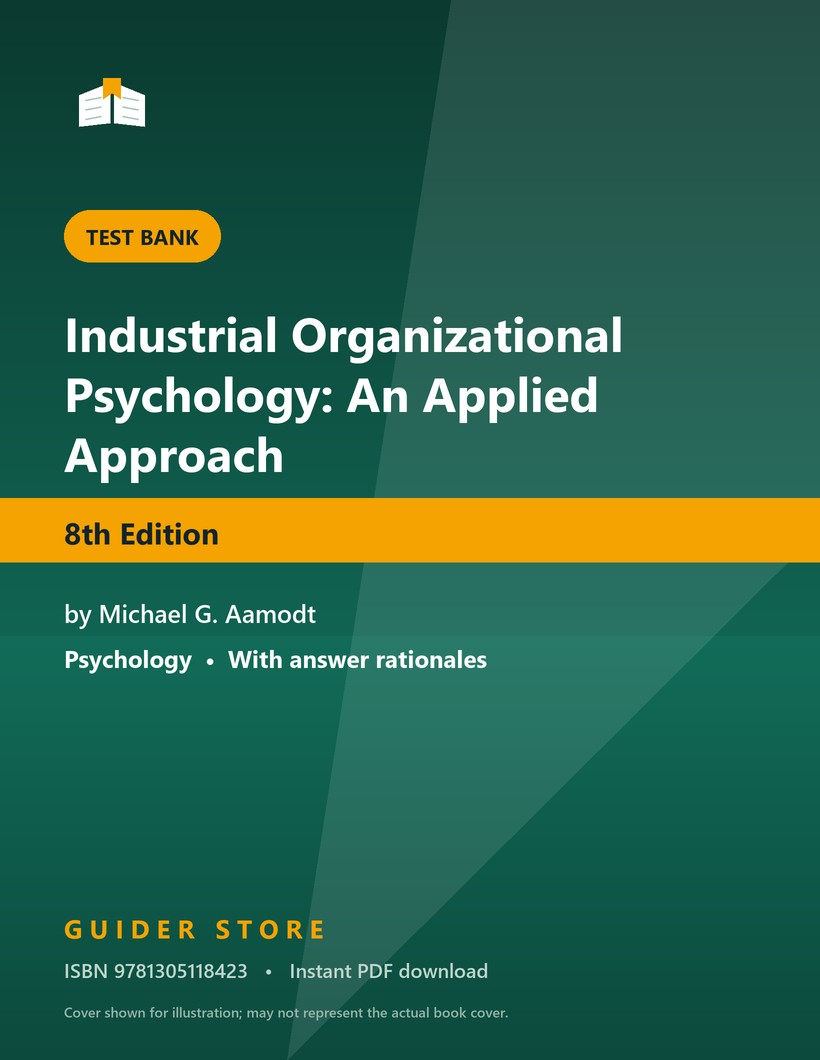


Read a chapter of Industrial Organizational Psychology: An Applied Approach, 8th Edition by Michael G. Aamodt and it feels less like a survey of a research literature than like the manual for an actual human resources job — writing the advertisement, screening the applications, structuring the interview, documenting the appraisal, and staying inside employment law while doing all of it. The assessment follows suit. A large share of the items describe an employer about to make a decision and ask what should be done, or which legal standard governs the situation.
Why this test bank helps
On applied items the correct action is often obvious in hindsight and impossible to reconstruct without knowing the rule behind it, which is why an unexplained answer key is close to useless here. Each question in this set is followed by an explanation that states the principle, statute or procedure at work and shows why the other courses of action fail it. That is what lets you handle a scenario you have not seen before, which is the whole point of an applied course.
What’s inside
- Questions arranged chapter by chapter to match the sequence the course is taught in.
- Applied scenario items alongside conceptual and definitional questions, in realistic proportions.
- A written rationale under every question naming the rule, statute or procedure being tested.
- Careful coverage of the employment law and selection chapters, where precision matters most.
- A single organized PDF, downloadable the moment your order completes.
Topics covered
- Employment law and fair employment — adverse impact, protected classes, affirmative action and reasonable accommodation.
- Job analysis and evaluation — writing job descriptions, choosing analysis methods, compensable factors and pay equity.
- Recruitment and employee selection — recruitment sources, application and resume screening, references and background checks.
- Interviews and selection tests — structured against unstructured interviews, ability, personality and integrity testing, assessment centres.
- Evaluating employee performance — performance criteria, rating scales and errors, appraisal interviews, documentation and termination.
- Training and needs assessment — designing programs, learning principles, on-the-job methods and evaluating training.
- Motivation and job satisfaction — expectancy, equity and goal-setting theory, incentives, job design and satisfaction surveys.
- Leadership, communication and groups — leadership theories, organizational communication, teams, conflict and decision making.
- Stress and workplace safety — stressors and strain, burnout, workplace violence and wellness programs.
Who it’s for
Students taking industrial and organizational psychology from this edition, especially on applied and human resources tracks — psychology majors, business and management students, and those preparing for human resources practice.
How to use it (the right way)
Read the chapter, then attempt a block of questions closed-book so that the applied items test judgment rather than recall of what you just read. Read every rationale and note the rule it names, since the same handful of legal and procedural standards recur across many scenarios. This is a study aid, to be used in line with your institution’s academic-integrity policy — as preparation and self-testing, never as a replacement for the assigned work or as material taken into a graded assessment.
Sample question (shows the format — your download contains the full set)
Q. Of 100 male applicants who take a selection test, 60 pass. Of 50 female applicants, 21 pass. Applying the four-fifths rule, what should the employer conclude?
- A. There is no adverse impact, because more men applied than women
- B. Adverse impact is indicated, because the female selection ratio of .42 is less than four-fifths of the male ratio of .60
- C. Adverse impact cannot be assessed without validity evidence for the test
- D. The test is automatically unlawful and must be withdrawn
Answer: B. The selection ratios are .60 and .42, and .42 divided by .60 is .70, below the .80 threshold the rule sets. A misuses applicant numbers, since the rule compares pass rates within each group rather than group sizes. C reverses the sequence, because validity evidence is what an employer uses to defend a test after adverse impact has been shown. D overstates the consequence, as adverse impact shifts the burden to demonstrating job-relatedness rather than rendering the test illegal by itself.
Edition & format
- Matches: Industrial Organizational Psychology: An Applied Approach, 8th Edition, by Michael G. Aamodt (ISBN 9781305118423).
- Format: Digital PDF, delivered instantly after checkout.
- Access: Lifetime — re-download from your account whenever you need it.
Chapter numbering and legal coverage differ between editions. Please check that the edition and ISBN above match the book on your syllabus before you buy.
Frequently asked questions
Is this the current edition? It is prepared against the 8th Edition. Later editions update the case law and reorganize chapters, so if your course lists a different edition, use that listing instead.
How do I receive it? Immediately, and entirely online. The PDF is attached to your order the second checkout finishes, so you can start using it the same evening.
Do all the questions include rationales? Yes — the rationale is the point of the set. Without it a question tells you only whether you were right, which is the least useful thing it could tell you.
Is using a test bank allowed? It is intended as preparation, in the same category as a study guide. Keep within your institution’s academic-integrity policy and keep it out of any graded assessment.
More titles for this course are in Psychology Test Banks.


Reviews
There are no reviews yet.