
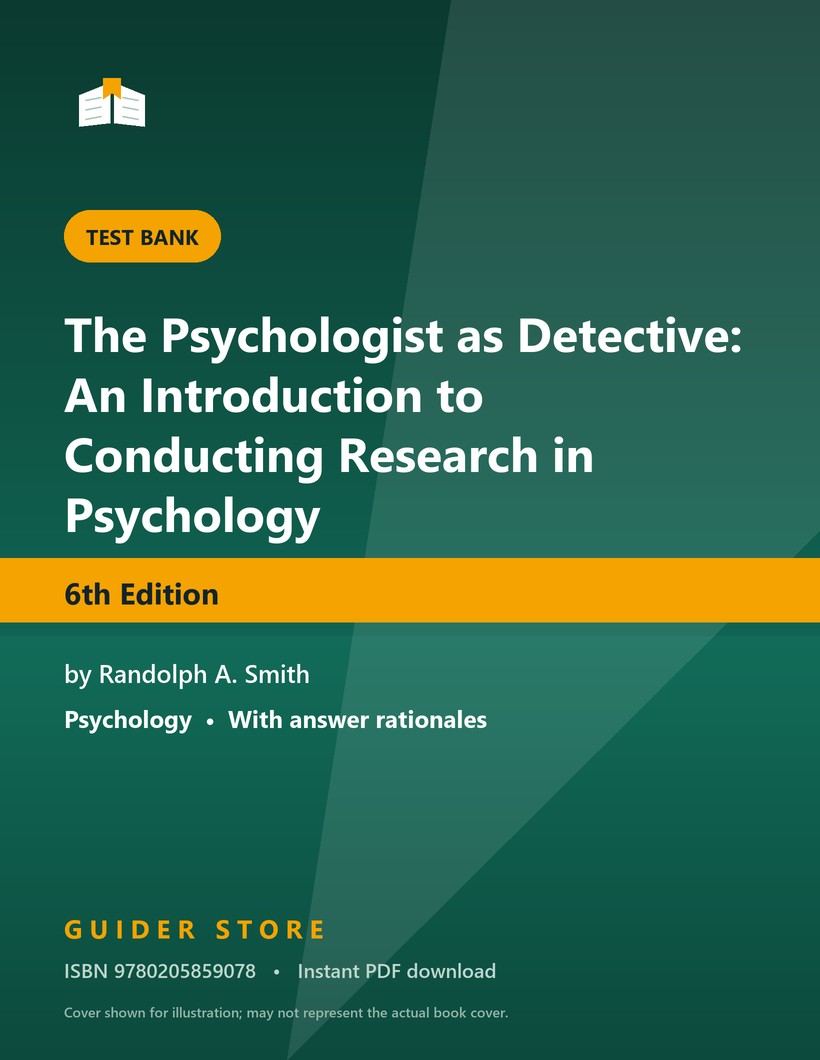



Research methods is the course psychology majors dread, and not because the vocabulary is long. The Psychologist as Detective, 6th Edition treats a study the way an investigator treats a case: a claim is only as good as the evidence gathered for it, and most of the work is ruling out the explanations you would rather ignore. That is a skill, not a set of definitions, and it shows on the exam. Students who can recite what a confound is still stall when a paragraph describes an actual experiment and asks which alternative explanation survives — the terms were learned, the detective work never was.
Why this test bank helps
In methods, the answer matters far less than the reason behind it. Nearly every question in this set describes a study and asks you to do something with it, and the rationale underneath spells out the reasoning: which variable was manipulated, which threat the design controls, why one alternative explanation is ruled out and another is not. Reading those explanations builds the diagnostic reflex the course is actually grading.
What’s inside
- Coverage that follows the book chapter by chapter, from the first research idea through the written report.
- Scenario items alongside definition items, so you practice recognition and application both.
- A written rationale for every question, including why each distractor describes a different design or threat.
- Attention to statistical interpretation, not just computation — what a result licenses you to conclude.
- A single organized PDF, downloadable immediately after checkout.
Topics covered
- Getting a question started — sources of research ideas, searching the literature, and turning a hunch into a testable hypothesis.
- Research ethics — informed consent, deception and debriefing, review board approval, and the treatment of animal subjects.
- Variables and measurement — operational definitions, scales of measurement, and the reliability and validity of a dependent measure.
- Sampling and assignment — populations versus samples, random selection compared with random assignment, and what each buys you.
- Controlling extraneous variables — confounds, counterbalancing, placebo and blind procedures, participant and experimenter effects.
- Experimental designs — two-group and multiple-group designs, within-subjects and between-subjects logic, factorial designs and interactions.
- Alternatives to the experiment — correlational and quasi-experimental work, observation, surveys, and single-case designs.
- Analysis and reporting — t tests and analysis of variance, statistical significance and effect size, and writing results in APA style.
Who it’s for
Undergraduates in experimental psychology or research methods working from this edition, including students preparing an independent project or thesis proposal, and anyone in a social science program who needs to design and critique studies rather than merely read them.
How to use it (the right way)
Work the chapter first, then attempt a block closed-book and treat every scenario item as a small case: name the independent and dependent variables before you look at the options. Mark anything you guessed correctly and read its rationale anyway. This is a study aid, to be used in line with your institution’s academic-integrity policy — for practice and self-testing, not as a way around the coursework or as material brought into a graded assessment.
Sample question (shows the format — your download contains the full set)
Q. Every participant completes a proofreading task under all three lighting conditions, and the researcher varies the order in which the conditions are presented across participants. Which problem is this ordering procedure designed to control?
- A. Regression toward the mean.
- B. Sequence effects such as practice and fatigue.
- C. Selection bias between the groups.
- D. Low statistical power.
Answer: B. In a within-subjects design each person serves in every condition, so performance can improve through practice or decline through fatigue as the session goes on; counterbalancing the order spreads those carryover effects evenly across conditions instead of letting them pile onto whichever condition came last. A is wrong because regression concerns extreme scores drifting toward the average on retesting, which order does not address. C describes a between-subjects problem that within-subjects designs avoid by definition, since the same people appear in every condition. D is a sample-size and effect-size matter; rearranging order does not change either.
Edition & format
- Matches: The Psychologist as Detective: An Introduction to Conducting Research in Psychology, 6th Edition, by Randolph A. Smith (ISBN 9780205859078).
- Format: Digital PDF, delivered instantly after checkout.
- Access: Lifetime — re-download from your account whenever you need it.
Chapter numbering and examples change between editions. Please confirm the edition and ISBN above match the book on your syllabus before buying.
Frequently asked questions
Is this the current edition? This set is prepared against the 6th Edition. If your course lists a different edition, use that listing instead, since the chapter sequence differs.
How do I receive it? Your download link appears on the order confirmation page and in your account the moment checkout finishes. There is nothing to ship and no waiting period.
Do all the questions include rationales? Yes. Each item carries a written explanation covering the correct choice and what the remaining options describe instead.
Is using a test bank allowed? Used as a study aid, it is an ordinary practice resource. Follow your institution’s academic-integrity policy and never carry the material into a graded assessment.
More titles for this course are in Psychology Test Banks.



Reviews
There are no reviews yet.