
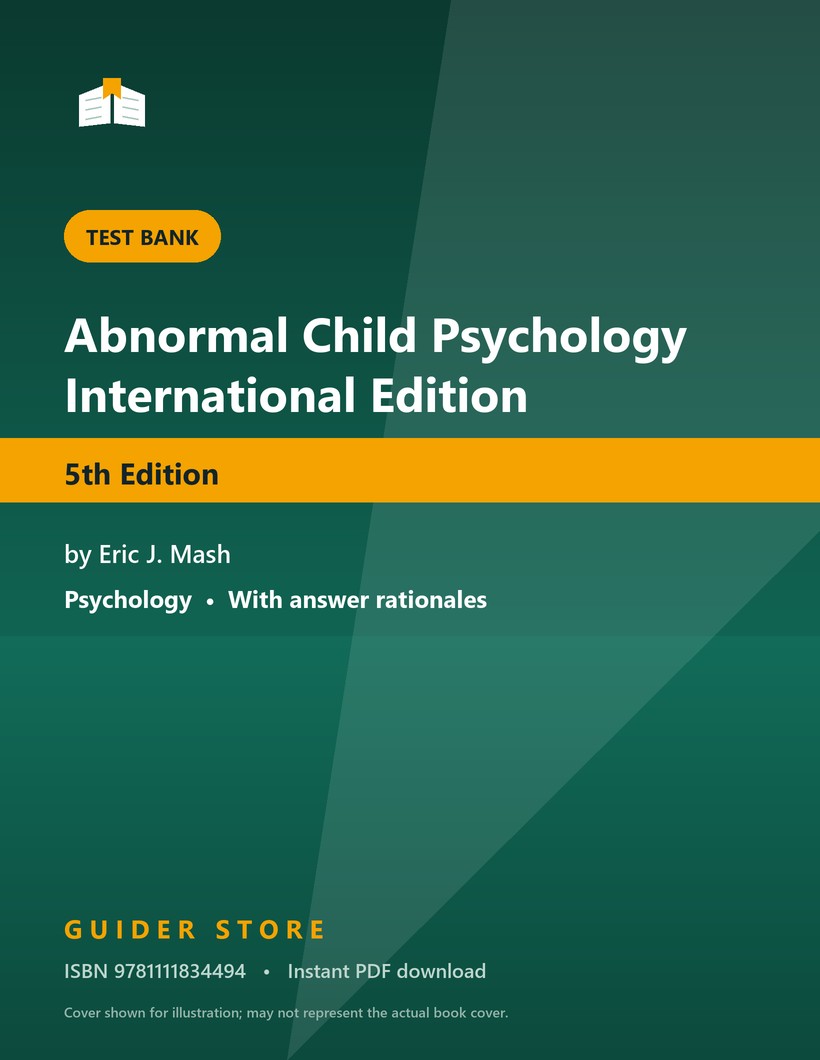

Adversity in childhood is a probability statement, not a verdict, and a great deal of this course is spent learning to say that precisely. Abnormal Child Psychology, International Edition, 5th Edition by Eric J. Mash frames each disorder inside a balance of risk and protective influences operating in the child, the family and the wider environment, so exam items frequently describe a history and ask which influence is doing the work. Getting those right means being able to separate a risk factor from a cause, a protective factor from the mere absence of risk, and a correlate from a mechanism.
Why this test bank helps
The correct option is easy to forget; the distinction that produced it is not, once you have seen it stated. Each item in this set is followed by a written rationale that names the influence in play and explains its role — whether it raises probability, buffers an existing risk, or simply co-occurs. Practising against those explanations is what stops the vocabulary of risk and resilience from collapsing into a single vague idea by exam week.
What’s inside
- Questions following the book chapter by chapter, so each disorder and framework chapter becomes its own block.
- Mixed formats — multiple choice, true/false, matching and short developmental case scenarios.
- A written rationale under every question, distinguishing risk, protection, correlation and cause.
- Emphasis on family, attachment and maltreatment content, which this edition treats at length.
- One organized PDF, available to download as soon as checkout completes.
Topics covered
- Risk and resilience — cumulative risk, protective influences, buffering effects and why outcomes vary so widely.
- Attachment and early relationships — classifications, caregiving quality and links to later adjustment.
- Family systems and parenting — discipline practices, parental psychopathology, conflict and coercive cycles.
- Child maltreatment and trauma — types of maltreatment, developmental consequences and recovery influences.
- Anxiety and mood problems in youth — presentation by age, persistence and the role of family accommodation.
- Autism spectrum and intellectual disability — early signs, adaptive behavior and levels of support required.
- Disruptive behavior problems — developmental pathways into aggression and the contexts that maintain them.
- Prevention and early intervention — targeting modifiable risks and strengthening protective influences.
Who it’s for
Students taking abnormal child psychology from this international edition, and those in education, social work and child-and-youth studies programs where the risk-and-resilience framework underpins later placement work.
How to use it (the right way)
Read the chapter, then attempt questions closed-book and, for each scenario, classify every influence mentioned before you choose an option. The classification usually decides the item. This is a study aid. Use it in line with your institution’s academic-integrity policy — as preparation and self-testing, never as a substitute for the coursework and never as material taken into a graded assessment.
Sample question (shows the format — your download contains the full set)
Q. In a longitudinal study of children raised in high-adversity households, those who had a stable, supportive relationship with at least one adult showed markedly fewer behavioral problems in adolescence. That relationship is best described as:
- A. A proximal risk factor
- B. A protective factor
- C. A diagnostic criterion
- D. A cumulative risk index
Answer: B. A protective factor is an influence that reduces the likelihood of a poor outcome for children already exposed to risk, which is exactly the buffering effect described here. A reverses the direction, since a risk factor raises rather than lowers the probability of difficulty. C confuses a study variable with a criterion used to assign a disorder, and supportive relationships are not diagnostic criteria for anything. D refers to a count of accumulated adversities used to predict outcome, not to a single buffering relationship.
Edition & format
- Matches: Abnormal Child Psychology, International Edition, 5th Edition, by Eric J. Mash (ISBN 9781111834494).
- Format: Digital PDF, delivered instantly after checkout.
- Access: Lifetime — re-download from your account whenever you need it.
International and domestic editions can differ in pagination and chapter content. Please confirm the edition and ISBN above match your course before buying.
Frequently asked questions
Which edition does this match? The 5th Edition international printing, ISBN 9781111834494. Other editions renumber chapters and revise diagnostic content.
How do I receive it? The download is available immediately after checkout, on the confirmation page and in your account.
Do all the questions include rationales? Yes, each one, with an explanation of the concept and of why the alternatives do not apply.
Is using a test bank allowed? Used for self-testing it is a standard study resource. Follow your institution’s academic-integrity policy, and never bring it into a graded assessment.
More study material for this subject is in Psychology Test Banks.



Reviews
There are no reviews yet.