
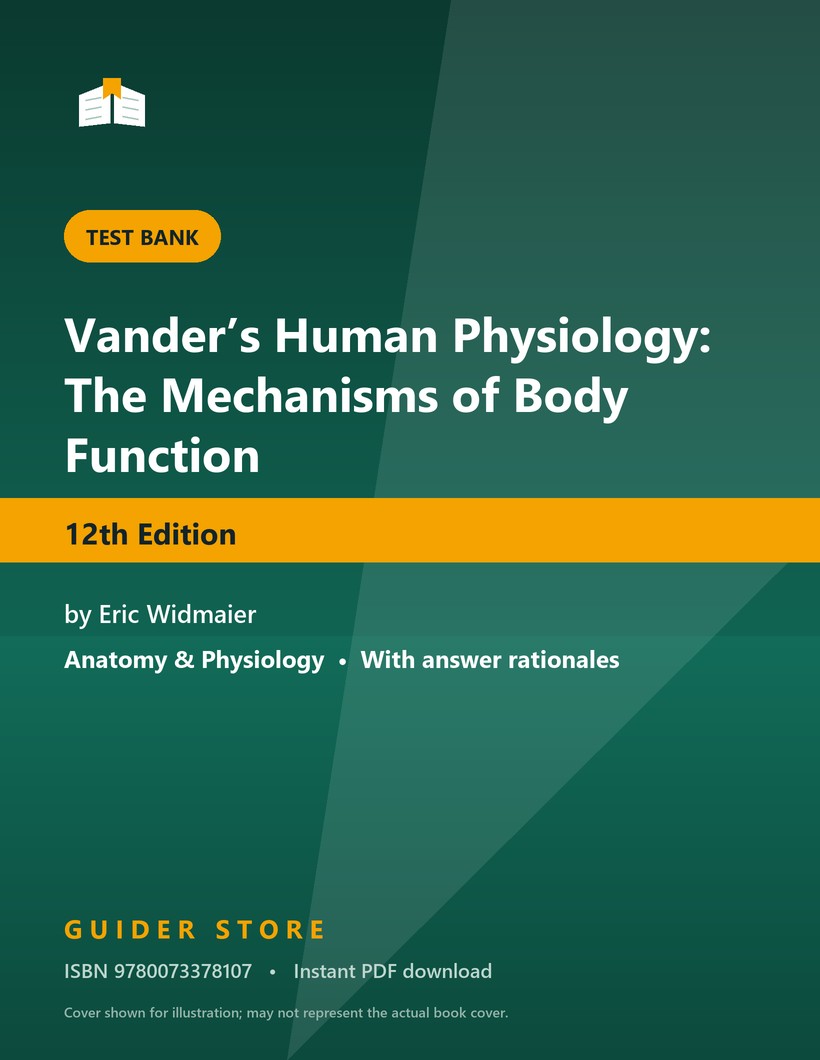


Human physiology is where memorized facts have to turn into a working mental model of the body. Vander’s Human Physiology: The Mechanisms of Body Function is famous for teaching through mechanism — how the signal, the feedback loop and the pressure gradient actually produce a response — and that is exactly what most course exams test. This test bank, matched to the 12th Edition by Eric Widmaier, gives you exam-style questions that push you to reason through those mechanisms rather than recite isolated terms.
Why this test bank helps
Physiology rewards understanding cause and effect: if aldosterone rises, what happens to sodium, water and blood pressure — and why? Every question here comes with a written rationale that explains the underlying mechanism, not just the correct letter. That rationale-first design turns each item into a mini-lesson, helping you catch the reasoning gaps that trip students up on integrated, application-heavy exams.
What’s inside
- Questions organized to follow the book’s system-by-system structure, so you can drill one chapter or organ system at a time.
- Exam-style formats used in physiology courses — single-best-answer multiple choice, cause-and-effect reasoning, and interpret-the-scenario questions.
- A clear rationale for every question explaining why the correct choice fits the mechanism and why the distractors do not.
- Coverage that mixes recall with application, mirroring how physiology is assessed.
- Instant PDF download — searchable and printable, ready the moment you check out.
Topics covered
- Cell physiology, membrane transport, and the resting and action potential
- Neural signaling, synapses, and the nervous system, including sensory and motor control
- Muscle physiology — skeletal, smooth, and cardiac contraction
- Cardiovascular physiology: cardiac output, blood flow, and blood pressure regulation
- Respiratory physiology: ventilation, gas exchange, and gas transport
- Renal physiology, fluid and electrolyte balance, and acid–base regulation
- The endocrine system and hormonal control of body function
- Digestion, absorption, and the regulation of metabolism and energy balance
- Reproductive physiology and the body’s defense and immune mechanisms
Who it’s for
This is built for undergraduate and pre-professional students taking a human physiology course that uses Vander’s text — including biology, kinesiology, exercise science, pre-nursing, pre-med, and allied-health students. It is also a strong self-check for anyone reviewing core physiology before advanced coursework, provided the content matches your syllabus.
How to use it (the right way)
Use it as active recall, not a shortcut. Read a chapter or attend the lecture first, then attempt a block of questions closed-book, and only afterward read the rationales — especially for the items you missed. Track the mechanisms you keep getting wrong and revisit those sections in your textbook. This is a study and self-assessment aid: it is meant to strengthen understanding, never to be used during a live exam or in any way that violates your institution’s academic-integrity policy. It cannot guarantee any particular grade, but disciplined, honest practice is one of the most reliable ways to improve.
Sample question
(Shows the format — your download contains the full set.)
Q. During strenuous exercise, arterioles in active skeletal muscle dilate. Which local change is the primary driver of this vasodilation?
- A. A rise in local tissue oxygen concentration
- B. A local increase in metabolic byproducts such as CO₂, H⁺, and adenosine
- C. Increased circulating levels of antidiuretic hormone
- D. Sympathetic stimulation of alpha-adrenergic receptors on the arterioles
Answer: B. Active muscle produces metabolites — carbon dioxide, hydrogen ions, adenosine, and potassium — that act on arteriolar smooth muscle to cause local (active hyperemia) vasodilation, matching blood flow to demand. A is wrong because working muscle consumes oxygen, so local O₂ falls rather than rises. C is wrong because ADH mainly affects water reabsorption and, at high levels, causes vasoconstriction. D is wrong because alpha-adrenergic stimulation causes vasoconstriction; local metabolic signals override sympathetic tone in exercising muscle.
Edition & format
- Matches: Test Bank for Vander’s Human Physiology: The Mechanisms of Body Function, 12th Edition by Eric Widmaier
- ISBN-13: 9780073378107
- Format: Digital PDF, delivered instantly after checkout
- Access: Lifetime — re-download anytime from your account
Please confirm the edition and ISBN match your course before buying — message us and we’ll check.
Frequently asked questions
Does this include answers and explanations? Yes. Every question has the correct answer plus a written rationale explaining the mechanism behind it and why the other options are incorrect.
Is this the textbook or a solutions manual? Neither. It is a test bank — practice exam-style questions with rationales — intended for self-study alongside your own copy of the textbook.
How will I receive it? It is a digital PDF delivered instantly after checkout, and you can re-download it anytime from your account.
Will this guarantee a better grade? No honest resource can promise a grade. It is a self-assessment tool; how much it helps depends on how consistently and honestly you use it.
Explore more Anatomy & Physiology Test Banks — all with instant PDF delivery and answer rationales.


Reviews
There are no reviews yet.