
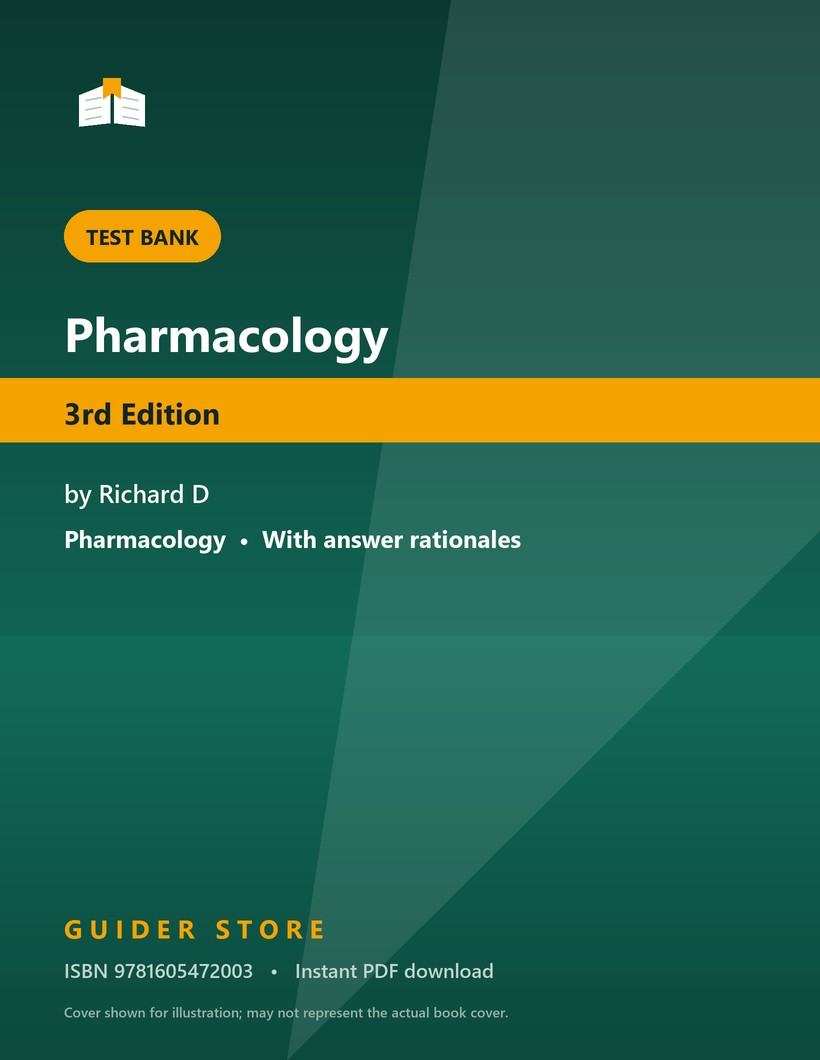

Pharmacology is one of the most demanding courses in any nursing or health-sciences program because it asks you to hold three things at once: how a drug works, what it does to a real patient, and what can go wrong. Memorizing drug names alone rarely survives an exam — you need to reason from mechanism to nursing action under time pressure. This test bank, matched to Pharmacology, 3rd Edition, gives you exam-style questions with a written rationale for every answer, so you practice the applied thinking your exams reward.
Why this test bank helps
The difference between passing and struggling in pharmacology is usually not effort — it is rationale-first learning. Every item explains why the correct option is correct and why each distractor is wrong, which is how you build the drug-class patterns (mechanism, therapeutic use, adverse effects, contraindications, monitoring) that let you answer questions you have never seen before. Instead of re-reading chapters passively, you retrieve, self-check, and close gaps fast.
What’s inside
- Questions organized to follow the textbook’s chapter and drug-class sequence, so you can study alongside your lectures
- NCLEX-style and exam-style formats relevant to pharmacology: multiple choice, priority/“which action first” items, and dosage-calculation reasoning
- A clear written rationale for every single question — correct answer explained plus why the other options fail
- Coverage spanning pharmacokinetics and pharmacodynamics through the major body-system drug classes
- Delivered as an instant PDF you download right after checkout — no waiting, no shipping
Topics covered
- Pharmacokinetics and pharmacodynamics: absorption, distribution, metabolism, excretion, and dose-response principles
- Autonomic nervous system drugs: cholinergic, anticholinergic, adrenergic, and adrenergic-blocking agents
- Cardiovascular and renal drugs: antihypertensives, antidysrhythmics, cardiac glycosides, diuretics, and anticoagulants
- Central nervous system agents: analgesics, sedative-hypnotics, antipsychotics, antidepressants, and antiepileptics
- Anti-infective therapy: antibiotics, antivirals, antifungals, and principles of antimicrobial resistance
- Endocrine drugs: insulin and oral antidiabetics, thyroid agents, and corticosteroids
- Respiratory and gastrointestinal medications
- Pain management, safe medication administration, and adverse-reaction recognition
Who it’s for
This resource is built for nursing and allied-health students working through a pharmacology course that uses Pharmacology, 3rd Edition, plus anyone reviewing drug therapy for midterms and finals or preparing pharmacology-heavy sections of licensure exams such as the NCLEX-RN or NCLEX-PN. It also suits repeat-exam preparation and tutors who want structured, rationale-backed practice items.
How to use it (the right way)
Use it as a self-assessment tool after you study, not as a substitute for reading and lectures. Work a chapter’s questions closed-book, mark every item you miss, then read the rationale and return to your textbook for that drug class before retrying. Space your reviews across several days rather than cramming — retrieval practice sticks far better. Please use this material honestly: it is a study and revision aid, not a way to obtain or share live exam content. Always follow your institution’s academic-integrity policy. This resource does not guarantee any grade or exam outcome.
Sample question
(Shows the format — your download contains the full set.)
Q. A client taking an ACE inhibitor for hypertension develops a persistent, dry, non-productive cough. Which explanation best accounts for this adverse effect?
- A. The drug directly irritates the bronchial lining
- B. The drug reduces breakdown of bradykinin, which accumulates in the airways
- C. The drug causes fluid retention and pulmonary congestion
- D. The drug triggers an IgE-mediated allergic reaction
Answer: B. ACE inhibitors block the enzyme that normally degrades bradykinin, so bradykinin builds up and provokes a characteristic dry cough. A is wrong because the cough is chemically mediated, not from direct irritation. C is wrong because these drugs reduce fluid overload rather than cause it. D is wrong because the cough is a predictable pharmacologic effect, not a true allergy.
Edition & format
- Matches: Test Bank for Pharmacology 3rd Edition by Richard D
- ISBN-13: 9781605472003
- Format: Digital PDF, delivered instantly after checkout
- Access: Lifetime — re-download anytime from your account
Please confirm the edition and ISBN match your course before buying — message us and we’ll check.
Frequently asked questions
Is this the textbook itself? No. This is a test bank of practice questions with answer rationales designed to help you review the material — it is not the textbook and does not replace it.
Will these be the exact questions on my exam? No. This is a study aid for practice and self-assessment. It is not live exam content, and we make no claim that any item will appear on your test.
How do I receive it? Immediately after checkout you download the PDF from your account, and you can re-download it anytime.
What if the edition doesn’t match my course? Message us with your ISBN before purchasing and we’ll confirm the correct match for you.
Explore more Pharmacology Test Banks — all with instant PDF delivery and answer rationales.



Reviews
There are no reviews yet.