
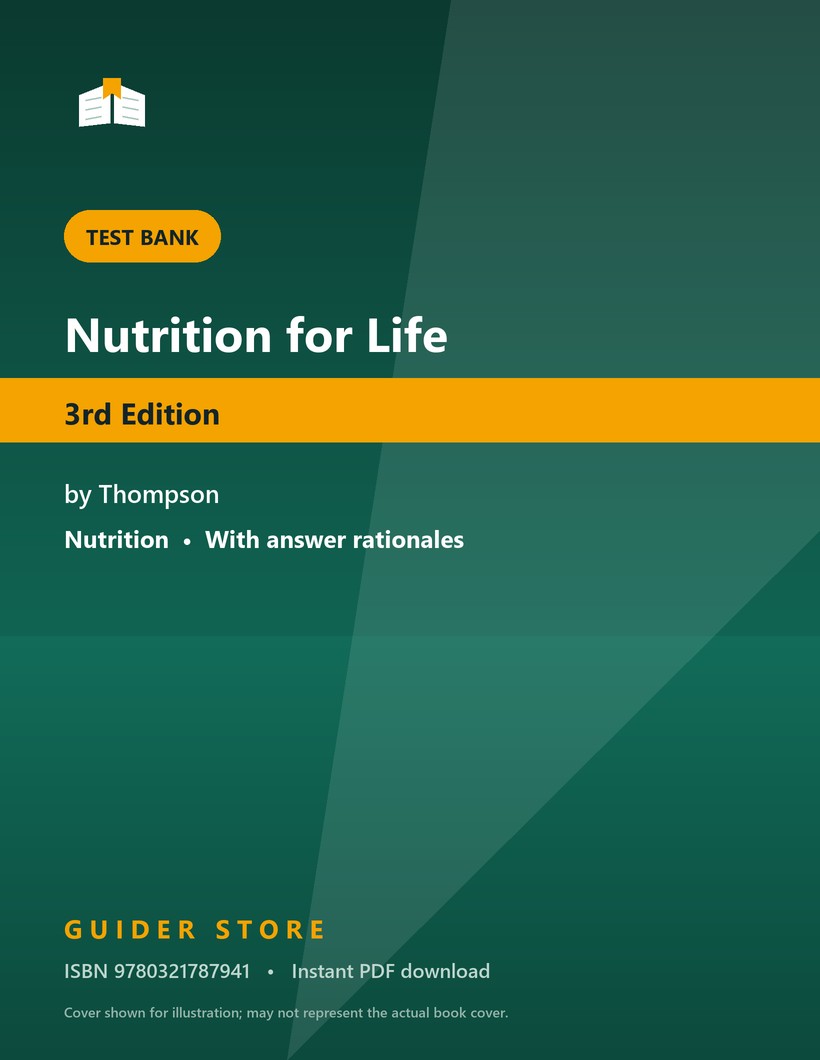

Introductory nutrition sits at the crossroads of biochemistry, physiology, and everyday food choices — and that breadth is exactly what makes exams tricky. One question asks you to trace a carbohydrate through digestion; the next wants the function of a fat-soluble vitamin; the one after that expects you to read a Nutrition Facts panel or judge an energy-balance scenario. This test bank is matched to Nutrition for Life, 3rd Edition by Thompson, so your practice questions line up with the same concepts and consumer-focused approach your course follows.
Why this test bank helps
Recognizing the right answer is not the same as understanding why it is right. Every question here includes a written rationale, so you learn the reasoning — why fiber slows glucose absorption, why a nutrient is essential, why a claim on a food label is misleading. That rationale-first habit is what turns memorized facts into knowledge you can apply on an exam and in real life.
What’s inside
- Practice questions organized to follow the book’s chapter flow, from nutrition basics through the macronutrients, micronutrients, and life-stage topics
- Exam-style formats you will actually meet: multiple choice, true/false, and applied “what would you recommend” scenarios
- A clear rationale for every question — correct and incorrect options explained
- Consumer-focused items on food labels, dietary guidelines, and evaluating nutrition claims
- Delivered as an instant, searchable PDF you can study on any device
Topics covered
- Nutrition fundamentals, essential nutrients, and dietary standards (DRIs)
- Dietary guidelines, MyPlate, and reading Nutrition Facts labels
- Carbohydrates: simple and complex sugars, fiber, and blood-glucose regulation
- Lipids: types of fat, cholesterol, and heart-health considerations
- Proteins and amino acids: functions, quality, and requirements
- Vitamins and minerals: water- and fat-soluble vitamins, major minerals, and antioxidants
- Energy balance, weight management, and physical activity
- Digestion, absorption, and metabolism of nutrients
- Nutrition across the life span and food safety basics
Who it’s for
This set is built for undergraduate students taking an introductory or consumer-nutrition course that uses Thompson’s Nutrition for Life, 3rd Edition — including students in health, nursing, kinesiology, education, and general-education science tracks. It is ideal for reviewing before midterms and finals, and for anyone who wants to self-check their grasp of core nutrition concepts.
How to use it (the right way)
Use it as a self-assessment tool, not a shortcut. Read a chapter first, then work a block of questions closed-book, and only afterward check your answers and read the rationales — especially for anything you missed. Revisit weak topics a few days later to lock them in. This is a study aid to support your own learning; it is not a substitute for your assigned reading, and you should never use it in any way that violates your school’s academic-integrity or exam policies. It cannot and does not guarantee any particular grade.
Sample question
(Shows the format — your download contains the full set.)
Q. A student compares two cereals with the same total carbohydrate per serving. One lists 8 grams of dietary fiber and the other lists 1 gram. Which statement best explains why the higher-fiber cereal may help with blood-glucose control?
- A. Fiber is a fat-soluble nutrient that stores extra glucose in the liver
- B. Fiber is fully digested into glucose, providing steady long-term energy
- C. Soluble fiber slows the digestion and absorption of carbohydrate, blunting the rise in blood glucose
- D. Fiber converts directly into protein, which prevents glucose from entering the blood
Answer: C. Soluble fiber forms a viscous gel in the digestive tract that slows gastric emptying and the absorption of glucose, so blood sugar rises more gradually. A is wrong because fiber is a carbohydrate, not a fat-soluble nutrient, and does not store glucose. B is wrong because dietary fiber is largely not digested by human enzymes, which is why it does not spike blood glucose. D is wrong because fiber is not converted into protein.
Edition & format
- Matches: Test Bank For Nutrition for Life 3rd Edition by Thompson
- ISBN-13: 9780321787941
- Format: Digital PDF, delivered instantly after checkout
- Access: Lifetime — re-download anytime from your account
Please confirm the edition and ISBN match your course before buying — message us and we’ll check.
Frequently asked questions
Is this the textbook itself? No. This is a test bank of practice questions with answer rationales designed to accompany the book — it is not the textbook and does not include the textbook chapters.
Will it match my exact edition? It is matched to the 3rd Edition by Thompson (ISBN-13: 9780321787941). Editions can differ, so confirm your course’s edition before purchasing and message us if you want us to verify.
How and when do I receive it? It is a digital PDF delivered instantly after checkout, and you can re-download it anytime from your account.
Does buying this guarantee a better grade? No. It is a self-study aid. Used honestly alongside your reading and coursework it can strengthen your understanding, but no resource can promise a specific grade.
Explore more Nutrition Test Banks test banks — all with instant PDF delivery and answer rationales.


Reviews
There are no reviews yet.