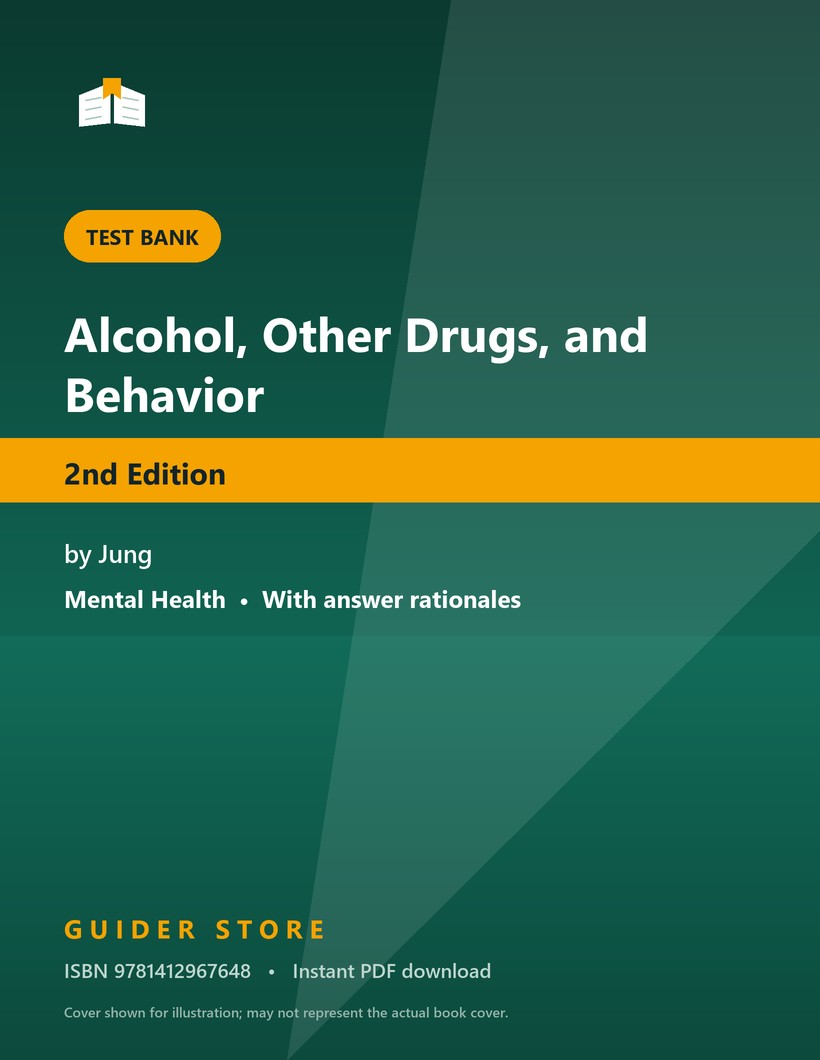


Psychoactive substances sit at the crossroads of pharmacology, brain science, individual psychology, and public policy — and that breadth is what makes Alcohol, Other Drugs, and Behavior such a demanding course. You are asked to hold neurotransmitter systems, addiction theory, and drug classifications in your head at once, then apply them to real behavioral outcomes. This test bank, matched to the 2nd edition by Jung, gives you exam-style practice that mirrors how substance-use and behavior courses actually test that integrated understanding.
Why this test bank helps
Passive re-reading rarely survives an exam on drug action and behavior; retrieval practice does. Every question here is built around a clear rationale, so you are not just checking a box — you learn why a stimulant produces its behavioral profile, why tolerance and dependence differ, and why a given theory of addiction fits some patterns better than others. Reasoning through distractors trains you to notice the fine distinctions that separate a correct answer from a plausible trap.
What’s inside
- Questions organized to follow the flow of the textbook, so you can practice chapter by chapter or review the whole course
- Multiple-choice items in the format used across psychology, addiction studies, and behavioral science exams
- A written rationale for every question explaining the correct choice and the logic behind it
- Application-style items that ask you to interpret behavioral effects rather than just recall definitions
- Instant PDF download — open it on any device and start reviewing right away
Topics covered
- Basic pharmacology: routes of administration, absorption, dose–response, tolerance, and dependence
- Neuroscience of drug action — neurons, neurotransmitters, and reward pathways in the brain
- Alcohol: metabolism, acute and chronic effects, and behavioral consequences
- Stimulants, depressants, opioids, cannabis, and hallucinogens and their distinct behavioral profiles
- Theories and models of addiction and problematic substance use
- Psychological, developmental, and social factors that shape drug-taking behavior
- Treatment, prevention, and harm-reduction approaches
- Drug policy, legal context, and the epidemiology of substance use
Who it’s for
This set is written for undergraduates in psychology, behavioral science, addiction and substance-use studies, counseling, social work, and health-related programs who are using Jung’s Alcohol, Other Drugs, and Behavior as a course text. It is equally useful for anyone preparing for midterms and finals in a drugs-and-behavior or psychopharmacology unit.
How to use it (the right way)
Use this as a self-assessment tool, not a shortcut. Read the relevant chapter first, then attempt a block of questions closed-book to simulate exam conditions. Mark every item you miss, read the rationale, and return to the textbook section it points to. Re-test a few days later so the material moves into long-term memory. Academic-integrity note: this is a study aid for your own preparation — do not present these questions or answers as your own graded work, and always follow your instructor’s and institution’s policies. No study tool can guarantee a grade; consistent, honest practice is what earns one.
Sample question
(Shows the format — your download contains the full set.)
Q. A person who has consumed alcohol regularly for a long period now needs noticeably more of it to feel the same relaxing effect they once got from a single drink. This change is best described as:
- A. Withdrawal
- B. Tolerance
- C. Sensitization
- D. Cross-dependence
Answer: B. Tolerance is the diminished response to a drug after repeated use, requiring larger doses to achieve the original effect — exactly what is described. A (withdrawal) refers to the adverse symptoms that appear when use stops, not to needing more. C (sensitization) is the opposite pattern, an increased response to the same dose. D (cross-dependence) describes when one drug can prevent withdrawal from another in the same class, which is unrelated to dose escalation.
Edition & format
- Matches: Test Bank For Alcohol, Other Drugs, and Behavior 2nd Edition By Jung
- ISBN-13: 9781412967648
- Format: Digital PDF, delivered instantly after checkout
- Access: Lifetime — re-download anytime from your account
Please confirm the edition and ISBN match your course before buying — message us and we’ll check.
Frequently asked questions
Does every question come with an explanation? Yes. Each item includes a written rationale for the correct answer so you understand the reasoning, not just the letter.
Is this the textbook or a solutions manual? Neither. It is a test bank of practice questions with answers and rationales, meant to be used alongside your own copy of the textbook.
How and when do I receive it? It is a digital PDF delivered instantly after checkout, and you can re-download it anytime from your account.
Will this guarantee me a better grade? No honest study tool can promise a grade. What it offers is structured retrieval practice, one of the most effective ways to prepare when used consistently and ethically.
Explore more Mental & Psychiatric Health Test Banks — all with instant PDF delivery and answer rationales.



Reviews
There are no reviews yet.