
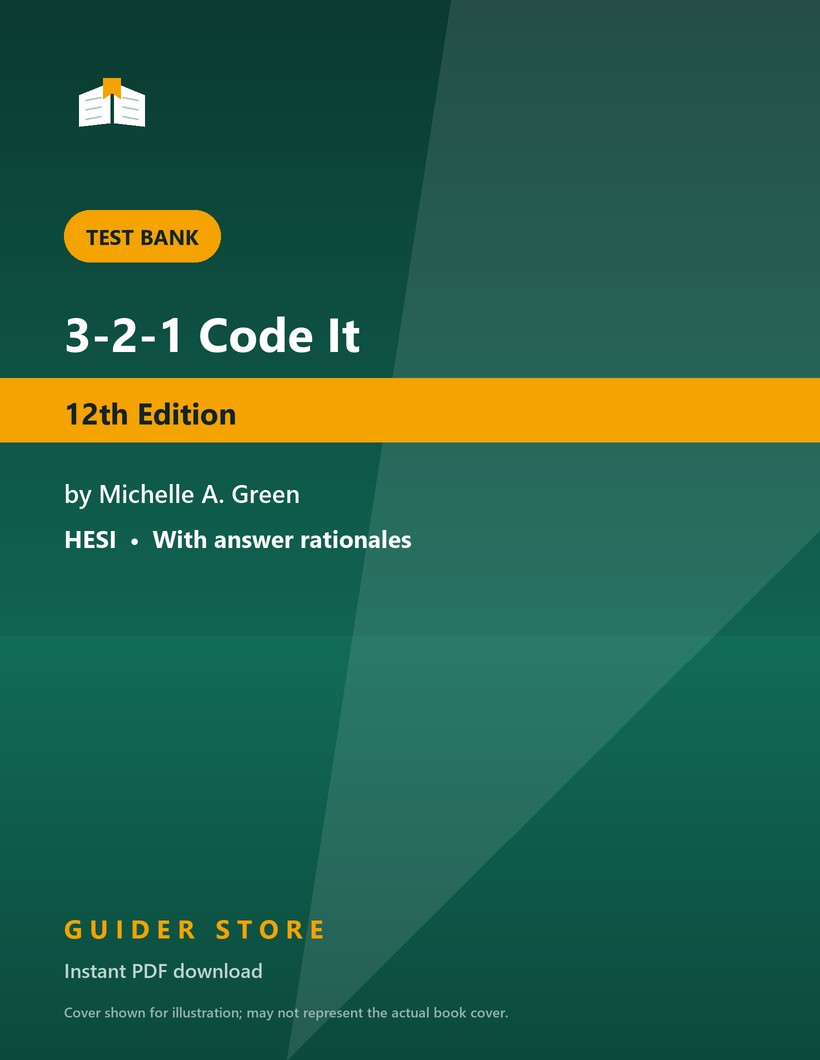


Learning medical coding means holding three separate rule systems in your head at once — ICD-10-CM diagnosis codes, ICD-10-PCS and CPT procedure codes, and HCPCS Level II — and applying each one under strict official guidelines that change every year. Michelle A. Green’s 3-2-1 Code It! 2024 is built around that layered logic, and this matched test bank turns each chapter’s concepts into the kind of applied coding questions that actually appear on quizzes, unit exams, and coding-credential practice sets.
Why this test bank helps
Medical coding is not memorization — it is decision-making. The difference between the right code and a rejected claim often comes down to a single guideline, a sequencing rule, or one word in a code description. Every question in this set is paired with a full rationale that explains why the selected code or answer is correct, which convention or guideline drives it, and why the plausible-looking alternatives fail. That is how you build the reflexes an audit or exam demands, instead of guessing between similar codes.
What’s inside
- Questions mapped to the chapters and sequence of 3-2-1 Code It! 2024, 12th Edition, so you can study alongside your syllabus.
- Multiple-choice items in exam and credential-prep style: code-selection scenarios, guideline application, and terminology recall.
- Short coding scenarios that ask you to assign the correct ICD-10-CM, CPT, or HCPCS code from a clinical statement.
- A written rationale for every question — the reasoning, the relevant convention or guideline, and why the distractors are wrong.
- Instant PDF download — searchable, printable, and yours to keep.
Topics covered
- Medical coding foundations: the coding process, code sets, and the healthcare reimbursement cycle
- ICD-10-CM conventions, official guidelines, and diagnosis code assignment
- ICD-10-CM chapter-specific coding across body systems and conditions
- ICD-10-PCS structure and inpatient procedure coding basics
- CPT format, guidelines, and modifiers for outpatient and physician services
- CPT category coding: Evaluation and Management, Surgery, Radiology, Pathology and Laboratory, and Medicine
- HCPCS Level II codes for supplies, drugs, and durable medical equipment
- Coding compliance, documentation requirements, and clean-claim principles
Who it’s for
This set is aimed at students in a medical coding, health information management, or medical billing and coding program using Green’s 3-2-1 Code It! as their course text, as well as anyone reviewing coding fundamentals before an entry-level credential exam. It maps naturally to coursework that prepares learners for certifications such as the CPC or CCA, where guideline-driven code assignment is exactly what is tested.
How to use it (the right way)
Read the matching textbook chapter first, then attempt the questions closed-book to simulate real exam conditions. Score yourself, then study every rationale — especially for items you got right by luck. Re-test after a few days to confirm the reasoning stuck. Treat this as a self-assessment and study aid: it is designed to help you learn the material and check your understanding, not to substitute for your own coursework or graded assessments. Always follow your institution’s academic-integrity policy, and confirm the codes you learn against the current official code sets and guidelines your program requires.
Sample question
(Shows the format — your download contains the full set.)
Q. In ICD-10-CM, a coder encounters the instructional note “Code first” beneath a code. What does this convention require the coder to do?
- A. Assign only the code listed and ignore any underlying condition
- B. Sequence the underlying etiology or associated condition before this code
- C. Query the physician before assigning any code at all
- D. Report the code twice to indicate a bilateral condition
Answer: B. A “Code first” note signals a mandatory sequencing rule: the underlying cause or associated condition must be listed as the first-listed or principal diagnosis, with the current code sequenced after it. Option A ignores the required additional code. Option C describes a physician query, which is a documentation step, not what this convention directs. Option D confuses sequencing with laterality, which is handled by separate seventh-character or bilateral code choices, not by repeating a code.
Edition & format
- Matches: for 3-2-1 Code It 2024 12th Edition By Michelle A. Green
- Format: Digital PDF, delivered instantly after checkout
- Access: Lifetime — re-download anytime from your account
Please confirm the edition and ISBN match your course before buying — message us and we’ll check.
Frequently asked questions
Does this include answer rationales, not just an answer key? Yes. Every question comes with a written explanation of the correct answer and why the other options are wrong, so you learn the coding logic rather than just the letter.
Will this help me prepare for a coding certification exam? It reinforces the same guideline-driven code-assignment skills that credential exams test, but it follows the textbook rather than any single certifying body’s official prep. Use it alongside current official code sets and any exam-specific study guides.
Is this the actual textbook or the coding manuals? No. This is a study and self-assessment test bank keyed to the 12th edition. It is not the textbook, and it does not replace the official ICD-10-CM, CPT, or HCPCS code books.
How do I receive it? Immediately after checkout you can download the PDF from your account, and you can re-download it anytime.
Explore more Allied Health & Medical Test Banks — all with instant PDF delivery and answer rationales.
Other editions of this book: 10th Edition · 11th Edition



Reviews
There are no reviews yet.