
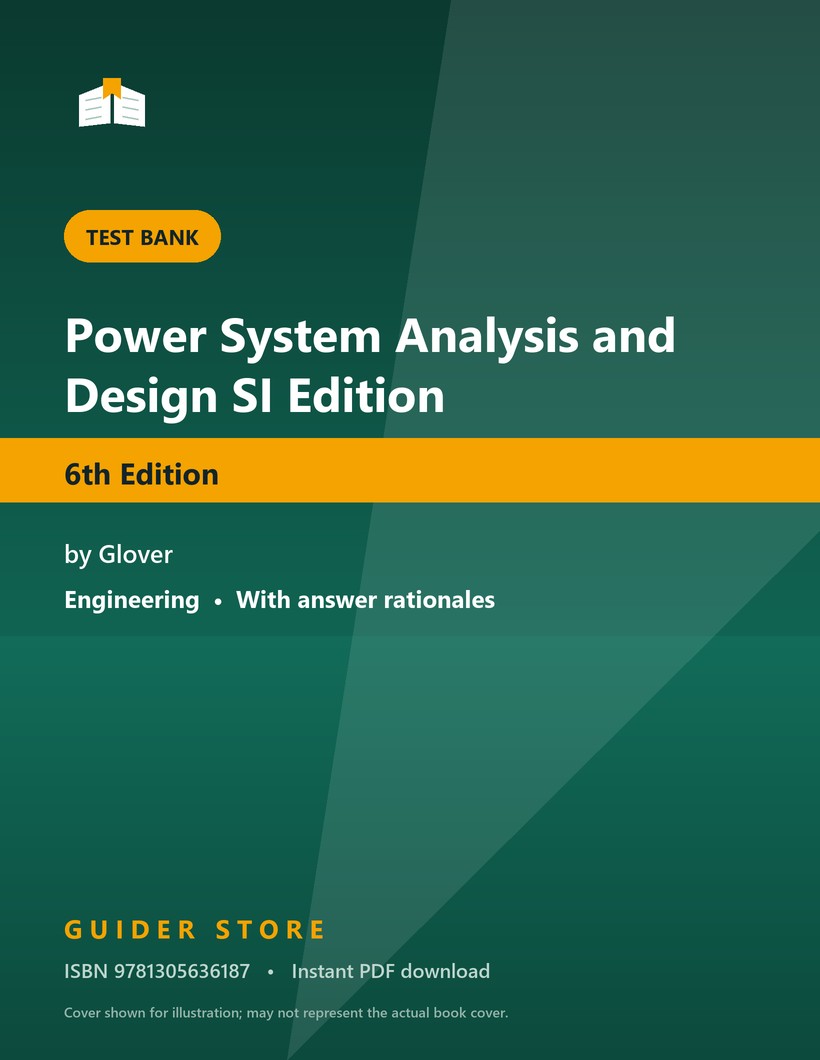

Power systems is the course where a single unresolved habit — not converting to a common base — quietly ruins every answer that follows. Power System Analysis and Design, SI Edition, 6th Edition by Glover introduces the per-unit system early precisely because everything afterwards depends on it: line models, transformer connections, power flow solutions, fault currents and stability limits are all handled in per-unit quantities. Students who treat the conversion as a preliminary chore rather than the framework of the subject find that their fault calculations are internally consistent and numerically wrong.
Why this test bank helps
In this subject a wrong answer usually comes from a wrong base, a wrong connection or a wrong sequence network, and none of those show up in an answer key. Each item here is followed by a written rationale that identifies the step — which base was used, why a delta-wye connection shifts the phase, why a single line-to-ground fault puts the three sequence networks in series. Locating the step is what keeps the error from repeating across an entire exam paper.
What’s inside
- Questions following the chapter structure of the SI edition, from fundamentals through to stability.
- Multiple choice, true/false and numerical items in per-unit and SI quantities.
- A written rationale under every question, identifying the base, the model or the network that governs the result.
- Emphasis on fault analysis and symmetrical components, the sections that carry the heaviest assessment weight.
- One organized PDF, available to download as soon as checkout completes.
Topics covered
- Per-unit system — base quantities, base changes across transformers and why per-unit simplifies a multi-voltage network
- Transformers — equivalent circuits, three-phase connections, phase shift and tap-changing regulation
- Transmission line parameters — resistance, inductance, capacitance, bundling and the effect of conductor geometry
- Line models and performance — short, medium and long line models, voltage regulation and surge impedance loading
- Power flow analysis — bus classification, the admittance matrix, and the Gauss-Seidel and Newton-Raphson methods
- Symmetrical faults — three-phase fault currents, subtransient reactance and circuit breaker duty
- Symmetrical components — positive, negative and zero sequence networks and unsymmetrical fault analysis
- System operation and stability — economic dispatch, protection principles, the swing equation and the equal area criterion
Who it’s for
Electrical engineering undergraduates taking a power systems analysis course from the SI sixth edition, and postgraduate or industry students revising the fundamentals before work in transmission planning, protection or system studies.
How to use it (the right way)
Convert every quantity to a common base before you begin any question, and write the base values at the top of the page as a matter of habit. Then work a block closed-book, and when an answer is wrong, check the base and the connection before you doubt the method. This is a study aid. Use it in line with your institution’s academic-integrity policy — for preparation and self-testing, never as a substitute for the coursework or as material taken into a graded assessment.
Sample question (shows the format — your download contains the full set)
Q. A transformer has a nameplate capacity of 50 MVA and a leakage impedance of 10 percent on its own base. What is its per-unit impedance on a 100 MVA system base at the same voltage base?
- A. 0.05 per unit
- B. 0.10 per unit
- C. 0.20 per unit
- D. 2.00 per unit
Answer: C. Per-unit impedance scales with the ratio of the new base power to the old, so 0.10 multiplied by 100/50 gives 0.20 per unit; doubling the base power doubles the per-unit impedance when the voltage base is unchanged. A applies the ratio in reverse. B ignores the base change entirely, which is the error that propagates through an entire fault study. D multiplies by the MVA figures instead of their ratio.
Edition & format
- Matches: Power System Analysis and Design, SI Edition, 6th Edition, by Glover (ISBN 9781305636187).
- Format: Digital PDF, delivered instantly after checkout.
- Access: Lifetime — re-download from your account whenever you need it.
The SI and US editions differ in units and in problem data. Please confirm the edition and ISBN above match the book your course assigned before buying.
Frequently asked questions
Is this the current edition? This set is prepared for the SI sixth edition, ISBN 9781305636187. Other editions and the non-SI printing are listed separately because their data differ.
How do I receive it? It downloads immediately after checkout and remains available in your account. Nothing is shipped.
Do all the questions include rationales? Yes. Every numerical item shows the reasoning behind the result, including where the common errors come from.
Is using a test bank allowed? As a study aid it is a normal practice resource. Follow your institution’s academic-integrity policy and never use it inside a graded assessment.
More study material for this subject is in Engineering Test Banks.

Reviews
There are no reviews yet.