
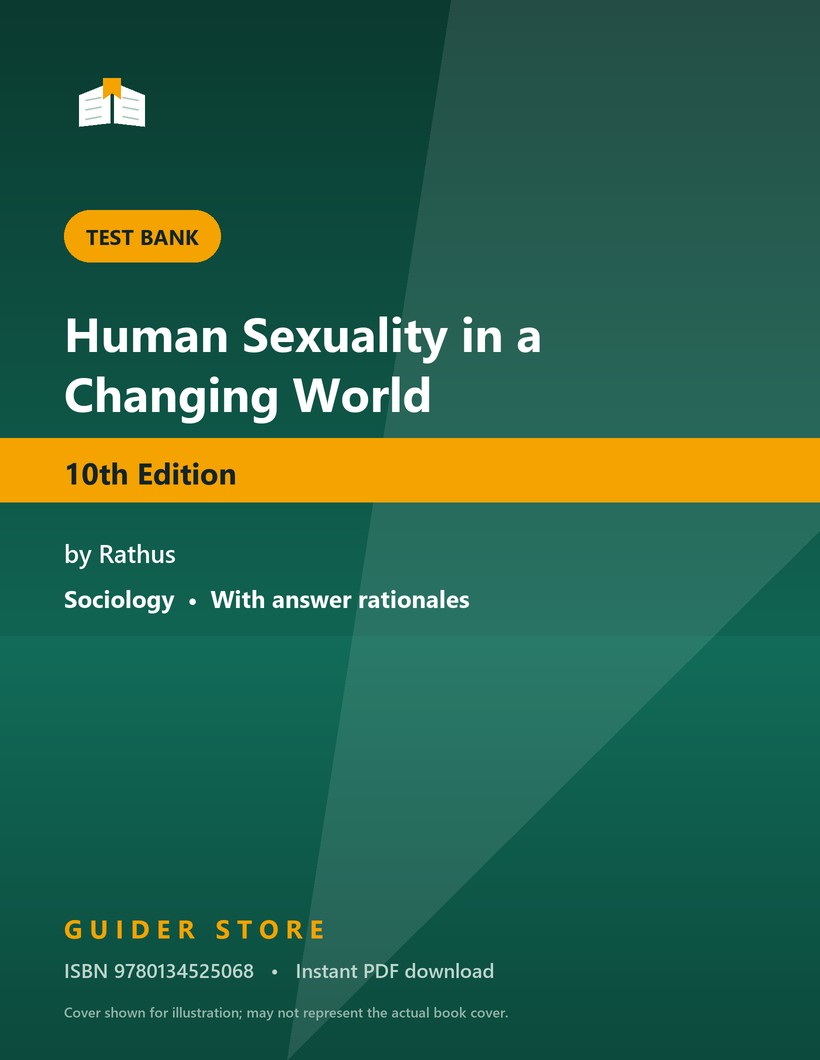


A course built around sexuality in a changing world spends more time on evidence than students expect. Human Sexuality in a Changing World, 10th Edition (Rathus) keeps asking how anyone knows what it reports — who was surveyed, who volunteered, what a correlation can and cannot show — alongside its chapters on anatomy, attraction, orientation and sexual health. The exam items follow suit, mixing straight recall with questions about the quality of the research behind a claim.
Why this test bank helps
Two kinds of question appear on this paper: what the finding is, and whether the study could support it. Each item here comes with a written rationale that handles both, naming the concept and, where the question is methodological, explaining exactly which flaw or safeguard the scenario illustrates.
What’s inside
- Question blocks that follow the textbook chapter by chapter across the whole semester.
- Multiple choice, true/false, matching and short-answer items, including research-critique questions.
- A written rationale under every question, covering both the content and the reasoning behind it.
- Real weight on the research methods chapter, which most students under-prepare and most instructors examine.
- One organized PDF, available to download immediately after checkout.
Topics covered
- Research methods in sexology — surveys, samples, volunteer bias, correlation and experimental design.
- Sexual anatomy and physiology — female and male structures, hormones and the sexual response cycle.
- Attraction, love and communication — theories of love, relationship formation and sexual communication.
- Gender identity and sexual orientation — development, theory and the evidence behind competing explanations.
- Contraception, conception and birth — methods and effectiveness, fertility, pregnancy and childbirth.
- Sexually transmitted infections — transmission, prevention, testing and public health strategy.
- Sexual variations and difficulties — classification, sexual dysfunctions and approaches to therapy.
- Coercion, consent and commercial sex — harassment, assault, the legal context and sex in the marketplace.
Who it’s for
Undergraduates taking human sexuality from this edition — psychology, sociology, nursing, health education and social work students, plus anyone meeting a social science requirement with this course.
How to use it (the right way)
Use it after reading, not instead of it. Do a timed block with your notes closed, mark the items that felt like guesses, and turn each rationale into a line on your own summary sheet. It is a study aid: keep it inside your institution’s academic-integrity policy, for revision and self-testing only, and never carry it into a graded assessment.
Sample question (shows the format — your download contains the full set)
Q. A magazine invites readers to complete an online questionnaire about their sexual behaviour and then reports the results as representative of adults nationally. What is the principal methodological problem?
- A. Volunteer self-selection: those who choose to respond differ systematically from those who do not
- B. The sample is too large to analyse reliably
- C. The study demonstrates correlation where causation was intended
- D. There is no control group receiving a placebo
Answer: A. Readers who see the invitation and choose to answer are not a random cross-section of the adult population, so the results describe a self-selected group rather than the country. This volunteer bias is the classic limitation of magazine and online sex surveys. B inverts the usual concern, since large samples help precision. C names a real inferential error, but nothing here claims a causal relationship. D applies experimental logic to a descriptive survey, which was never designed to test an intervention.
Edition & format
- Matches: Human Sexuality in a Changing World, 10th Edition (Rathus) — ISBN 9780134525068.
- Format: Digital PDF, delivered instantly after checkout.
- Access: Lifetime — re-download from your account whenever you need it.
Chapter numbering and the survey data cited change between editions. Please confirm the edition and ISBN above match the book on your syllabus before you buy.
Frequently asked questions
Is this the current edition? It is prepared for the 10th Edition, ISBN 9780134525068. Other editions update the research findings and renumber chapters, so their question sets are listed separately.
How do I receive it? Delivery is digital: the file is on your confirmation page and in your account the moment payment is confirmed, with no dispatch step in between.
Do all the questions include rationales? Yes, without exception. The explanation under each question is written to be read, not skimmed past once you have the letter.
Is using a test bank allowed? As a study aid it works like any other practice resource. Follow your institution’s academic-integrity policy, and never take the material into a graded assessment.
You can browse more of these under Sociology Test Banks.

Reviews
There are no reviews yet.