
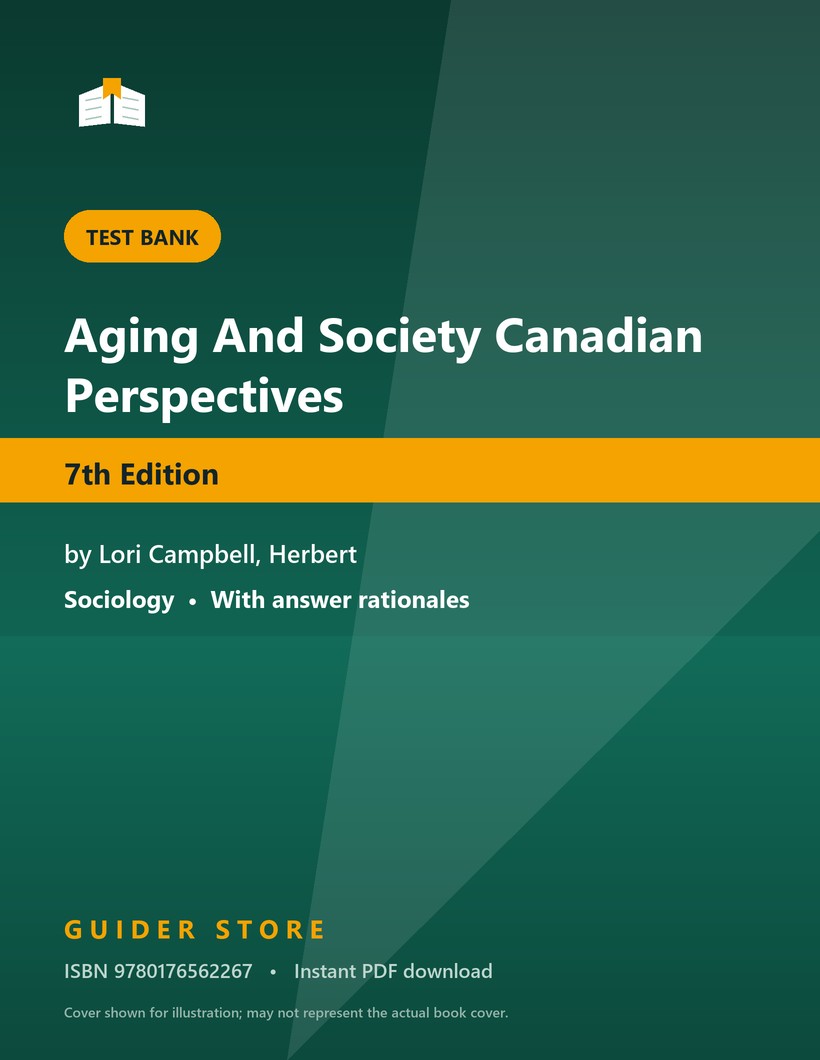


Social gerontology surprises students who signed up expecting a health course. Aging and Society: Canadian Perspectives, 7th Edition spends as much time on pension policy, housing and family caregiving as it does on the biology of growing older, because its central argument is that most of what we call aging is organized socially. Exams test that distinction directly, asking which theory, which policy instrument or which demographic measure explains the pattern in front of you.
Why this test bank helps
In this field the wrong answer is usually the intuitive one: a personal explanation for something the book treats as structural. Each question here is followed by a rationale that names the theory or policy mechanism at work, so you practise reading a scenario the way the course does rather than the way common sense suggests.
What’s inside
- Chapter-by-chapter question blocks that follow the book from demography through to death and dying.
- Multiple choice, true/false, matching and short-answer items, including scenario questions about older adults and services.
- A written rationale under every question identifying the theory, policy or measure being tested.
- Careful coverage of the Canadian policy chapters — pensions, health care and long-term care — where precision matters most.
- A single organized PDF, available immediately after checkout.
Topics covered
- Population aging in Canada — life expectancy, dependency ratios and the demographic transition.
- Theories of aging — disengagement, activity, continuity, political economy and life-course perspectives.
- Biological and psychological change — normal aging, cognition, memory and mental health in later life.
- Health and the care system — chronic illness, home care, long-term care and health policy.
- Income security and retirement — public pensions, workplace plans, savings and low income in later life.
- Family, friendship and caregiving — informal care, intergenerational support and caregiver strain.
- Housing, transportation and community — aging in place, supportive housing and age-friendly design.
- Ageism, diversity and dying — stereotypes, Indigenous and immigrant elders, palliative care and bereavement.
Who it’s for
Students in social gerontology, aging and society or health studies courses using this edition — sociology, nursing, social work, kinesiology and recreation therapy students, and staff studying part time while working in seniors’ services.
How to use it (the right way)
Attempt a set cold, before you feel ready, because the errors are the useful information. Then read every rationale slowly, and re-attempt the same block a few days later to see what actually stuck. This is a study aid: use it consistently with your institution’s academic-integrity policy, as preparation and self-assessment, never as a way around the assigned work.
Sample question (shows the format — your download contains the full set)
Q. An older woman retires from paid work, gradually reduces her community involvement, and the organizations around her stop expecting her participation. A student explains this as a mutually beneficial and functional process. Which theory is being applied?
- A. Activity theory
- B. Disengagement theory
- C. Political economy of aging
- D. Continuity theory
Answer: B. Disengagement theory is the perspective that frames mutual withdrawal between an older person and society as functional for both. A argues the opposite, that well-being depends on maintaining activity and roles. C would explain the withdrawal by structural forces such as pension rules and labour market pressures rather than mutual benefit. D holds that people carry earlier patterns and preferences forward, which describes stability rather than a process of withdrawal.
Edition & format
- Matches: Aging and Society: Canadian Perspectives, 7th Edition — ISBN 9780176562267.
- Format: Digital PDF, delivered instantly after checkout.
- Access: Lifetime — re-download from your account whenever you need it.
Statistics, pension figures and policy detail are updated with each edition. Please confirm the edition and ISBN above match the book your course assigned before you buy.
Frequently asked questions
Is this the current edition? It is prepared for the 7th Edition, ISBN 9780176562267. Other editions update the demographic data and policy chapters and renumber sections, so their question sets are listed separately.
How do I receive it? Delivery is automatic and digital. The link sits on your confirmation page and stays stored in your account for later re-downloads.
Do all the questions include rationales? Yes — each item carries an explanation rather than just a letter, so a wrong attempt shows you where your reasoning went off.
Is using a test bank allowed? Treated as a study aid it is like a problem set or a revision guide. Your institution’s academic-integrity policy governs how you may use it, so follow it.
More titles for this course are in Sociology Test Banks.



Reviews
There are no reviews yet.