
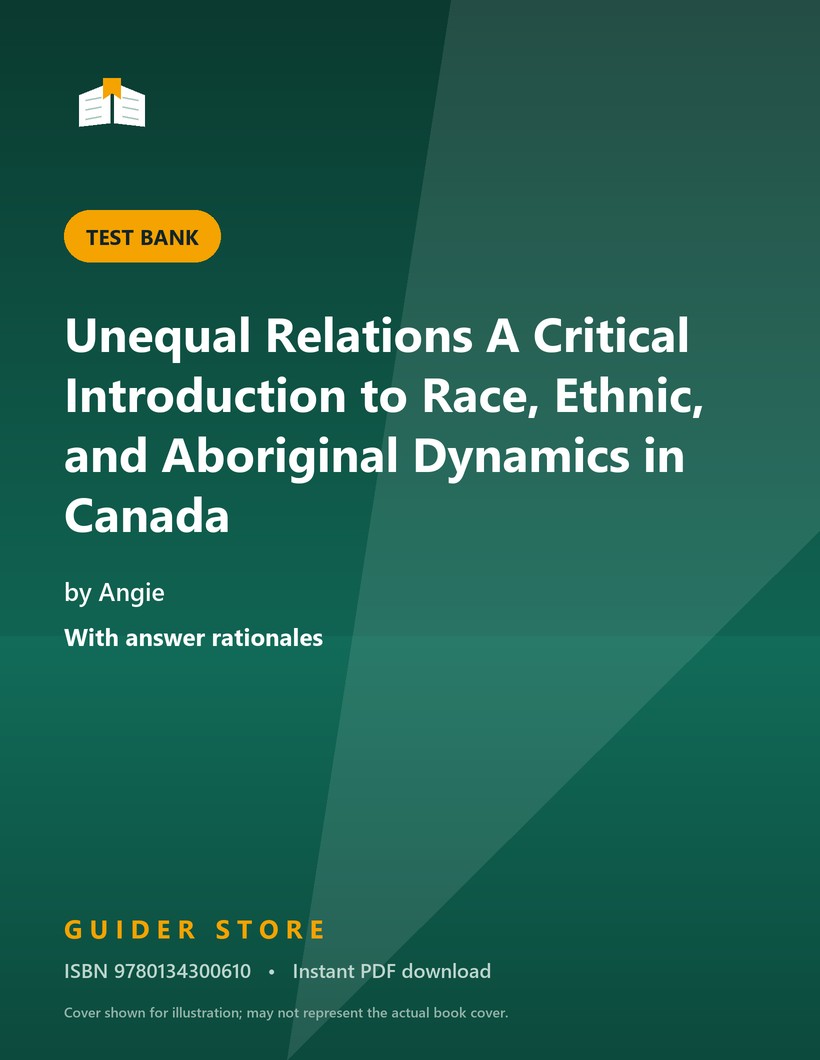



Race and ethnic relations courses ask students to argue about words they have used casually all their lives — racism, prejudice, multiculturalism, reconciliation — and then grade them on precision. Unequal Relations: A Critical Introduction to Race, Ethnic, and Aboriginal Dynamics in Canada makes that harder on purpose, because its argument is structural: inequality is treated as something built into institutions and policy rather than something carried around in individual attitudes. The assessment questions follow that logic closely.
Why this test bank helps
In this subject the tempting answer is usually the individual one, and it is usually wrong. Each question in the set is followed by a rationale that identifies the level of analysis the item is testing — attitude, interaction, institution or policy — so you learn to spot which level a scenario belongs to before you choose an option.
What’s inside
- Questions grouped chapter by chapter, matching the order the course works through the material.
- Multiple choice, true/false and short-answer items, plus scenario questions that describe a situation and ask you to name it.
- A written rationale under every question distinguishing the correct concept from the near-miss term beside it.
- Particular attention to Indigenous–state relations and to the policy chapters, which carry heavy weight in most course assessments.
- One organized PDF, downloadable immediately after checkout.
Topics covered
- Race, ethnicity and racialization — why the text treats race as a social construction with material consequences.
- Prejudice, discrimination and systemic racism — separating attitudes from actions and from institutional outcomes.
- Indigenous peoples and the Canadian state — treaties, the Indian Act, residential schools and claims to self-determination.
- Multiculturalism as policy — its origins, its critics, and the gap between official pluralism and lived experience.
- Immigration and refugee policy — selection criteria, settlement, credential recognition and labour market access.
- Media and representation — framing, stereotyping and the everyday language of difference.
- Intersecting inequalities — how gender, class and racialization compound one another.
- Anti-racism and reconciliation — human rights frameworks, employment equity and models of institutional change.
Who it’s for
Students in Canadian race and ethnic relations, diversity or Indigenous studies courses using this text — sociology and social work majors, criminology and education students, and anyone taking the course as a social science elective.
How to use it (the right way)
Use it after reading, not instead of it. Do a timed block with your notes closed, mark the items that felt like guesses, and turn each rationale into a line on your own summary sheet. It is a study aid: keep it inside your institution’s academic-integrity policy, for revision and self-testing only, and never carry it into a graded assessment.
Sample question (shows the format — your download contains the full set)
Q. A national employer’s hiring policy makes no reference to ethnicity, yet applicants holding foreign credentials are screened out at the first stage almost without exception. Which concept best describes this outcome?
- A. Individual prejudice on the part of the recruiter
- B. Systemic discrimination, in which apparently neutral rules produce consistently unequal outcomes
- C. Cultural relativism applied to hiring standards
- D. Assimilation of newcomers into the workplace
Answer: B. The defining feature is that no discriminatory intent is required: a rule that looks neutral on its face reproduces disadvantage through its effects, which is precisely how the text defines systemic or institutional discrimination. A locates the cause in one person’s attitude, when the policy would produce the same result under any recruiter. C is a method for interpreting cultural practices, not a form of exclusion. D names a process of absorption into a dominant culture, which is a different phenomenon from a screening barrier.
Edition & format
- Matches: Unequal Relations: A Critical Introduction to Race, Ethnic, and Aboriginal Dynamics in Canada — ISBN 9780134300610.
- Format: Digital PDF, delivered instantly after checkout.
- Access: Lifetime — re-download from your account whenever you need it.
This title is revised as policy, case law and census data change. Please confirm the ISBN above matches the book on your syllabus before you buy.
Frequently asked questions
Is this the current edition? This set is prepared against the edition carrying ISBN 9780134300610. Other editions revise the policy chapters and renumber sections, so their question sets are listed separately.
How do I receive it? Delivery is digital: the file is on your confirmation page and in your account the moment payment is confirmed, with no dispatch step in between.
Do all the questions include rationales? Yes, without exception. The explanation under each question is written to be read, not skimmed past once you have the letter.
Is using a test bank allowed? As a study aid it works like any other practice resource. Follow your institution’s academic-integrity policy, and never take the material into a graded assessment.
You can browse more of these under Sociology Test Banks.


Reviews
There are no reviews yet.