
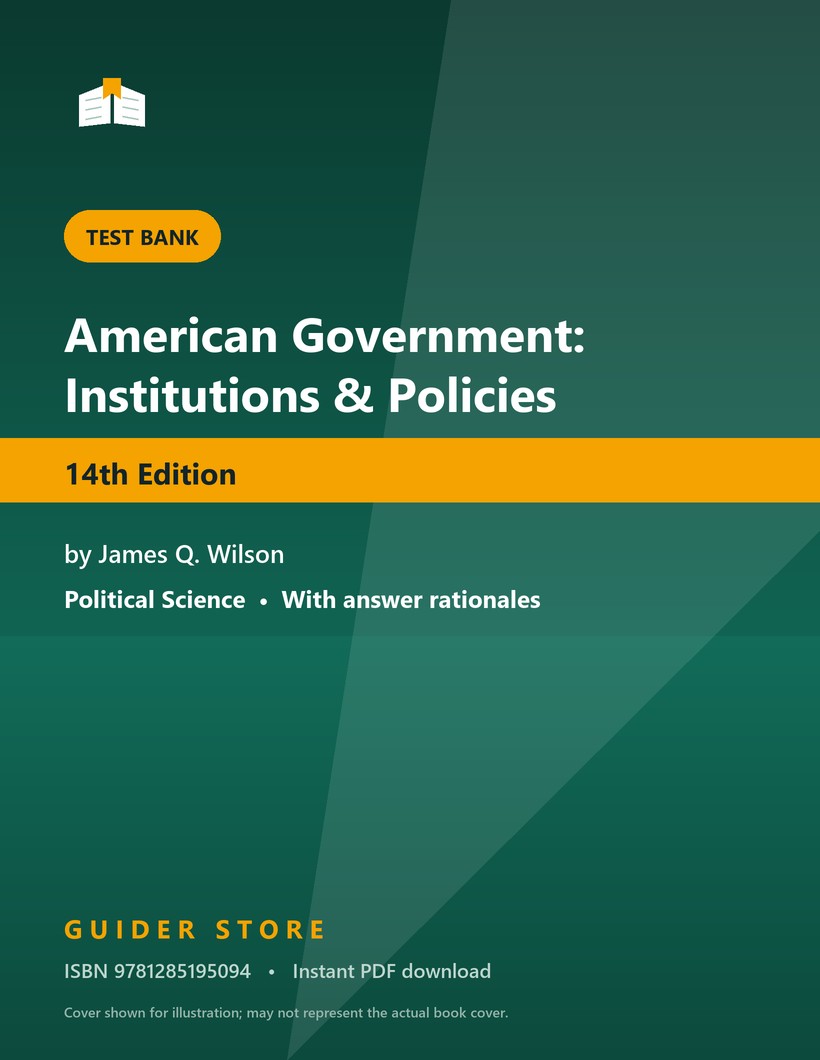

Most students handle the branches of government competently and then lose marks in the final third of the course, where the subject stops being structure and becomes process. American Government: Institutions and Policies, 14th Edition by James Q. Wilson closes with chapters on how policy is actually made — who sets the agenda, which coalitions form around a program, why a benefit concentrated on a few and paid for by everyone is so durable — and those chapters are examined on analysis rather than on opinion about the policies themselves.
Why this test bank helps
Policy questions look subjective and are not. They test whether you can classify a political relationship correctly, and the options are usually four real concepts, only one of which fits the arrangement described. Every item in this set is followed by a written rationale that names the concept, points to the feature of the scenario that identifies it, and explains what the other three would look like in practice. That is the sharpest way to fix the vocabulary this half of the course depends on.
What’s inside
- Chapter-aligned questions covering the institutional chapters and the policy chapters that follow them.
- Multiple choice, true/false and scenario items that require a concept to be applied, not recited.
- A written rationale under every question, naming the concept and the evidence that identifies it.
- Deliberate weight on the policy-making material that survey courses reach late and test heavily.
- One organized PDF, available to download the moment checkout completes.
Topics covered
- The policy-making process — agenda setting, policy entrepreneurs, and the politics of costs and benefits.
- Interest groups and lobbying — group formation, access, iron triangles and issue networks.
- Congress — committees, party leadership, the legislative process and constituency incentives.
- The presidency and the bureaucracy — executive power, appointments, agency discretion and oversight.
- The judiciary — judicial review, precedent, and the courts as participants in policy.
- Economic and social welfare policy — taxing and spending, the budget process, and entitlement programs.
- Civil liberties and civil rights — First Amendment doctrine, due process and equal protection.
- Foreign and military policy — the division of war powers, treaty-making and the machinery of national security.
Who it’s for
Students taking introductory American government from the full 14th Edition, including political science majors starting the sequence, pre-law students, and public administration and criminal justice students who need the policy chapters as background for later coursework.
How to use it (the right way)
For the policy chapters especially, practice sorting before you practice answering: given a scenario, decide first which concept it illustrates, and only then look at the options. Work blocks closed-book, then read every rationale and note any concept you keep confusing with another. This is a study aid. Use it in line with your institution’s academic-integrity policy — as preparation and self-assessment, never as a substitute for the coursework and never as material taken into a graded assessment.
Sample question (shows the format — your download contains the full set)
Q. A congressional subcommittee, a federal agency and an industry trade association support the same subsidy program year after year, and outside actors rarely influence the outcome. Political scientists usually describe this arrangement as:
- A. An issue network
- B. An iron triangle
- C. Judicial review
- D. Cooperative federalism
Answer: B. The defining features are all present: three participants, each holding something the others need, in a stable and largely closed relationship that outsiders struggle to enter. A describes the opposite pattern — a large, fluid set of experts, journalists, officials and rival groups who contest an issue, which is why issue networks are far less predictable. C is a power of the courts, not a description of a policy relationship. D refers to national and state governments sharing administration of a program, which is a different axis of politics altogether.
Edition & format
- Matches: American Government: Institutions and Policies, 14th Edition, by James Q. Wilson (ISBN 9781285195094).
- Format: Digital PDF, delivered instantly after checkout.
- Access: Lifetime — re-download from your account whenever you need it.
The full text and the brief version are numbered differently and the policy examples change between editions. Please confirm the edition and ISBN above match your assigned book before you buy.
Frequently asked questions
Is this the current edition? It is prepared for the 14th Edition, ISBN 9781285195094. Adjacent editions and the brief version are listed separately because their chapters do not line up.
How do I receive it? Your download is available on the order confirmation page and in your account immediately after checkout. Nothing is mailed and there is no processing wait.
Do all the questions include rationales? Yes. Each item carries a written explanation of the concept and of why the alternatives do not fit the situation described.
Is using a test bank allowed? Used as a study aid it is comparable to any other practice resource. Follow your institution’s academic-integrity policy, and never take the material into a graded assessment.
More titles for this course are in Political Science Test Banks.


Reviews
There are no reviews yet.