
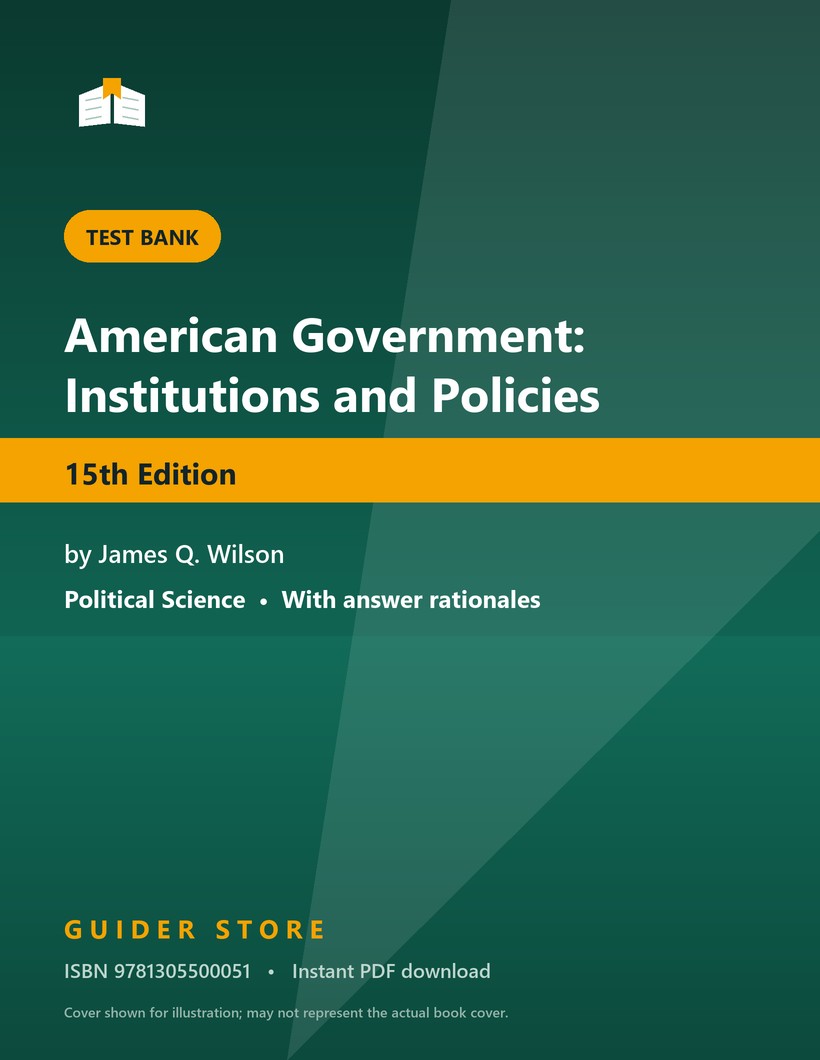
One thread that separates this textbook from most survey texts is its habit of asking why American government produces outcomes no other democracy quite produces. American Government: Institutions and Policies, 15th Edition by James Q. Wilson keeps returning to the comparison — a legislature that can refuse its own executive, courts that decide questions parliaments elsewhere settle, elections held on a calendar nobody can move — and its exams reward students who can trace an outcome back to that design rather than to the personalities involved in it.
Why this test bank helps
Questions about design cannot be answered from memory of a chart, because they ask what the arrangement produces. Every item here comes with a written rationale that works from the structural feature to its consequence — why fixed terms change a president’s incentives, why a supermajority requirement protects a minority, why an allocation rule can separate a popular majority from a governing one — and explains what each wrong option would actually describe. That reasoning is the part that carries into essay questions and later coursework.
What’s inside
- Questions following the 15th Edition’s chapter order, so reading and practice stay aligned.
- Multiple choice, true/false and applied items that connect a structural feature to a political result.
- A written rationale under every question, tracing the reasoning rather than restating the answer.
- Balanced coverage of constitutional design, the institutions, and the electoral and party chapters.
- One organized PDF, ready to download the moment checkout completes.
Topics covered
- American political culture — the beliefs and expectations that shape participation and trust in government.
- Constitutional design — separation of powers, checks and balances, and how the system differs from parliamentary alternatives.
- Federalism — the allocation of authority, fiscal relations and the courts’ role in policing the boundary.
- Parties and polarization — party organization, realignment, primaries and the incentives that sharpen partisan division.
- Campaigns, elections and money — nomination rules, the Electoral College, campaign finance and turnout.
- Interest groups and the media — organized influence, lobbying regulation, agenda setting and framing.
- Congress, the presidency and the bureaucracy — representation, legislative procedure, executive power and administrative control.
- Courts, liberties and rights — judicial review, First Amendment doctrine, due process and equal protection.
Who it’s for
Students in an introductory American government or American national politics course using the 15th Edition, whether taken as a general-education requirement, as the gateway course for a political science major, or as preparation for constitutional law and public policy coursework later in a degree.
How to use it (the right way)
Before a block of questions, pick one institution and write down two consequences of how it is designed; the exam is far more interested in that than in dates. Attempt the block closed-book, then read every rationale, paying particular attention to items where you chose a defensible but structurally wrong answer. This is a study aid. Use it in line with your institution’s academic-integrity policy — for preparation and self-testing, not as a substitute for coursework and never as material taken into a graded assessment.
Sample question (shows the format — your download contains the full set)
Q. A presidential candidate wins the national popular vote but loses the election. Which feature of the American system best explains how that outcome is possible?
- A. Electoral votes are allocated state by state, nearly all on a winner-take-all basis, and a majority of the 538 electors decides the outcome
- B. The Senate certifies the result and may substitute its own judgment for the voters’
- C. Seats are apportioned by population, so small states have no meaningful influence
- D. The Supreme Court selects the president whenever the result is close
Answer: A. The presidency is not decided by one national tally but by fifty-one separate contests, and in almost every state the winner takes all of that state’s electors regardless of the margin. Narrow wins in enough states can therefore outweigh a large popular margin concentrated elsewhere. B misdescribes the congressional role, which is to count certified electoral votes rather than to reweigh them. C reverses the effect of the two-elector Senate component, which gives small states more weight per voter, not less. D is simply not a power the Court holds; it may resolve legal disputes about an election, but it does not choose the winner.
Edition & format
- Matches: American Government: Institutions and Policies, 15th Edition, by James Q. Wilson (ISBN 9781305500051).
- Format: Digital PDF, delivered instantly after checkout.
- Access: Lifetime — re-download from your account whenever you need it.
Chapters are renumbered between editions and the brief version differs again. Please confirm the edition and ISBN above match the book on your course outline before you buy.
Frequently asked questions
Is this the current edition? This set is written for the 15th Edition, ISBN 9781305500051. Earlier editions and the brief version have their own listings because their chapters differ.
How do I receive it? The download is on your order confirmation page and in your account the moment checkout completes. Nothing is posted and there is no processing delay.
Do all the questions include rationales? Yes — every item is followed by a written explanation that traces the reasoning from the institutional feature to the result.
Is using a test bank allowed? Treated as a study aid it is like any other practice resource. Follow your institution’s academic-integrity policy, and never take the material into a graded assessment.
More titles for this course are in Political Science Test Banks.




Reviews
There are no reviews yet.