
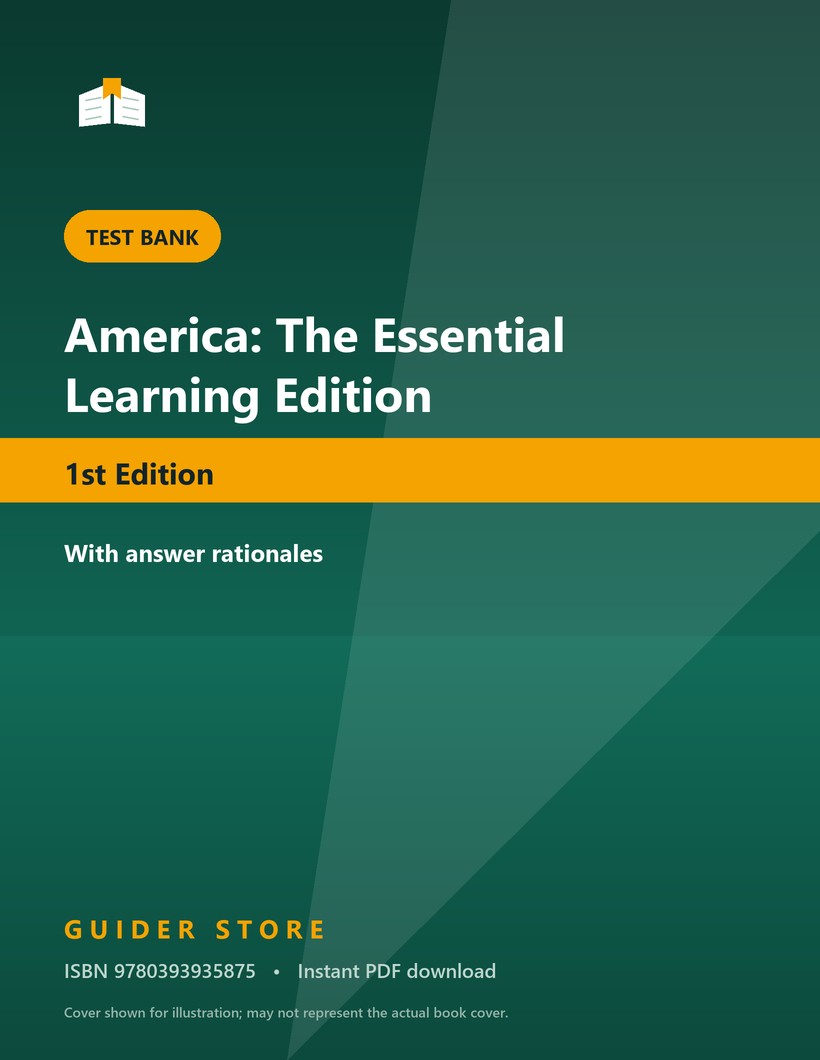


A single-volume survey of the entire American past has to be ruthlessly selective, and this one is unusually open about it: each chapter states the questions it wants you to be able to answer by the end. America: The Essential Learning Edition, 1st Edition is organized around those focus questions, and instructors write assessments straight from them — which is good news for anyone who studies with the framework instead of trying to memorize every name on the page.
Why this test bank helps
A survey course covering four hundred years cannot be revised by rereading. What works is repeated retrieval against the questions the chapter set, because that is both how the book is built and how the examination is written.
Every item in this set is followed by an explanation that connects the answer back to the larger development it belongs to — expansion, industrialization, reform, war, rights — and shows why the other options sit in a different period or a different argument. Over a term, that turns a long list of events into a much shorter list of causes.
What’s inside
- Question sets following the chapter sequence of the first edition, covering the full survey from pre-contact America to the present.
- Multiple choice, true/false, matching and short-answer items, including questions built on quotations and images of the kind the text uses.
- A written rationale for every question, tying the correct answer to the chapter’s central development rather than to an isolated fact.
- Balanced coverage of political, social and economic history, matching the way this edition distributes its focus questions.
- Instant PDF download, easy to read on a laptop and to print for a revision session before a midterm or final.
Topics covered
- Contact and colonization — Indigenous societies, European empires in North America, and the colonial regions that emerged.
- Revolution and the new republic — imperial crisis, independence, the Constitution and the first party conflicts.
- Expansion and the antebellum era — the market revolution, Jacksonian politics, reform movements and slavery in the South.
- Civil War and Reconstruction — sectional crisis, secession, emancipation, and the rebuilding and abandonment of Reconstruction.
- Industrial America — railroads and big business, immigration, urban growth, labour conflict and Populism.
- Reform, empire and world war — Progressive politics, overseas expansion, the First World War and the 1920s.
- Depression, war and the Cold War — the New Deal, the Second World War, containment and postwar prosperity.
- Rights and the modern era — the civil rights movement, Vietnam and its aftermath, conservative resurgence and recent decades.
Who it’s for
For students taking the United States history survey as a general-education requirement, whether in a single-semester course using the full volume or a two-semester sequence. It suits first-year students who need a manageable framework for a very large body of material, and education students who will later teach the American survey.
How to use it (the right way)
Before answering anything, write down the chapter’s focus questions in your own words. Then work the practice items closed-book and, for each mistake, decide which focus question it belonged to. Errors in a survey course cluster rather than spreading evenly, and finding the cluster tells you what to reread.
Treat this as a study aid used with your lectures, primary sources and assigned reading, and in line with your institution’s academic-integrity policy. It supports essay and examination preparation rather than replacing it.
Sample question (shows the format — your download contains the full set)
Q. Which of the following was established by the Social Security Act of 1935?
- A. A federal minimum wage and a maximum working week
- B. A system of old-age pensions funded by payroll taxes, together with unemployment insurance
- C. Federal insurance for bank deposits
- D. A public works program employing artists, writers and construction workers
Answer: B. The Social Security Act created contributory old-age pensions financed by payroll taxes on employers and employees, and established a federal-state system of unemployment insurance along with assistance for certain other groups. Option A describes the Fair Labor Standards Act of 1938. Option C describes the deposit insurance created by the Banking Act of 1933. Option D describes the Works Progress Administration, also part of the New Deal but a relief program rather than a social insurance system. The question tests the distinction between relief, recovery and reform measures, the standard framework for organizing New Deal legislation.
Edition & format
- Matches: America: The Essential Learning Edition, 1st Edition (ISBN 9780393935875).
- Format: Digital PDF, delivered instantly after checkout.
- Access: Lifetime access — re-download anytime from your account.
Please check the title, edition and ISBN above against your course outline before ordering, and note that this title is also issued in one-volume and two-volume formats.
Frequently asked questions
Which edition and format is this? The first edition, ISBN 9780393935875. This title is published in combined and split-volume formats, so match the ISBN on your syllabus rather than the title alone.
How quickly is the file available? As soon as checkout completes. You get a link on screen and the same link by email, and the download is a plain PDF.
Is a rationale provided for every question? Yes. Each answer is explained and connected to the chapter’s central development, with the reason each other option is incorrect.
Is using a test bank permitted? Used as practice it is an ordinary revision resource. It is a study aid rather than a copy of any live assessment, and it should be used in line with your institution’s academic-integrity policy.
Studying more than one history course this year? Browse the wider selection of History & Humanities Test Banks for titles matched to your editions.


Reviews
There are no reviews yet.