
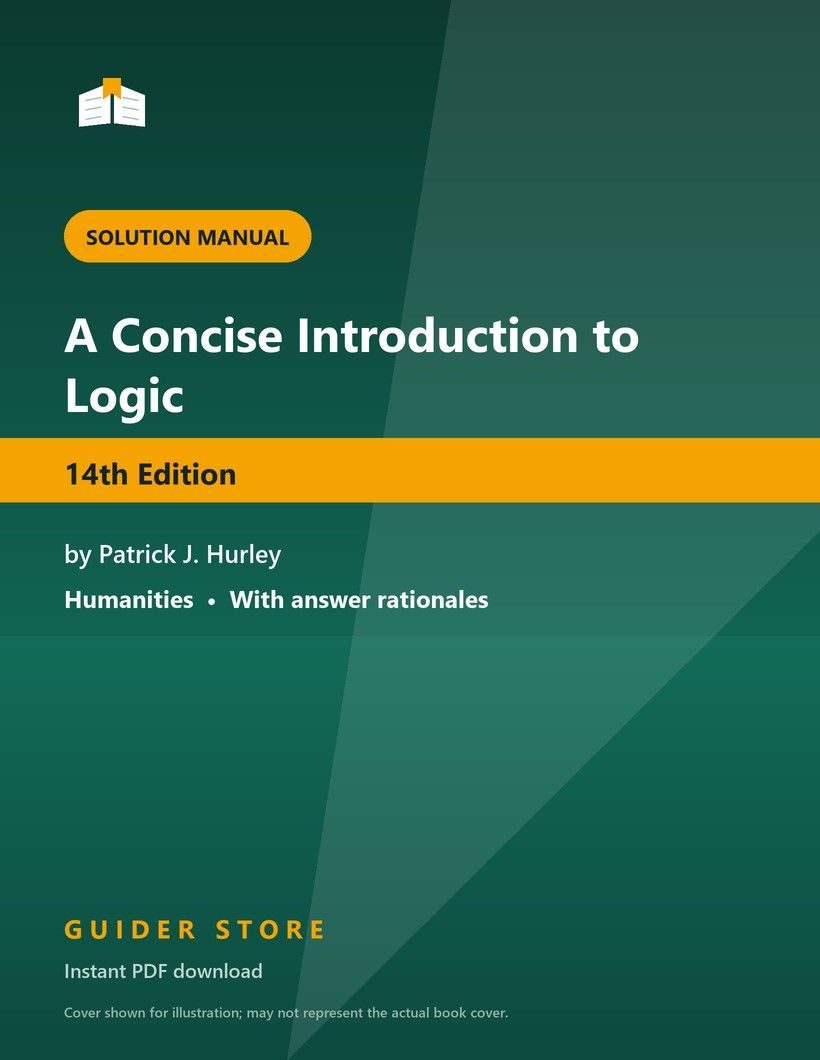
A proof either works or it does not, and when it does not the textbook rarely tells you where. A Concise Introduction to Logic, 14th Edition by Patrick J. Hurley sets exercises whose answers are a single line — valid, invalid, a completed truth table, a finished derivation — while the reasoning that produces them runs to several steps, any one of which can go wrong invisibly. A student who reaches the wrong conclusion in a natural deduction problem has no way of knowing whether the fault was the translation, a misapplied replacement rule, or a scope error three lines earlier. The final answer, on its own, diagnoses nothing.
Why this solution manual helps
Worked solutions restore the middle of the problem, which is where logic is actually learned. Instead of a verdict to compare against, you get the sequence: the line that was cited, the rule that licensed the move, the reason the rule applied at that point rather than another. Reading down from the top and stopping at the first line that differs from your own attempt locates the earliest error, and in a formal derivation that earliest error is almost always the only one — everything after it was correct reasoning applied to a broken line.
What’s inside
- Written solutions to the book’s exercise sets, presented in its own chapter and section order.
- Step-by-step derivations with each rule named and each cited line shown, rather than final answers alone.
- Full working for truth tables and Venn diagram tests, including the row or region that decides the verdict.
- Reasoned answers for the fallacy and argument-analysis exercises, where the justification carries the credit.
- One organized PDF, downloadable as soon as checkout completes.
Topics covered
- Arguments and their structure — identifying premises and conclusions, recognizing non-arguments and diagramming.
- Deduction and induction — validity, soundness, strength and cogency, and testing arguments by counterexample.
- Informal fallacies — relevance, weak induction, presumption, ambiguity and grammatical analogy.
- Categorical propositions — the square of opposition, conversion, obversion, contraposition and existential import.
- Categorical syllogisms — mood and figure, Venn diagram testing, and the rules and their corresponding fallacies.
- Propositional logic — symbolizing ordinary language, truth tables for propositions and arguments, and indirect truth tables.
- Natural deduction — rules of implication and replacement, conditional proof and indirect proof.
- Predicate logic and induction — quantifier translation and proofs, relational predicates, analogy, causality and probability.
Who it’s for
Students taking introductory logic or critical thinking from this edition — philosophy majors meeting formal methods for the first time, and students taking the course to satisfy a reasoning requirement who need to check long derivations without a tutor available.
How to use it (the right way)
Attempt the whole exercise before opening the solution, and when you compare, read from the first line downward rather than jumping to the verdict. Stop at the first divergence, work out for yourself which rule should have applied, and redo the remainder unaided. This is a study aid. Use it in line with your institution’s academic-integrity policy — to check and understand your own attempts, never to copy into submitted work and never as a shortcut around the coursework.
Sample worked solution (shows the format — your download contains the full set)
Problem. Derive the conclusion using the rules of natural deduction. Premise 1: P ⊃ (Q • R), read as if P then both Q and R. Premise 2: ~R, read as not R. Conclusion: ~P.
- Step 1. Line 3: ~Q ∨ ~R, from line 2 by Addition — a disjunct may always be added to a true statement.
- Step 2. Line 4: ~(Q • R), from line 3 by De Morgan’s rule, since the negation of a conjunction is the disjunction of the negations.
- Step 3. Line 5: ~P, from lines 1 and 4 by Modus Tollens, because denying the consequent of a conditional denies its antecedent.
Answer: the derivation closes in three lines. The move students miss is the first one: Addition looks pointless until you notice that De Morgan’s rule needs a whole disjunction to work on, and only then does the conditional in line 1 become available to Modus Tollens. Naming the target form before choosing a rule is what shortens proofs of this kind.
Edition & format
- Matches: A Concise Introduction to Logic, 14th Edition, by Patrick J. Hurley.
- Format: Digital PDF, delivered instantly after checkout.
- Access: Lifetime — re-download from your account whenever you need it.
Exercise numbering and problem sets change between editions of this book. Please confirm the edition above matches the one your course assigned before you buy.
Frequently asked questions
Which edition does this match? The 14th Edition. Earlier editions have different exercise sets and are listed separately, so use the edition named on your syllabus.
How do I receive it? By instant download at the end of checkout, with the file also kept in your account.
Is the working shown, or just the answers? The working is shown. Derivations are built line by line with each rule named, rather than presented as a finished verdict.
Is using a solution manual allowed? As a self-checking aid it is a normal study resource. Follow your institution’s academic-integrity policy, and never submit a worked solution as your own work.
More study material for this subject is in History & Humanities Test Banks.

Reviews
There are no reviews yet.