
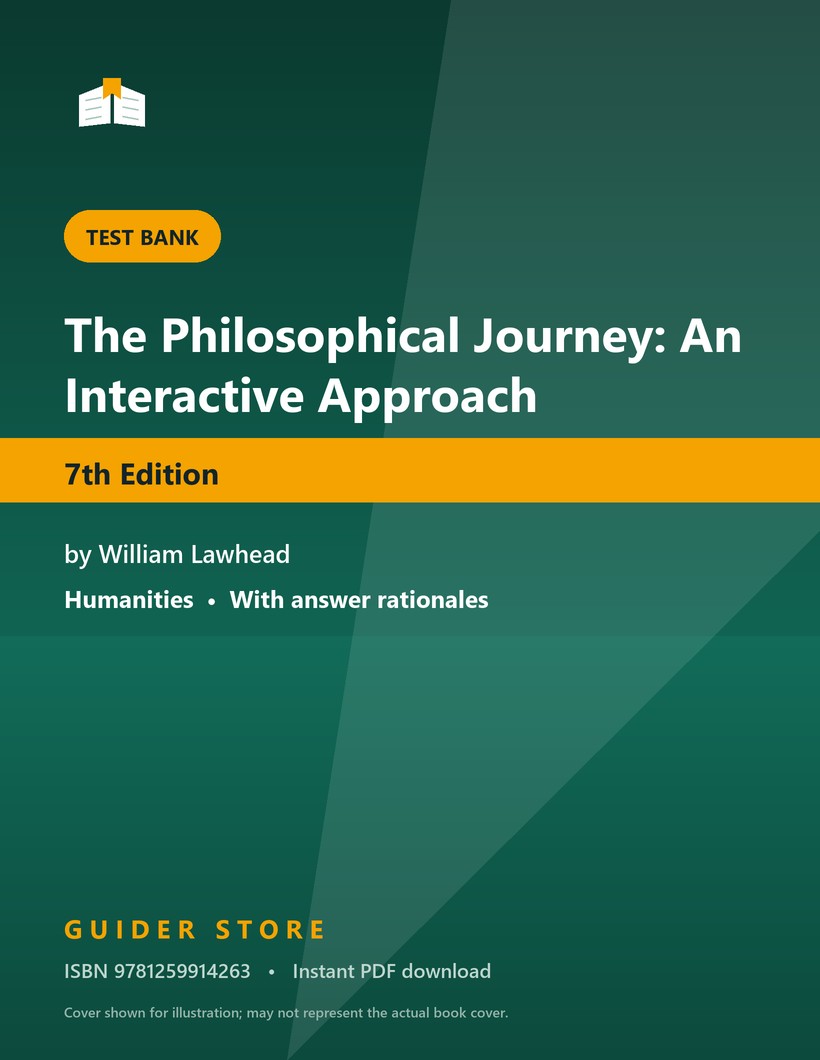


Some textbooks explain a position and then name it. The Philosophical Journey: An Interactive Approach, 7th Edition by William Lawhead reverses that order deliberately: it stops you mid-chapter with a thought experiment, makes you commit to an answer, and only afterwards tells you which philosopher you have just agreed with. The method works, and it changes what an exam can ask. Instead of asking who held a view, the questions describe a position in ordinary language and ask what follows from it — which means the students who did the thought experiments honestly are at a real advantage.
Why this test bank helps
Getting the answer is half of it; being able to run the argument forward and see what it commits you to is the other half. Each item here is followed by a written rationale that takes the position apart — the premise doing the work, the consequence that makes it uncomfortable, the neighboring view it is most often confused with. That is precisely the skill the book’s interactive method is training, and questions are the only realistic way to practice it alone.
What’s inside
- Questions organized by the book’s chapters, following the sequence of philosophical problems as the course meets them.
- A mix of formats — multiple choice, true/false, matching positions to their implications, and short argument-evaluation prompts.
- A written rationale under every question, tracing the argument instead of restating the label.
- Items on the reasoning skills chapter as well as the content chapters, since courses test both.
- One organized PDF, available the moment checkout completes.
Topics covered
- Doing philosophy — the examined life, the structure of arguments, deductive validity and soundness, inductive strength and informal fallacies.
- Theory of knowledge — skepticism, rationalism and empiricism, Kant’s constructivism, and the relation between belief, truth and justification.
- Philosophy of mind — substance dualism, behaviorism, the identity theory, functionalism, and the questions raised by artificial intelligence.
- Freedom and determinism — hard determinism, libertarian free will, compatibilism, and the implications of each for moral responsibility.
- Philosophy of religion — cosmological, teleological and ontological arguments, the problem of evil, faith and evidence.
- Metaphysics — realism and idealism about the external world, personal identity over time, and the mind-body relation.
- Moral philosophy — relativism, egoism, utilitarian and Kantian theories, virtue ethics and the grounds of moral obligation.
- Political philosophy and meaning — justice, liberty and the state, and philosophical accounts of a meaningful life.
Who it’s for
Students taking introduction to philosophy from this edition — those meeting a humanities requirement, and prospective majors who need the standard problems and the vocabulary of argument before advancing.
How to use it (the right way)
Do the book’s thought experiments before you read the section that resolves them; the method only works if you commit to an answer first. Then attempt a block of questions closed-book, and for each miss, identify whether you misread the position or accepted a premise you did not notice. This is a study aid, to be used in line with your institution’s academic-integrity policy — preparation and self-assessment rather than a shortcut around the reading and the papers, and never material taken into a graded assessment.
Sample question (shows the format — your download contains the full set)
Q. A philosopher holds that every human choice is fully caused by prior events, and also that a person acts freely whenever the action flows from their own desires without external compulsion. This position is:
- A. Hard determinism.
- B. Libertarian free will.
- C. Compatibilism.
- D. Fatalism.
Answer: C. Compatibilism accepts universal causation and then redefines freedom as acting from one’s own desires without coercion, so determinism and moral responsibility can both stand. A accepts the first claim and rejects the second, concluding that freedom and responsibility are illusions. B rejects the first claim, insisting that some choices are not fully determined by prior causes. D is a different thesis altogether: that certain outcomes will occur no matter what anyone chooses, which does not depend on a causal chain running through the agent’s own desires.
Edition & format
- Matches: The Philosophical Journey: An Interactive Approach, 7th Edition, by William Lawhead (ISBN 9781259914263).
- Format: Digital PDF, delivered instantly after checkout.
- Access: Lifetime — re-download from your account whenever you need it.
Chapter order and the interactive exercises change between editions. Please confirm the edition and ISBN above match your assigned text before buying.
Frequently asked questions
Is this the current edition? It is prepared for the 7th Edition specifically. Other editions are listed separately, since the readings and exercises were revised.
How do I receive it? The download appears on the confirmation page as soon as checkout completes and stays available in your account.
Do all the questions include rationales? Yes. Every item includes a written explanation that follows the argument and names what separates the near-miss options.
Is using a test bank allowed? As private practice it is like any other question set. Follow your institution’s academic-integrity policy and keep it out of graded assessments.
More titles are listed in History & Humanities Test Banks.



Reviews
There are no reviews yet.