
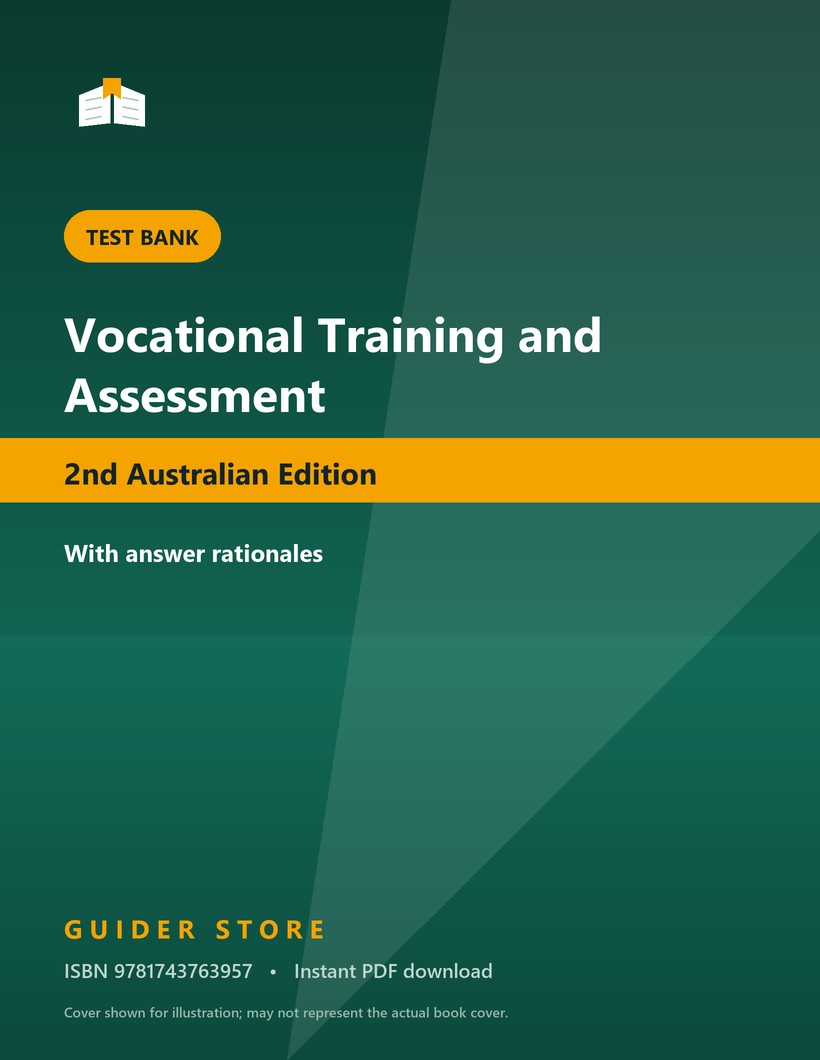

Competency-based assessment behaves nothing like the marking most students have met before: no curve, no partial credit, and only two outcomes — competent, or not yet competent. Vocational Training and Assessment, 2nd Australian Edition teaches that logic together with the regulatory scaffolding around it, and the assessment tests the vocabulary precisely. Confusing the principles of assessment with the rules of evidence, or a training package with a qualification, costs marks that re-reading the chapter will not recover, because the terms sit close enough together to feel interchangeable and are not.
Why this test bank helps
In a competency framework the reasoning matters more than the verdict, and a bare answer key hides exactly that. Each question here is followed by an explanation naming the standard or principle it turns on: why evidence collected years ago raises currency rather than authenticity, why an adjustment can support a learner without lowering the benchmark. That is also the habit the job demands, since an assessor has to justify a judgment to a validator rather than simply record it.
What’s inside
- Questions ordered by the chapters of the book, so weekly reading maps to a defined block of practice.
- A mix of definitional items and short applied scenarios of the kind used in assessor training.
- A written rationale beneath every question, naming the principle or standard being applied.
- Emphasis on assessment design, evidence and validation, where the terminology traps sit.
- One organized PDF, available to download as soon as checkout completes.
Topics covered
- Training packages and units of competency — elements, performance criteria and how a qualification is packaged.
- The Australian Qualifications Framework — level descriptors and what separates a Certificate IV from a Diploma.
- Principles of assessment — validity, reliability, flexibility and fairness, and what each one actually constrains.
- Rules of evidence — valid, sufficient, authentic and current, and the judgment each supports.
- Designing assessment tools — instruments, instructions, benchmarks and mapping back to the unit.
- Recognition of prior learning — gathering evidence, questions of currency, and credit transfer.
- Validation and moderation — pre- and post-assessment processes and who may take part in them.
- Learner support — language, literacy and numeracy needs, and adjustment that leaves the standard intact.
Who it’s for
Candidates working through a Certificate IV in Training and Assessment, trainers and assessors employed by a registered training organisation, and education, human resources and workplace-learning students studying the Australian vocational system from this edition.
How to use it (the right way)
Work through the chapter and put its terms into your own words before answering anything, because this subject punishes recognition memory in particular. Then attempt a block closed-book, and for every scenario item write down the principle you relied on before reading the rationale. It is a study aid, to be used in line with your institution’s academic-integrity policy, not a way around the coursework or the evidence you are required to produce yourself.
Sample question (shows the format — your download contains the full set)
Q. An assessor is offered a portfolio of workplace evidence the candidate produced four years ago, in a role using equipment that has since been replaced. Which rule of evidence is most directly in question?
- A. Validity
- B. Sufficiency
- C. Authenticity
- D. Currency
Answer: D. Currency asks whether the evidence demonstrates competence now, and equipment that has since been replaced puts precisely that in doubt. Validity would be the issue if the evidence addressed something other than the unit requirements. Sufficiency concerns quantity and breadth rather than age. Authenticity asks whether the candidate produced the work themselves, which nothing in the scenario disputes.
Edition & format
- Matches: Vocational Training and Assessment, 2nd Australian Edition (ISBN 9781743763957).
- Format: Digital PDF, delivered instantly after checkout.
- Access: Lifetime — re-download from your account whenever you need it.
Regulatory references and chapter structure change between editions of this title. Please confirm the edition above is the one named on your unit outline before you buy.
Frequently asked questions
Is this the current edition? This set is prepared against the 2nd Australian Edition. Standards and terminology in the vocational sector are revised periodically, so match the edition on your unit outline.
How do I receive it? A download link appears the moment payment completes, both on the confirmation screen and in your account. Nothing is posted to you.
Do all the questions include rationales? Yes. Each question is followed by an explanation of why the answer is what it is, rather than a bare letter.
Is using a test bank allowed? Treated as practice material it works like any other revision resource. Follow your provider’s academic-integrity rules, and keep it out of any graded assessment.
Related study aids are in Counseling & Education Test Banks.


Reviews
There are no reviews yet.