
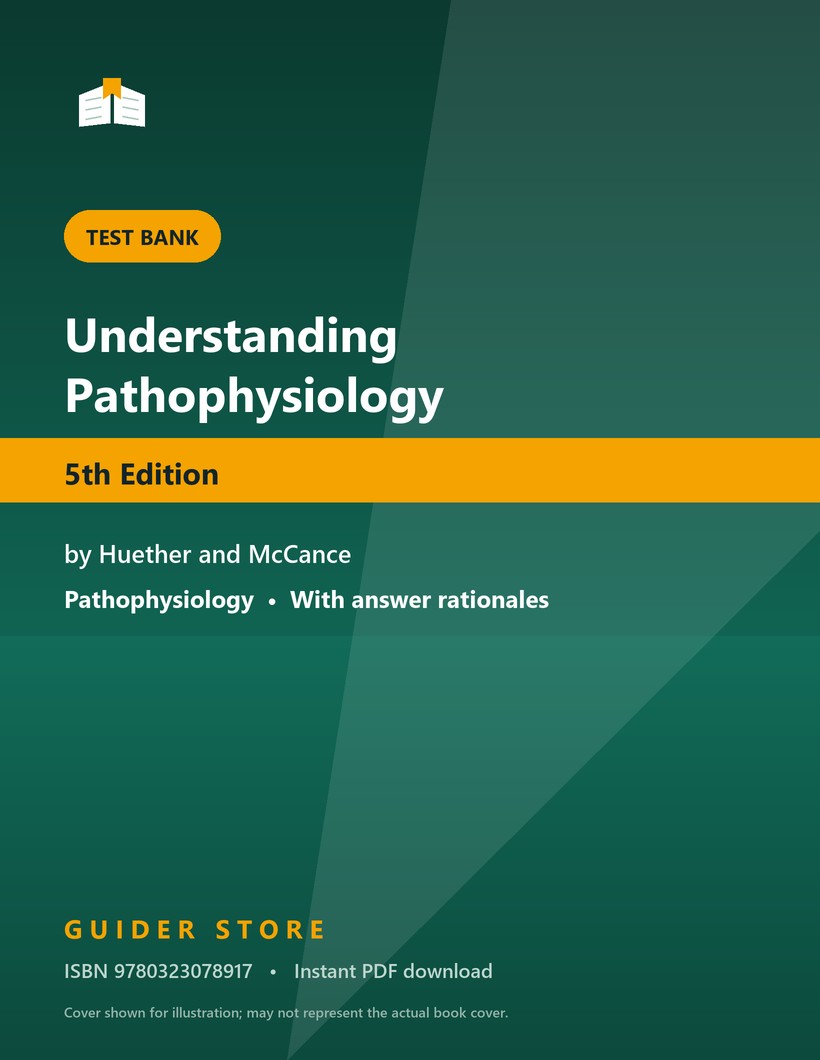


Pathophysiology is where anatomy, physiology, and clinical reasoning collide — and it’s the course that separates students who memorize from students who truly understand disease. Huether and McCance’s Understanding Pathophysiology asks you to trace how a single altered mechanism (a mutated gene, a blocked artery, an overactive immune response) ripples outward into signs, symptoms, and lab values. This test bank is built to match the 5th Edition so your self-testing mirrors the way this specific book frames disease processes, from cellular injury all the way to complex multi-system disorders.
Why this test bank helps
Reading a chapter on the renin-angiotensin-aldosterone system feels clear until an exam question asks you to predict what happens when it’s chronically activated. This resource is rationale-first: every item includes an explanation of why the correct answer works mechanistically and why each distractor fails. That turns passive review into active reasoning practice — the exact skill pathophysiology exams (and later NCLEX-style application questions) actually measure.
What’s inside
- Questions organized to follow the chapter flow of the 5th Edition, so you can study alongside the section you just read.
- Multiple-choice items written in exam and NCLEX-style application formats relevant to disease mechanisms.
- A written rationale for every question — correct answer justified, distractors explained.
- Coverage that spans foundational cell biology through organ-system and multi-system pathophysiology.
- Delivered as an instant, searchable PDF you can open on any device.
Topics covered
- Cellular injury, adaptation, and mechanisms of cell death
- Fluid, electrolyte, acid-base, and osmotic balance disturbances
- Inflammation, immunity, hypersensitivity, and self-tolerance
- Genes, environment, and the biology of cancer
- Cardiovascular and hematologic alterations, including shock and clotting disorders
- Pulmonary and respiratory dysfunction
- Renal and urinary tract disorders
- Endocrine, neurologic, and musculoskeletal pathophysiology
- Reproductive, digestive, and integumentary system alterations
Who it’s for
Nursing and allied-health students taking an undergraduate pathophysiology course that uses Huether & McCance, plus RN-to-BSN learners and anyone building the mechanistic foundation that later shows up on the NCLEX and other licensure exams. It is especially useful if your instructor writes application-level questions rather than pure recall.
How to use it (the right way)
Study the chapter first, then attempt the matching questions closed-book. When you miss one, don’t just note the letter — read the rationale and re-trace the mechanism in your own words until you could explain it to a classmate. Use it as a diagnostic tool to find weak systems before your exam, not a shortcut around learning. Academic-integrity note: this is a personal study and self-assessment aid. Do not present it as your own graded work, and always follow your institution’s academic honesty policy. It supports understanding — it does not guarantee any grade.
Sample question
(Shows the format — your download contains the full set.)
Q. A patient with long-standing left-sided heart failure develops progressive shortness of breath and crackles on lung auscultation. Which mechanism best explains the pulmonary findings?
- A. Decreased pulmonary capillary hydrostatic pressure reducing gas exchange
- B. Increased pulmonary capillary hydrostatic pressure forcing fluid into the alveoli
- C. Loss of plasma oncotic pressure from hepatic protein synthesis failure
- D. Bronchoconstriction caused by excess aldosterone secretion
Answer: B. In left-sided failure, the left ventricle cannot eject blood effectively, so blood backs up into the pulmonary circulation. The resulting rise in pulmonary capillary hydrostatic pressure pushes fluid across the capillary membrane into the interstitium and alveoli, causing pulmonary edema, dyspnea, and crackles. A is the opposite of what occurs. C describes a mechanism tied to hypoalbuminemia rather than the primary problem here. D is not a recognized effect of aldosterone and does not explain alveolar fluid.
Edition & format
- Matches: Test Bank for Understanding Pathophysiology, 5th Edition by Huether and McCance
- ISBN-13: 9780323078917
- Format: Digital PDF, delivered instantly after checkout
- Access: Lifetime — re-download anytime from your account
Please confirm the edition and ISBN match your course before buying — message us and we’ll check.
Frequently asked questions
Does this include an answer rationale for every question? Yes. Each item comes with an explanation of the correct answer and why the other options are incorrect, so you learn the mechanism, not just the letter.
Is this the textbook or the actual pathophysiology content? No. This is a test bank of practice questions and rationales designed to accompany the textbook. You still need the book and your course materials to learn the content fully.
How and when do I receive it? It’s a digital PDF delivered instantly after checkout, and you can re-download it anytime from your account.
Will using this improve my grade? It can strengthen your understanding and exam readiness, but no study aid can promise a grade. Your results depend on how you study and your own preparation.
Explore more Pathophysiology Test Banks — all with instant PDF delivery and answer rationales.





Reviews
There are no reviews yet.