
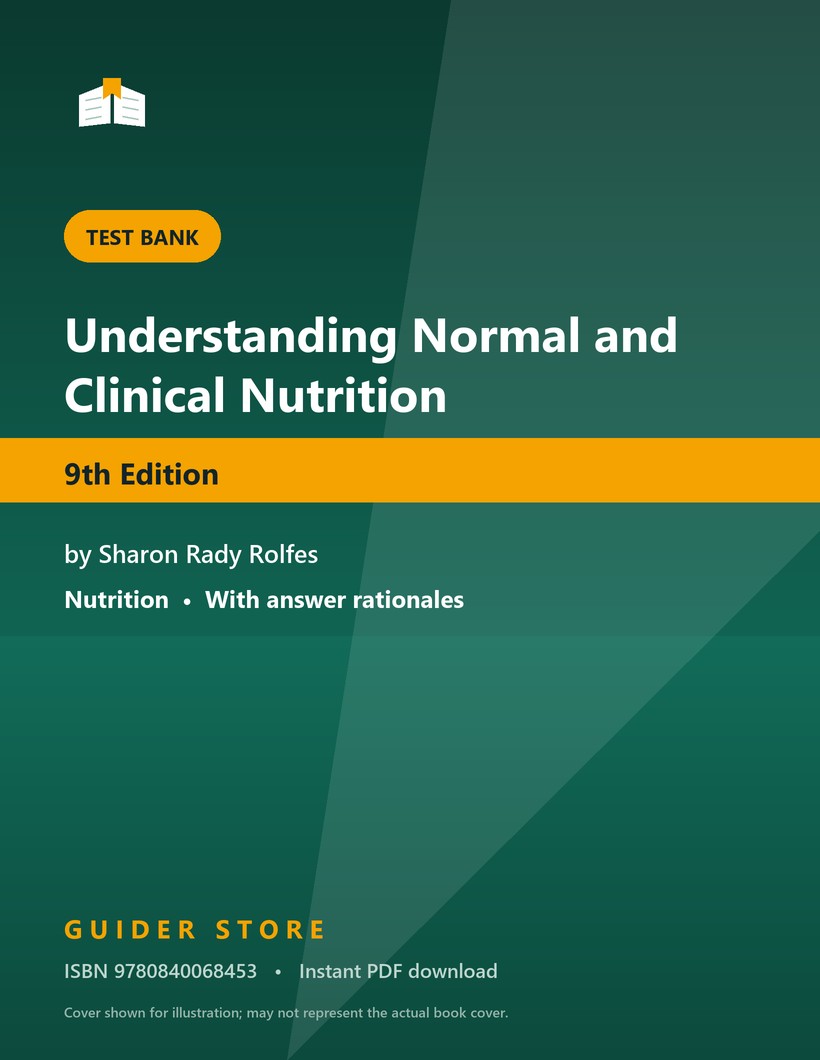


Understanding Normal and Clinical Nutrition asks you to hold two worlds in your head at once: the biochemistry of how the body handles carbohydrate, fat, and protein, and the bedside reality of feeding a patient who is critically ill, pregnant, or living with diabetes. Lectures move fast, and it is easy to memorise a nutrient’s function without ever being tested on how you would apply it to a real case. This test bank, matched to the 9th Edition by Sharon Rady Rolfes, gives you exam-style practice on exactly the concepts your instructor is likely to assess — each question paired with a full rationale so you understand the reasoning, not just the letter.
Why this test bank helps
Nutrition science rewards connections: why fibre affects glycaemic response, why protein needs rise with surgical stress, how a vitamin deficiency shows up as a specific clinical sign. Passive re-reading rarely builds those links. Answering a question, checking whether you were right, and then reading why forces active recall and exposes the gaps you would otherwise carry into the exam. Every item here is rationale-first, so a wrong answer becomes a targeted mini-lesson instead of a dead end.
What’s inside
- Questions organised to follow the flow of the textbook, from digestion and the energy-yielding nutrients through vitamins, minerals, and clinical application chapters
- Multiple-choice items in the style used on nutrition course exams and relevant to allied-health and nursing coursework
- A clear rationale for every question — explaining the correct choice and why the distractors fall short
- Coverage of both the “normal” foundations (metabolism, requirements, assessment) and the “clinical” half (diet therapy across conditions)
- Delivered as an instant, searchable PDF you can study on any device
Topics covered
- Carbohydrates, lipids, and protein: digestion, absorption, and metabolism
- Energy balance, weight management, and body composition
- The fat-soluble and water-soluble vitamins and their deficiency signs
- Water and the major and trace minerals, including fluid and electrolyte balance
- Nutrition through the life cycle: pregnancy, lactation, infancy, childhood, and aging
- Nutrition assessment and the diet–health connection
- Enteral and parenteral nutrition support
- Medical nutrition therapy for conditions such as diabetes, cardiovascular disease, and renal disease
Who it’s for
This is built for students taking an introductory or intermediate nutrition course — commonly nursing, dietetics, nutrition science, and allied-health majors — who are using the Rolfes 9th Edition and want realistic self-assessment before midterms and finals. It is equally useful for anyone reviewing normal and clinical nutrition fundamentals ahead of a comprehensive or licensure-related exam.
How to use it (the right way)
Study a chapter first, then attempt the matching questions closed-book to simulate exam conditions. Mark anything you guessed, read the rationale even when you were correct, and revisit weak areas after a day or two so recall has to work. Treat this as a self-assessment and study aid — a way to check your understanding, not a substitute for your reading, lectures, or clinical practice. Please follow your institution’s academic-integrity policy and do not use these materials during an actual graded exam.
Sample question
(Shows the format — your download contains the full set.)
Q. A patient with type 2 diabetes asks why the dietitian recommends oats and legumes over white bread for breakfast. Which property of these foods best explains the recommendation?
- A. They contain no carbohydrate
- B. Their soluble fibre slows glucose absorption, blunting the post-meal blood glucose rise
- C. They are pure protein sources
- D. They eliminate the need for insulin entirely
Answer: B. Soluble fibre forms a viscous gel that slows gastric emptying and glucose absorption, moderating the post-meal glucose response — a key reason low-glycaemic, high-fibre choices are favoured in diabetes management. A is wrong because both foods are carbohydrate-containing. C is wrong because they are primarily carbohydrate sources, not pure protein. D overstates the effect; diet supports glucose control but does not replace prescribed insulin therapy.
Edition & format
- Matches: Test Bank for Understanding Normal and Clinical Nutrition 9th Edition by Sharon Rady Rolfes
- ISBN-13: 9780840068453
- Format: Digital PDF, delivered instantly after checkout
- Access: Lifetime — re-download anytime from your account
Please confirm the edition and ISBN match your course before buying — message us and we’ll check.
Frequently asked questions
Does this include answer explanations or just the answers? Every question comes with a written rationale that explains the correct choice and why the other options are incorrect, so you learn the reasoning behind each answer.
Is this the same as the textbook or an official study guide? No. This is an independent test-bank study aid designed to complement the 9th Edition; it is not the textbook and is not published by or affiliated with the textbook’s publisher.
Will this guarantee a better grade? We cannot promise any grade or outcome. It is a practice and self-assessment tool — how much it helps depends on how you use it alongside your own study.
How do I receive the file? It is delivered as a digital PDF immediately after checkout, and you can re-download it anytime from your account.
Explore more Nutrition Test Banks — all with instant PDF delivery and answer rationales.
Other editions of this book: 10th Edition


Reviews
There are no reviews yet.