
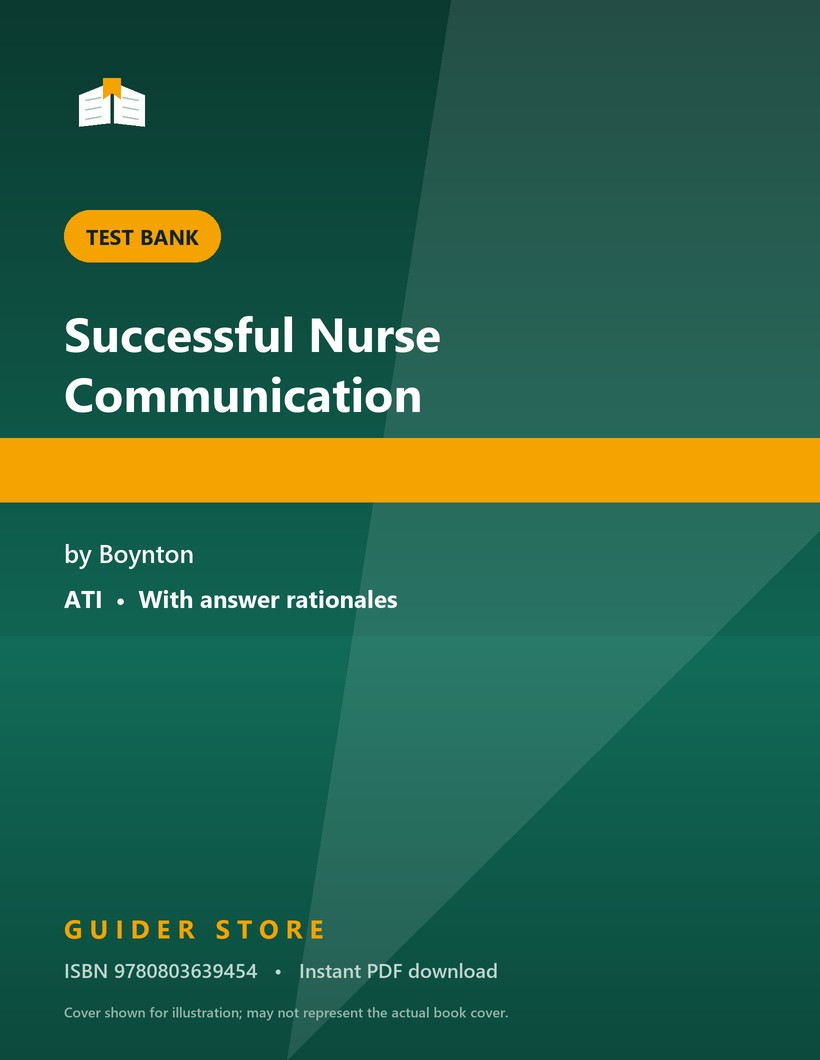


Nursing is a human profession before it is a clinical one, and the moments that decide a patient’s experience are often conversations — breaking difficult news, calming an anxious family, handing off a complex case, or de-escalating an upset visitor. Successful Nurse Communication teaches the safe, professional, and person-centered communication that underpins every one of those moments, yet its concepts (therapeutic techniques, cultural humility, conflict management, documentation, interprofessional collaboration) are easy to read and hard to recall under pressure. This matched test bank turns that reading into active recall so the principles are ready when a real conversation is on the line.
Why this test bank helps
Communication content is deceptively soft — it feels intuitive until an exam asks you to choose the single most therapeutic response, or to identify the barrier a nurse just created. Every question here is built around a rationale, not just a key. You learn why an open-ended, empathetic reply outperforms reassurance, why “why” questions can feel accusatory, and why closed-loop communication prevents handoff errors. Reasoning through the explanations builds the judgment that carries from the test into the unit.
What’s inside
- Questions organized to follow the book’s progression — from communication foundations through therapeutic techniques, conflict, culture, and professional documentation.
- Exam-style, NCLEX-relevant formats: single-best-response, scenario/case items, prioritization (“best therapeutic response”), and select-all-that-apply where the topic fits.
- A clear rationale for every question — explaining the correct choice and why each distractor is a communication barrier or a lesser response.
- Coverage of verbal and nonverbal cues, active listening, and empathy in practice.
- Delivered as an instant PDF you can study on any device, print, or annotate.
Topics covered
- Therapeutic communication techniques and common non-therapeutic barriers
- Active listening, empathy, and reading nonverbal cues
- Communicating with anxious, angry, grieving, or reluctant patients and families
- Cultural humility and communicating across language and health-literacy differences
- Conflict management, assertiveness, and de-escalation
- Interprofessional and team communication, including structured handoff (e.g., SBAR)
- Professional documentation, charting, and communication ethics
- Communication technology, telehealth etiquette, and privacy considerations
Who it’s for
Pre-licensure BSN and ADN students taking a nursing communication, professional practice, or fundamentals course that uses Boynton’s text; students preparing for the communication and psychosocial-integrity content on the NCLEX-RN; and returning or bridge-program nurses who want to sharpen therapeutic-communication judgment before clinicals.
How to use it (the right way)
Read the chapter first, then answer a block of questions closed-book to expose weak spots. For each item, read the rationale even when you were right — the explanation of why the distractors fail is where the learning lives. Track missed items by theme (barriers, culture, conflict) and revisit them before your exam. Use this as a study and self-assessment aid only. It is not a copy of any live exam and is not a substitute for your assigned reading, faculty guidance, or clinical practice. Follow your school’s academic-integrity policy; the goal is genuine mastery, not shortcuts, and no study tool can promise a specific grade.
Sample question
(Shows the format — your download contains the full set.)
Q. A patient newly diagnosed with a serious illness says, “I just don’t think I can handle this.” Which nurse response is the most therapeutic?
- A. “Don’t worry — the doctors here are the best, so you’ll be fine.”
- B. “It sounds like this news feels overwhelming right now. Can you tell me more about what worries you most?”
- C. “Why do you feel that way? Plenty of people get through this.”
- D. “You need to stay positive — a good attitude is half the battle.”
Answer: B. Option B acknowledges the patient’s feeling and uses an open-ended invitation to explore concerns — a core therapeutic technique. Option A offers false reassurance, which shuts down the patient’s expression. Option C’s “why” question can sound accusatory and minimizes the feeling by comparing the patient to others. Option D dismisses the emotion and imposes the nurse’s agenda, a common barrier to communication.
Edition & format
- Matches: Test Bank For Successful Nurse Communication By Boynton
- ISBN-13: 9780803639454
- Format: Digital PDF, delivered instantly after checkout
- Access: Lifetime — re-download anytime from your account
Please confirm the edition and ISBN match your course before buying — message us and we’ll check.
Frequently asked questions
Does this include an answer rationale for every question? Yes. Each question is paired with an explanation of the correct answer and why the other options are less therapeutic or incorrect.
Is this the same as my actual course exam? No. It is an independent study and self-assessment resource keyed to the textbook’s topics — not a copy of any instructor’s live exam.
How do I receive it? It’s an instant digital PDF download available right after checkout, with lifetime re-download from your account.
Will it guarantee a better grade? No honest tool can promise a grade. Used for active recall and rationale review, it can strengthen the communication judgment your exams assess.
Explore more Nursing Test Banks test banks — all with instant PDF delivery and answer rationales.

Reviews
There are no reviews yet.