
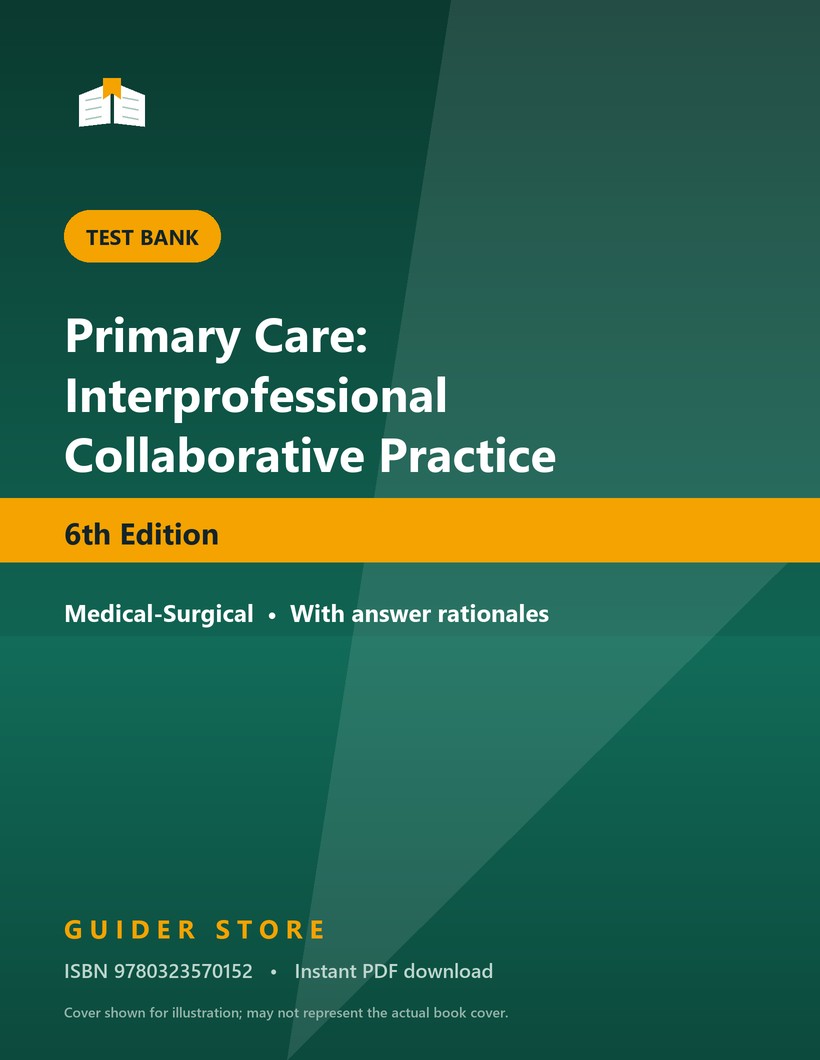


Primary care asks you to be a generalist who can reason across the whole lifespan — a chest complaint in a 68-year-old, a rash on a toddler, a well-woman visit, a mental-health screen, and a chronic-disease follow-up can all land in the same clinic morning. Primary Care: Interprofessional Collaborative Practice, 6th Edition is dense with that breadth, and the hardest part of studying it is holding differential diagnosis, evidence-based management, and interprofessional coordination in your head at once. This test bank turns the textbook’s chapters into focused self-assessment so you can find the gaps before a graded exam or a real patient does.
Why this test bank helps
Passive re-reading feels productive but rarely sticks. Answering a question forces you to commit to a diagnosis or a plan, and the rationale attached to every item tells you why that choice fits the presentation and why the tempting alternatives do not. That rationale-first approach is how you move from memorising facts to the clinical reasoning primary care actually demands — weighing history, exam findings, red flags, and the appropriate next step.
What’s inside
- Questions organised to follow the textbook’s chapter and system-based structure, so you can drill one topic at a time
- Case-based and application-style items in the format used on advanced-practice and certification exams, not just simple recall
- A written rationale for every question — explaining the correct answer and the reasoning behind the distractors
- Coverage spanning assessment, differential diagnosis, pharmacologic and non-pharmacologic management, patient education, and interprofessional referral
- Instant digital PDF you can review on any device, at your own pace
Topics covered
- Foundations of primary care and interprofessional collaborative practice
- Health promotion, screening, and preventive care across the lifespan
- Common presentations by body system — cardiovascular, respiratory, GI, GU, musculoskeletal, neurologic, and dermatologic
- Management of chronic conditions such as diabetes, hypertension, and asthma
- Care of children, adolescents, women, men, and older adults
- Mental and behavioral health concerns in the primary care setting
- Acute and episodic complaints and appropriate triage or referral
- Evidence-based prescribing, patient education, and shared decision-making
Who it’s for
This is built for nurse practitioner and advanced-practice students, family and adult-gerontology primary care trainees, PA students, and clinicians using this specific textbook in a diagnosis-and-management course. It is also useful revision for anyone preparing for a primary-care-focused certification exam who wants practice that mirrors the textbook’s content and the exam’s style.
How to use it (the right way)
Read the assigned chapter first, then work the matching questions closed-book to simulate exam conditions. Score yourself, and for anything you miss, read the rationale and return to the textbook section it points to. Revisit weak topics a few days later so the reasoning consolidates. Use this as a study and self-assessment aid only — it is not a substitute for your coursework, clinical training, or your program’s assessments, and it should never be brought into or used during an actual exam. Honest preparation is what carries over to patient care.
Sample question
(Shows the format — your download contains the full set.)
Q. A 54-year-old man presents to primary care with a 3-week history of a persistent dry cough that began shortly after he was started on a new medication for newly diagnosed hypertension. He has no fever, wheeze, or sputum, and his chest exam is clear. Which medication is the most likely cause?
- A. Amlodipine
- B. Lisinopril
- C. Hydrochlorothiazide
- D. Metoprolol
Answer: B. A dry, non-productive cough is a well-recognised side effect of ACE inhibitors such as lisinopril, thought to result from accumulation of bradykinin and other mediators; it typically resolves after stopping the drug, and an ARB is a common alternative. Amlodipine (A), a calcium channel blocker, more often causes peripheral edema rather than cough. Hydrochlorothiazide (C), a thiazide diuretic, is not associated with cough. Metoprolol (D), a beta-blocker, can cause fatigue or bradycardia and may worsen bronchospasm in reactive airway disease, but a new dry cough points specifically to the ACE inhibitor.
Edition & format
- Matches: Test Bank For Primary Care: Interprofessional Collaborative Practice 6th Edition
- ISBN-13: 9780323570152
- Format: Digital PDF, delivered instantly after checkout
- Access: Lifetime — re-download anytime from your account
Please confirm the edition and ISBN match your course before buying — message us and we’ll check.
Frequently asked questions
Does this include an answer rationale for every question? Yes. Each question comes with an explanation of the correct answer and, where relevant, why the other options are wrong, so you learn the reasoning rather than just the letter.
Is this the textbook itself? No. This is a test bank of exam-style practice questions with rationales, meant to be used alongside your copy of the textbook — not a replacement for it.
How do I receive the file? It is a digital PDF delivered instantly after checkout, and you can re-download it anytime from your account for lifetime access.
Will this guarantee a better grade? No honest resource can promise that. It is a self-assessment tool that helps you find and close knowledge gaps — your results still depend on your own study and clinical understanding.
Explore more Medical-Surgical (Med-Surg) Test Banks — all with instant PDF delivery and answer rationales.



Reviews
There are no reviews yet.