
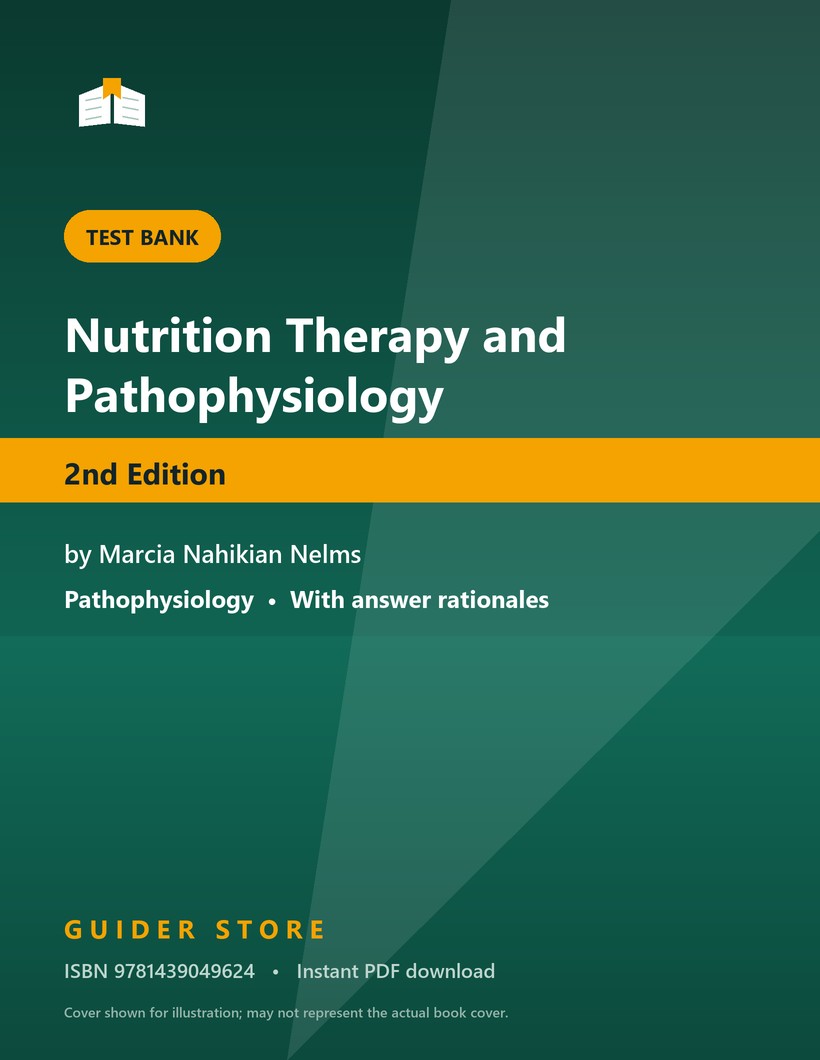

Nutrition Therapy and Pathophysiology asks you to hold two demanding subjects at once: the disease process happening inside the body, and the nutrition intervention that supports or corrects it. It is not enough to memorise a diet sheet — you have to reason from the underlying pathophysiology to the metabolic consequences, then to the medical nutrition therapy (MNT) that follows. This test bank, matched to the 2nd Edition by Marcia Nahikian-Nelms, gives you exam-style practice that trains exactly that clinical reasoning.
Why this test bank helps
The real difficulty in this course is connective, not factual. Knowing that the pancreas produces insulin is easy; explaining why a patient with cirrhosis needs adjusted protein, or how renal failure changes potassium and phosphorus targets, is where students lose marks. Every item leads with a rationale, so you learn why an answer is correct and why the tempting distractors are wrong — turning passive review into active diagnosis of your own knowledge gaps.
What’s inside
- Questions organised to follow the textbook’s chapter flow, from nutrition assessment through organ-system disease chapters
- Multiple-choice, application, and case-based items in the style used on RD/DTR and nursing pathophysiology exams
- A written rationale for every question, explaining the correct choice and the errors behind each distractor
- Calculation-style prompts where the subject demands them (energy needs, protein estimates, fluid and electrolyte targets)
- Instant digital PDF — searchable, printable, ready at checkout
Topics covered
- Nutrition assessment, screening, and the Nutrition Care Process
- Energy balance, macronutrient and micronutrient metabolism
- Fluid, electrolyte, and acid–base physiology in disease
- Diabetes mellitus and disorders of glucose regulation
- Gastrointestinal and hepatobiliary disease (including cirrhosis and pancreatitis)
- Renal disease and dialysis-related nutrition therapy
- Cardiovascular and pulmonary conditions
- Cancer, critical illness, and metabolic stress; enteral and parenteral nutrition support
Who it’s for
This is built for dietetics and nutrition students working through a medical nutrition therapy or pathophysiology sequence, plus nursing and allied-health students who need to connect disease processes to nutritional care. It is useful for course midterms and finals, and for building the reasoning that RD/RDN and DTR credentialing exams expect. It is a study aid, not a replacement for your textbook, lectures, or clinical training.
How to use it (the right way)
Work one chapter at a time. Attempt each question before reading the rationale, note your reasoning, then compare it against the explanation to see where your logic broke down. Re-test missed items a few days later so the material moves into long-term memory. Use this to check your understanding and rehearse exam formats — not to circumvent graded assessments. Academic integrity matters: never submit these questions or answers as your own coursework, and always follow your institution’s honour code. We make no promises about grades; the payoff comes from honest practice.
Sample question
(Shows the format — your download contains the full set.)
Q. A patient with decompensated cirrhosis presents with confusion, asterixis, and an elevated serum ammonia level. Which nutrition therapy adjustment is most appropriate for managing hepatic encephalopathy?
- A. Restrict all dietary protein indefinitely to lower ammonia production
- B. Provide adequate protein, often favouring vegetable and dairy sources and branched-chain amino acids as tolerated
- C. Eliminate carbohydrates to reduce hepatic workload
- D. Initiate a high-sodium diet to correct fluid shifts
Answer: B. Current practice avoids prolonged protein restriction, which worsens malnutrition and muscle wasting without reliably improving outcomes; adequate protein is provided, with vegetable and dairy sources and branched-chain amino acids often better tolerated. A is outdated and harmful because sustained restriction promotes catabolism. C is wrong — carbohydrates are a key energy source. D is incorrect because cirrhosis with ascites typically calls for sodium restriction, not a high-sodium diet.
Edition & format
- Matches: Test Bank for Nutrition Therapy and Pathophysiology 2nd Edition by Marcia Nahikian Nelms
- ISBN-13: 9781439049624
- Format: Digital PDF, delivered instantly after checkout
- Access: Lifetime — re-download anytime from your account
Please confirm the edition and ISBN match your course before buying — message us and we’ll check.
Frequently asked questions
Does this include answer rationales, or just an answer key? Every question comes with a written rationale that explains the correct choice and why the other options are wrong, so you learn the reasoning, not just the letter.
Will this match my exact textbook? It is prepared to align with the 2nd Edition by Marcia Nahikian-Nelms. Editions can differ, so confirm your title and ISBN against the details above, or message us and we’ll verify before you buy.
How and when do I receive it? It is a digital PDF delivered instantly after checkout, and you can re-download it anytime from your account.
Is using a test bank allowed? As a personal study and self-assessment tool, yes. Do not submit its content as graded work and always follow your school’s academic-integrity policy.
Explore more Pathophysiology Test Banks — all with instant PDF delivery and answer rationales.
Other editions of this book: 3Rd Edition



Reviews
There are no reviews yet.