
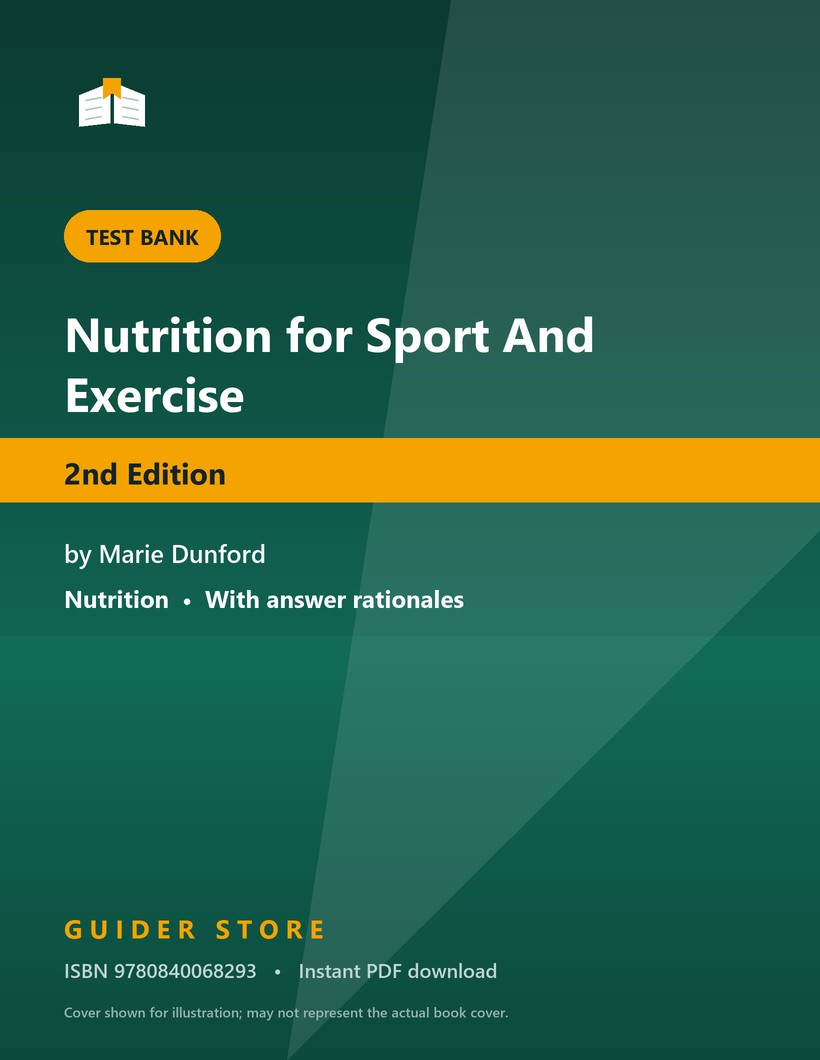
Sports nutrition sits at the crossroads of biochemistry, exercise physiology, and real-world coaching — and that is exactly what makes the course so demanding. You are asked to explain how carbohydrate loading changes muscle glycogen, calculate an athlete’s energy availability, judge whether a supplement claim holds up, and translate all of it into a practical fueling plan. This test bank, matched to Nutrition for Sport and Exercise, 2nd Edition by Marie Dunford, gives you a focused way to pressure-test that knowledge before it counts on an exam.
Why this test bank helps
Memorizing macronutrient tables rarely survives contact with an applied exam question. Every item here is built around a rationale, so you learn why a fat-adaptation strategy suits an ultra-endurance athlete but not a sprinter, or why a positive nitrogen balance matters during resistance training. Reading the reasoning — not just the letter of the correct answer — is what turns recall into the kind of understanding that transfers to new scenarios.
What’s inside
- Questions organized to follow the flow of the textbook, from energy systems through the individual nutrients to applied fueling for training and competition.
- Exam-style formats relevant to this subject: applied calculation prompts (energy expenditure, fluid replacement, macronutrient targets), concept-check multiple choice, and scenario questions set in real training contexts.
- A written rationale for every question explaining the correct choice and the common distractors.
- Instant PDF download — open it on any device and start reviewing immediately after checkout.
Topics covered
- Bioenergetics and the ATP-PCr, glycolytic, and oxidative energy systems during exercise
- Carbohydrate needs, glycogen storage, glycemic timing, and loading strategies
- Dietary fat, fat metabolism, and its role in endurance performance
- Protein, amino acids, and nitrogen balance for training adaptation and recovery
- Fluid balance, hydration, electrolytes, and thermoregulation
- Vitamins, minerals, and micronutrient concerns for active populations (e.g., iron, calcium, antioxidants)
- Body composition, weight management, energy availability, and disordered-eating risks
- Ergogenic aids and dietary supplements — evidence, safety, and regulation
- Nutrition across the lifespan and for special athletic populations
Who it’s for
This set is aimed at students in sport and exercise nutrition, kinesiology, exercise science, athletic training, and dietetics courses that assign Dunford’s text, as well as candidates reviewing applied nutrition concepts before certification-style exams. If your syllabus lists Nutrition for Sport and Exercise, 2nd Edition, the sequencing here should feel familiar chapter to chapter.
How to use it (the right way)
Use it as active self-assessment, not as a shortcut. Read the relevant chapter first, attempt a block of questions with the answers hidden, then study every rationale — including for the items you got right — to expose shaky reasoning. Re-test after a few days to check retention. Please treat this as a personal study aid only: it is not a copy of any graded exam, and you should follow your institution’s academic-integrity policy and your instructor’s rules. No study tool can guarantee a grade; consistent, honest practice is what builds real competence.
Sample question
(Shows the format — your download contains the full set.)
Q. An endurance runner completes a 90-minute race in hot conditions and finishes 2 kg lighter than her pre-race body weight. Beyond replacing carbohydrate, what is the most appropriate immediate rehydration guideline?
- A. Drink plain water only, aiming for exactly 2 L
- B. Consume roughly 1.25–1.5 L of fluid per kg of body mass lost, including sodium
- C. Avoid fluids for 2 hours to let the stomach settle
- D. Replace losses solely with a high-protein recovery shake
Answer: B. A body-mass loss reflects fluid deficit, and effective rehydration requires replacing more than the raw amount lost (about 125–150% of the deficit) because urine losses continue; including sodium helps retain the fluid. A is wrong because a fixed 2 L ignores individual losses and omits electrolytes; C needlessly delays recovery and worsens the deficit; D provides protein but not the fluid and sodium that are the priority here.
Edition & format
- Matches: Test Bank For Nutrition for Sport And Exercise 2nd Edition by Marie Dunford
- ISBN-13: 9780840068293
- Format: Digital PDF, delivered instantly after checkout
- Access: Lifetime — re-download anytime from your account
Please confirm the edition and ISBN match your course before buying — message us and we’ll check.
Frequently asked questions
Does this include answer explanations or just the answers? Every question comes with a written rationale covering why the correct option is right and why the others are not.
Is this the actual textbook or the ebook? No. This is a test bank — a set of practice questions with rationales for self-study. It does not include the textbook or its chapters.
How do I receive it? It is a digital PDF delivered instantly after checkout, and you can re-download it anytime from your account.
Will this guarantee a better grade? No honest study tool can promise a grade. It is designed to help you practice and understand the material; your results depend on your own preparation.
Explore more Nutrition Test Banks — all with instant PDF delivery and answer rationales.


Reviews
There are no reviews yet.