
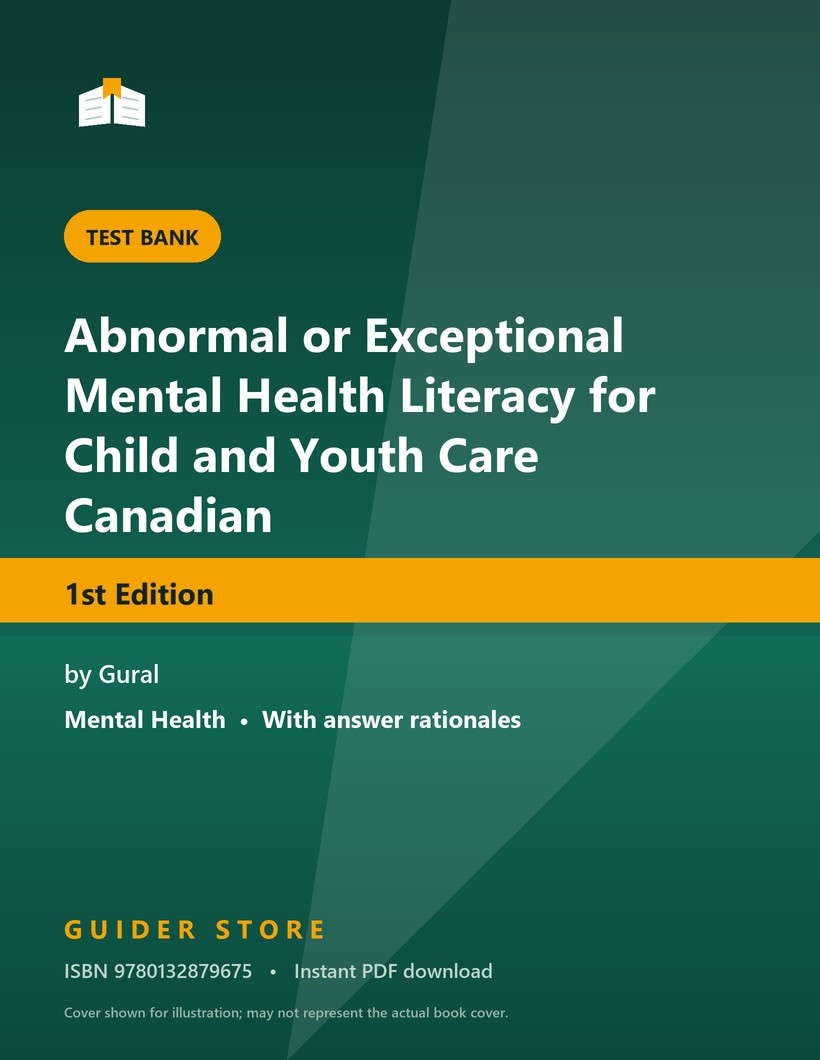

Studying child and youth mental health means learning to see a struggling young person clearly — without labels, stigma, or snap judgements. In a Child and Youth Care (CYC) program, the hard part isn’t memorising diagnostic terms; it’s understanding what “abnormal” even means, how mental health difficulties actually present in children and adolescents, and how to respond with a relational, strengths-based approach. This test bank is matched to Abnormal or Exceptional? Mental Health Literacy for Child and Youth Care, Canadian 1st Edition by Gural, so your practice questions follow the same framing, vocabulary, and CYC lens as your course.
Why this test bank helps
Every question comes with a written rationale, so you are not just checking a box — you are learning why one answer reflects sound mental health literacy and why the others rest on myths, stigma, or over-medicalised thinking. That rationale-first design is what turns a quiz into genuine understanding, which is exactly what CYC coursework and reflective assignments demand.
What’s inside
- Questions organised to follow the book’s chapter flow, so you can revise topic by topic alongside your readings
- A clear, written rationale for every question — the correct choice explained, plus why each distractor is wrong
- Concept-check and applied-scenario items in the style used across CYC and mental health literacy courses
- Terminology and definition items that separate everyday language from clinical concepts
- Delivered as an instant PDF you can read on any device, print, or annotate
Topics covered
- Mental health literacy: what it is and why it matters in Child and Youth Care
- Defining “abnormal,” “normal,” and “exceptional” — and the limits of each
- Stigma, labelling, and the impact of language on young people
- How mental health concerns present in children and adolescents specifically
- Common conditions and challenges seen in youth (mood, anxiety, behavioural, neurodevelopmental)
- Risk, resilience, and protective factors across development
- Relational, strengths-based, and trauma-informed CYC practice
- The Canadian mental health and service context relevant to CYC practitioners
Who it’s for
This is built for Child and Youth Care students, and for social service, human services, education, and early-childhood learners taking a mental health literacy course that uses Gural’s Canadian 1st edition. It is a strong fit for midterm and final exam prep, and useful review for practicum students who want to sharpen how they think about young people’s mental health.
How to use it (the right way)
Read the chapter first, then attempt the matching questions before looking at the answers. Mark what you miss, return to the text, and re-test until the reasoning — not just the answer — feels automatic. Treat scenario items as a chance to rehearse a compassionate, non-stigmatising response. Academic-integrity note: this is a study and self-assessment aid to help you learn, not a way to obtain live exam content. Use it to prepare honestly and follow your institution’s academic-integrity policy.
Sample question
(Shows the format — your download contains the full set.)
Q. A Child and Youth Care worker describes a 10-year-old as “just a difficult, abnormal kid.” From a mental health literacy standpoint, why is this framing a concern?
- A. It is accurate because behaviour that disrupts a classroom is by definition abnormal
- B. It applies a stigmatising label to the child rather than seeking to understand the behaviour in context
- C. It is helpful because a firm label speeds up access to services
- D. It is fine as long as the worker only uses the word privately
Answer: B. Mental health literacy in CYC calls for understanding behaviour in its developmental and environmental context rather than fixing a stigmatising label onto the child. A is wrong because disruptive behaviour is not automatically “abnormal” and may be a normal response to circumstances. C is wrong because a blanket label can distort assessment and harm the young person more than it helps. D is wrong because stigmatising framing shapes a worker’s expectations and responses whether or not it is said aloud.
Edition & format
- Matches: Test Bank for Abnormal or Exceptional Mental Health Literacy for Child and Youth Care Canadian 1st Edition Gural
- ISBN-13: 9780132879675
- Format: Digital PDF, delivered instantly after checkout
- Access: Lifetime — re-download anytime from your account
Please confirm the edition and ISBN match your course before buying — message us and we’ll check.
Frequently asked questions
Is this the textbook itself? No. This is a test bank of practice questions with answer rationales, designed to be used alongside the book — it is not the textbook and does not replace your assigned reading.
Are the questions the same as my real exam? No. These are study questions for self-assessment. They help you learn the material and practise the format; they are not a copy of any live exam.
Does every question include an explanation? Yes. Each question has a written rationale explaining the correct answer and why the other options are wrong, so you understand the reasoning.
How do I get it after paying? You receive an instant PDF download at checkout, and you can re-download it anytime from your account.
Explore more Maternity & Pediatric Test Banks — all with instant PDF delivery and answer rationales.




Reviews
There are no reviews yet.