
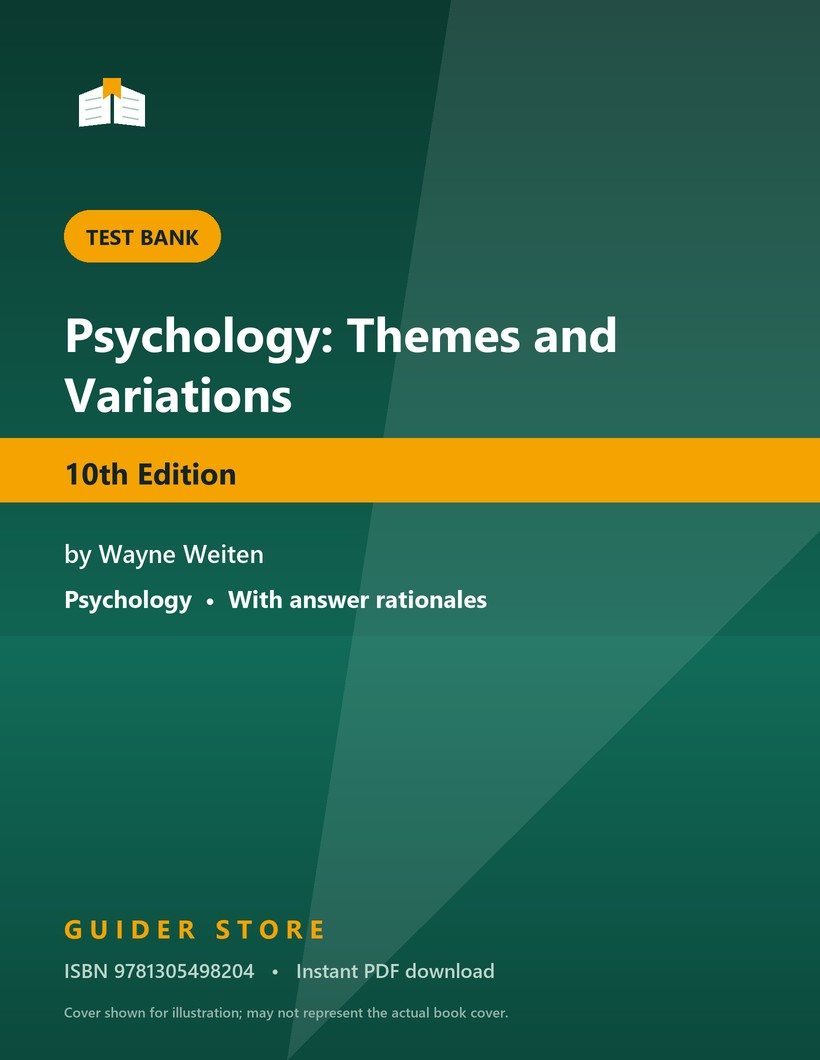


A set of unifying themes runs through every chapter of this book and reappears in the assessment more often than students expect: that psychology is empirical and theoretically diverse, that behaviour has multiple causes, that heredity and environment work jointly, that cultural heritage shapes behaviour, and that experience of the world is deeply subjective. Psychology: Themes and Variations, 10th Edition by Wayne Weiten returns to them deliberately, and exam items regularly present a finding and ask which theme it demonstrates rather than what the finding was.
Why this test bank helps
Naming a theme correctly requires understanding why the finding illustrates it, and that reasoning is exactly what a stripped-down answer key omits. The rationale on every question in this set explains what in the material makes the answer fit — which cause is being added, which subjective element is doing the work, which cultural comparison is implied — and why the other themes would need a different piece of evidence. Read across chapters, this is how the themes stop being an introductory list.
What’s inside
- Questions arranged chapter by chapter to follow the book through the full survey.
- Definitional, conceptual and applied items, including questions built directly on the unifying themes.
- A written rationale under every question explaining what makes the answer fit and the rest fail.
- Coverage of the personal application and critical thinking sections that close each chapter.
- One organized PDF, ready to download immediately after checkout.
Topics covered
- The evolution of psychology — the schools of thought, contemporary perspectives and the seven unifying themes.
- The research enterprise — experimental and correlational methods, sampling, descriptive and inferential statistics, ethics.
- The biological bases of behaviour — the nervous system, brain organization and research methods, and heredity and behaviour.
- Sensation and perception — vision and hearing, form perception, depth cues, perceptual sets and illusions.
- Variations in consciousness — sleep and dreaming, hypnosis, meditation and the effects of psychoactive drugs.
- Learning, memory, language and thought — conditioning, memory processes and distortions, problem solving and decision making.
- Motivation, emotion and human development — hunger and achievement motivation, theories of emotion, and development across the lifespan.
- Personality, stress, disorders and social behaviour — trait and psychodynamic models, coping, diagnostic categories, therapy, attribution and conformity.
Who it’s for
Students taking introductory or general psychology from this edition, including psychology majors and those taking the course to satisfy a science or social science requirement, on courses that assess the book’s thematic framework.
How to use it (the right way)
Read the chapter and mark which theme each major section is illustrating, then attempt a block of questions closed-book. Score it, read every rationale, and revisit any theme you had to guess at more than once. This is a study aid, to be used in line with your institution’s academic-integrity policy, as preparation and self-testing rather than a shortcut around the assigned work or material carried into a graded assessment.
Sample question (shows the format — your download contains the full set)
Q. Two students receive identical written feedback on an essay. One describes it as encouraging and constructive, the other as harsh and discouraging. Which of the book’s unifying themes does this best illustrate?
- A. Psychology is empirical
- B. People’s experience of the world is highly subjective
- C. Behaviour is shaped by cultural heritage
- D. Heredity and environment jointly influence behaviour
Answer: B. The objective stimulus is held constant and only the interpretation differs, which is the definition of the subjectivity theme. A concerns the discipline resting on systematic observation rather than on how individuals interpret events. C would require evidence that the difference tracks cultural background, which the scenario does not supply. D addresses the joint contribution of genes and experience to a characteristic, not the divergent perception of one identical event.
Edition & format
- Matches: Psychology: Themes and Variations, 10th Edition, by Wayne Weiten (ISBN 9781305498204).
- Format: Digital PDF, delivered instantly after checkout.
- Access: Lifetime — re-download from your account whenever you need it.
Chapter order and thematic examples change between editions. Please confirm the edition and ISBN above match the text your course assigned before you buy.
Frequently asked questions
Is this the current edition? This set is built against the 10th Edition. Editions of this title renumber chapters and refresh the applications, so if your syllabus names a different edition, choose that listing instead.
How do I receive it? As a direct download. The confirmation page carries the link, and your account keeps a copy so you never depend on an email arriving.
Do all the questions include rationales? Every one of them. The explanation names the concept being tested rather than restating the option, so you can see where your reasoning diverged.
Is using a test bank allowed? Yes, when it is used to prepare. It is a study aid, so apply your institution’s academic-integrity policy to it and never carry it into an assessed exam.
More titles for this course are in Psychology Test Banks.



Reviews
There are no reviews yet.