
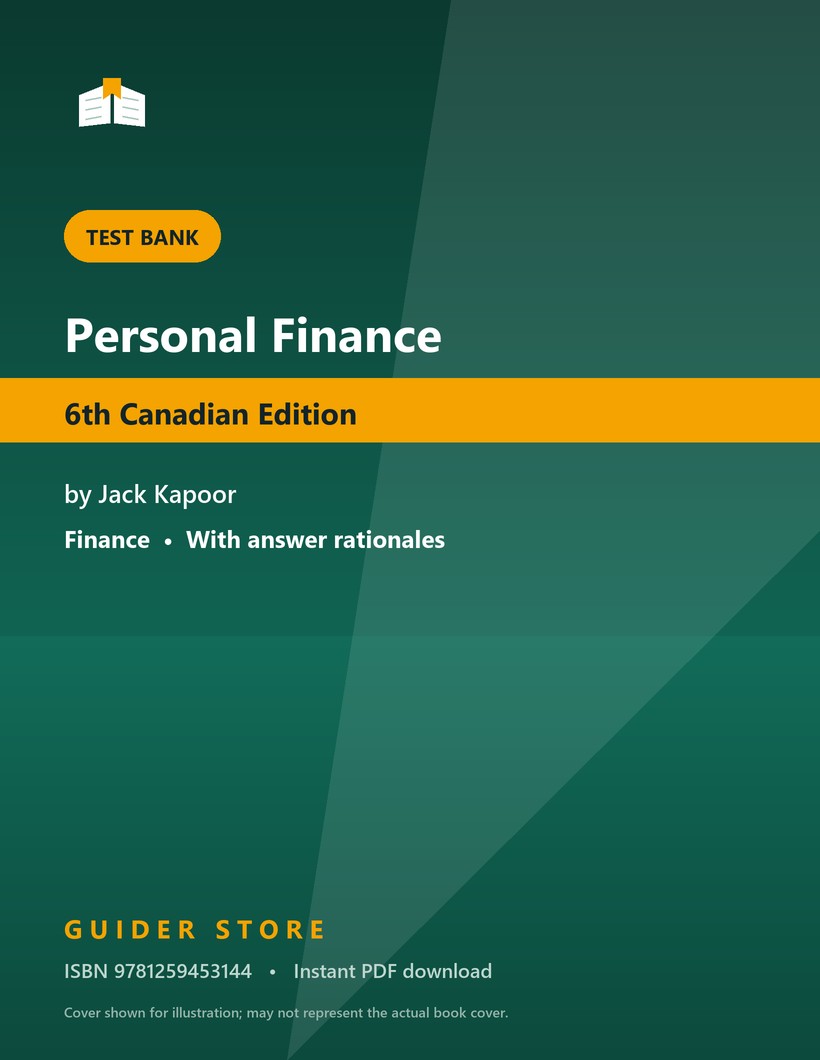
The arithmetic of personal finance travels across borders; the institutions do not, and that is where a Canadian course quietly diverges from everything students find online. Personal Finance, 6th Canadian Edition by Jack Kapoor is written around registered plans, provincial and federal tax credits, the Canada Pension Plan and mortgage rules that have no American equivalent, so revision material aimed at a United States syllabus will give you a correct compound interest calculation attached to entirely the wrong account. Exam questions in this course test the Canadian structure directly: which plan gives a deduction, which withdrawal is taxable, which agency holds your credit file.
Why this test bank helps
Institutional detail is exactly the kind of knowledge that feels solid when you read it and evaporates under exam conditions. Every question here is followed by a written rationale that states the rule plainly — when a contribution is deductible against income, when growth is sheltered but the withdrawal still taxed, how contribution room is created and carried forward. Practising against explanations rather than a bare answer key is what fixes the plan-by-plan differences that these papers keep testing.
What’s inside
- Questions organized in the book’s chapter order, so weekly reading has a matching set of practice.
- Mixed formats — multiple choice, true/false and short calculations in a Canadian context.
- A written rationale beneath every item, naming the plan, rule or formula being applied.
- Particular attention to the registered plan, tax and mortgage chapters where the Canadian material differs most.
- A single organized PDF, downloadable the moment checkout completes.
Topics covered
- The financial planning process — goals, opportunity cost and the Canadian economic environment.
- Income tax in Canada — federal and provincial brackets, non-refundable credits against deductions, and filing basics.
- Registered plans — RRSPs, TFSAs and RESPs, contribution room, and how each is treated on withdrawal.
- Banking and savings products — chequing accounts, savings vehicles, guaranteed investment certificates and effective yield.
- Consumer credit — credit cards, lines of credit, Canadian credit reporting agencies and the cost of carrying a balance.
- Housing and mortgages — qualifying, amortization against term, fixed and variable rates, and mortgage default insurance.
- Insurance — provincial health coverage and what it excludes, plus life, disability and property protection.
- Investing and retirement income — bonds, equities, mutual funds, employer pensions, the Canada Pension Plan and Old Age Security.
Who it’s for
Students at a Canadian college or university taking personal finance from this edition, including business and commerce students meeting it as a requirement and anyone whose paper draws heavily on the registered plan and tax chapters.
How to use it (the right way)
Read the chapter first, then attempt a block closed-book. Keep a single page listing each registered plan with three columns — contribution treatment, growth treatment, withdrawal treatment — and update it from the rationales as you go. This is a study aid. Use it in line with your institution’s academic-integrity policy, for preparation and self-testing rather than as a substitute for the coursework, and never as material taken into a graded assessment.
Sample question (shows the format — your download contains the full set)
Q. Which statement correctly describes the tax treatment of a registered retirement savings plan?
- A. Contributions are not deductible and withdrawals are received tax-free
- B. Contributions are deductible from income and withdrawals are included in taxable income
- C. Contributions are deductible from income and withdrawals are received tax-free
- D. Neither the contribution nor the withdrawal affects taxable income
Answer: B. An RRSP defers tax: the contribution reduces taxable income in the year it is made, growth inside the plan is sheltered, and the full amount withdrawn is added to income in the year of withdrawal. A describes a tax-free savings account, where the contribution gives no deduction but the withdrawal is not taxed. C combines the advantages of both plans and describes neither. D describes no registered plan at all, since a non-registered account gives no deduction and taxes investment income as it is earned.
Edition & format
- Matches: Personal Finance, 6th Canadian Edition, by Jack Kapoor (ISBN 9781259453144).
- Format: Digital PDF, delivered instantly after checkout.
- Access: Lifetime — re-download from your account whenever you need it.
Canadian and United States editions of this title are different books, and the Canadian editions are themselves renumbered. Please confirm the edition and ISBN above match your course before you buy.
Frequently asked questions
Is this the current edition? This set is prepared for the 6th Canadian Edition, ISBN 9781259453144. Other Canadian and American editions are listed separately.
How do I receive it? Instantly after checkout, from your order confirmation page and from your account. Nothing is shipped.
Do all the questions include rationales? Yes. Every item is explained in writing, which is what makes the plan comparisons stick.
Is using a test bank allowed? As practice material it is a normal study resource. Follow your institution’s academic-integrity policy and never take it into a graded assessment.
More titles for this course are in Finance Test Banks.



Reviews
There are no reviews yet.