
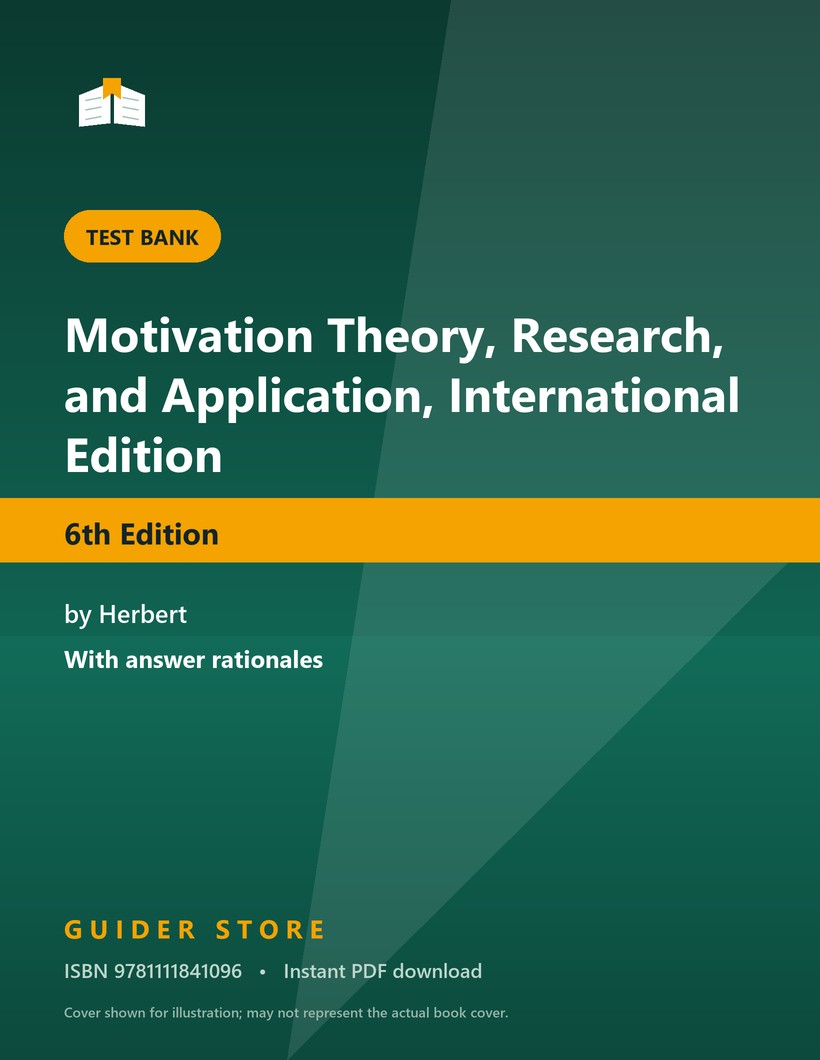


Few psychology courses cover as much historical ground as this one, and that breadth is where the difficulty sits. Motivation: Theory, Research, and Application, International Edition, 6th Edition moves from philosophical and physiological roots through drive and incentive theories to modern cognitive and social accounts, and the exam expects you to place a study in its tradition, not just to summarize it. Answering that a behavior is “motivated by reward” is worth nothing when the question is asking whether Hull, Tolman or an attributional account explains the result.
Why this test bank helps
Recognizing a theory’s name is the surface; being able to state what it predicts, and what evidence would count against it, is what earns credit. Every item here is followed by a written rationale that positions the answer within its tradition — physiological, behavioral, cognitive or social — and explains why the alternatives make a different prediction. Working through those explanations builds the historical map that makes the whole course easier to hold in memory.
What’s inside
- Questions that follow the book chapter by chapter, so a week of reading maps to a defined block of practice.
- Multiple choice, true/false, matching and short-answer items on theories, classic studies and applications.
- A written rationale under every question, naming the theory or research finding at issue.
- Coverage of the applied chapters — work, sport, education and clinical settings — that are easy to leave until too late.
- One organized PDF, ready to download as soon as checkout completes.
Topics covered
- Philosophical and physiological roots — instinct doctrine, the nervous system’s role, and the emergence of motivation as a science.
- Genetics and ethology — fixed action patterns, sign stimuli, evolutionary accounts and the limits of instinct explanations.
- Drive and incentive theories — homeostasis, Hull’s drive reduction, incentive motivation and the shift away from need states.
- Arousal and activation — optimal arousal, the reticular system and arousal’s relationship to performance.
- Hunger, thirst and regulation — peripheral and central signals, set points and the psychology of eating.
- Emotion theories — James-Lange, Cannon-Bard, the two-factor account and cognitive appraisal models.
- Cognitive motivation — expectancy-value, attribution, self-efficacy, cognitive dissonance and goal setting.
- Social and applied motivation — achievement need, affiliation, aggression, and motivation in work, sport and learning.
Who it’s for
Undergraduates in a motivation and emotion, psychology of motivation or theories of motivation course using this edition — psychology majors meeting the classic theories in sequence, and students in sport science, education and organizational behavior who need the theoretical foundation their applied courses assume.
How to use it (the right way)
Read the chapter, then write a one-line prediction for each theory it introduces before you attempt any questions; the items are built on exactly those contrasts. Work a block closed-book, flag anything where two theories seemed to fit, and read every rationale. This is a study aid. Use it in line with your institution’s academic-integrity policy — for preparation and self-testing, never as a substitute for the coursework or as material taken into a graded assessment.
Sample question (shows the format — your download contains the full set)
Q. Participants injected with a stimulant and given no explanation for their symptoms reported feeling euphoric when placed with a cheerful confederate and irritated when placed with an angry one. This result is most often cited as support for:
- A. The James-Lange theory of emotion
- B. The Cannon-Bard theory of emotion
- C. The two-factor theory of emotion
- D. Drive-reduction theory
Answer: C. The two-factor account holds that undifferentiated physiological arousal is labeled using situational cues, which is why the same drug produced different reported emotions in different social contexts. A predicts that the bodily response itself specifies which emotion is felt, so one drug should yield one emotion. B holds that arousal and emotional experience arise independently, which does not explain the influence of the confederate. D concerns the reduction of biological need states and makes no prediction about emotional labeling at all.
Edition & format
- Matches: Motivation: Theory, Research, and Application, International Edition, 6th Edition (ISBN 9781111841096).
- Format: Digital PDF, delivered instantly after checkout.
- Access: Lifetime — re-download from your account whenever you need it.
Chapter order and numbering change between editions. Please confirm the edition and ISBN above match the book your course assigned before you buy.
Frequently asked questions
Is this the current edition? This set is prepared against the 6th Edition specifically. If your syllabus names a different edition, choose that listing instead, because chapter coverage shifts between editions.
How do I receive it? The download appears on your order confirmation page and in your account as soon as checkout completes. Nothing is shipped and there is no waiting period.
Do all the questions include rationales? Yes. Every item carries a written explanation of the reasoning behind the answer, which is the part that turns checking into studying.
Is using a test bank allowed? As a study aid it works like any other practice resource. Follow your institution’s academic-integrity policy, and never take the material into a graded assessment.
More titles for this course are in Psychology Test Banks.



Reviews
There are no reviews yet.