
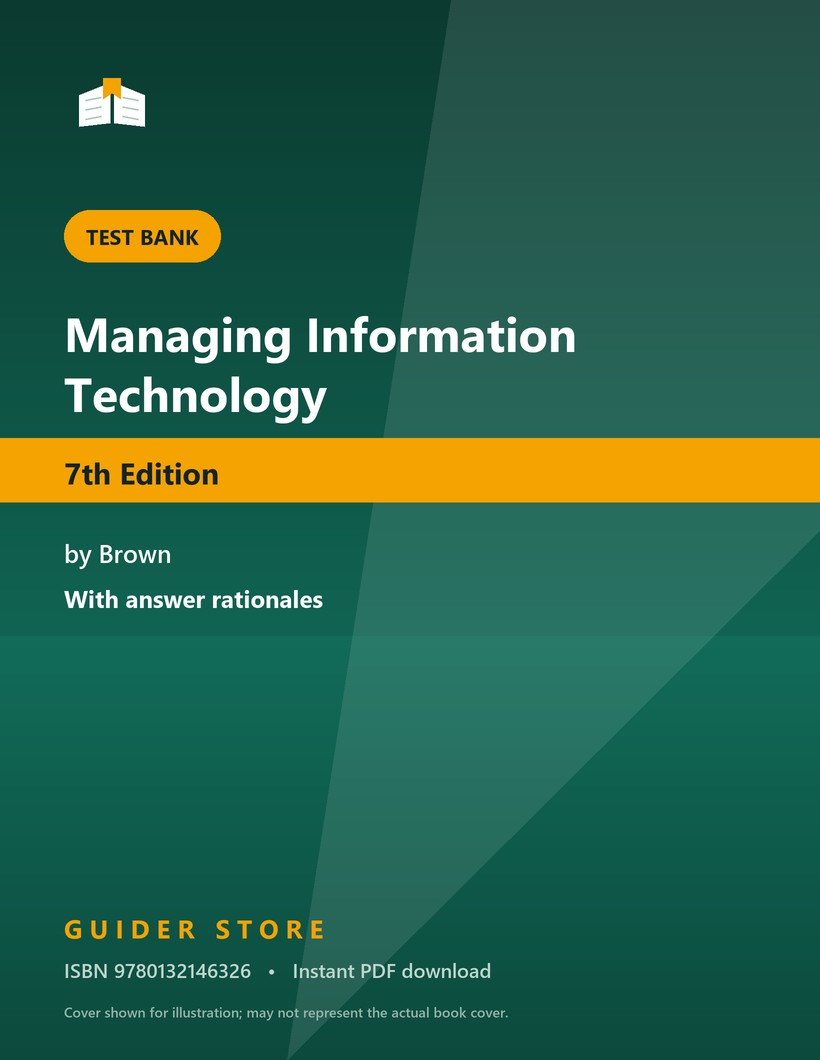


Capstone information systems courses are taught through cases, and cases do not revise well. Managing Information Technology, 7th Edition by Brown (ISBN 9780132146326) works through long organizational narratives about failed implementations, sourcing decisions and architecture choices, and students finish a semester able to discuss those situations while still shaky on the frameworks underneath them. Examinations tend to invert that balance: they take a two-sentence scenario and ask which conversion strategy, which sourcing model or which development methodology it describes.
Why this test bank helps
Case discussion builds judgment; question practice checks whether the vocabulary underneath it is precise. Each item here is followed by a written rationale that pins down the framework at stake — what separates a pilot from a phased conversion, why a fixed-price contract shifts risk rather than removing it, when an agile approach genuinely fits the requirement stability described. Those definitions are what a written paper can test, and they are the part most easily lost in a semester of discussion.
What’s inside
- Questions following the book’s chapter order, so each module of the course has a matching practice block.
- Framework, definitional and short-scenario items, reflecting how a capstone IS course is usually examined.
- A written rationale under every question, identifying the model that decides the answer.
- Focused coverage of development methodologies, sourcing and project risk, the highest-yield chapters.
- One organized PDF, downloadable the moment checkout completes.
Topics covered
- IT infrastructure and architecture — networks, servers, virtualization, platform standards and the case for consolidation.
- Enterprise systems — ERP scope decisions, customization against configuration, and post-implementation stabilization.
- Systems development methodologies — the traditional life cycle, prototyping, agile methods and packaged software selection.
- Implementation and conversion — direct, parallel, phased and pilot approaches, training and user acceptance.
- IT project management — scope control, estimation, risk identification and portfolio prioritization.
- Sourcing decisions — insourcing, outsourcing, offshoring, cloud services and contract and vendor management.
- Governance and the IT organization — centralized against decentralized structures, the CIO role and steering mechanisms.
- Information security and data management — policy, compliance obligations, business intelligence and knowledge management.
Who it’s for
Upper-level undergraduate and graduate students in a management of information systems course using this edition, including MBA students taking the core IS requirement, and IS majors preparing for a capstone examination built on the book’s cases.
How to use it (the right way)
Use the questions to interrogate the cases rather than as a separate activity: after reading a case, answer a block on that chapter and see whether you can name the frameworks the narrative was illustrating. Attempt closed-book, read every rationale, and keep a one-page list of the models you keep confusing. This is a study aid. Use it in line with your institution’s academic-integrity policy — for preparation and self-testing, not as a substitute for the coursework and not as material taken into a graded assessment.
Sample question (shows the format — your download contains the full set)
Q. An organization runs its legacy system and its new system simultaneously for one month, comparing outputs daily, before retiring the legacy system. Which conversion strategy is this?
- A. Direct cutover
- B. Parallel conversion
- C. Phased conversion
- D. Pilot conversion
Answer: B. Running both systems on the same work at the same time so results can be compared is the defining feature of parallel conversion; it is the safest option and also the most expensive, since the organization operates two systems at once. A switches over on a single date with no fallback. C introduces the new system module by module over time. D deploys the full system to one site or business unit before the wider rollout, which limits exposure without duplicating processing.
Edition & format
- Matches: Managing Information Technology, 7th Edition, by Brown (ISBN 9780132146326).
- Format: Digital PDF, delivered instantly after checkout.
- Access: Lifetime — re-download from your account at any time.
Cases and chapter order are substantially revised between editions of this text. Please confirm the edition and ISBN above match your course before you buy.
Frequently asked questions
Is this the current edition? This set is prepared against the 7th Edition and its chapter organization. If your course lists another edition, choose that listing instead.
How do I receive it? Immediately after checkout, as a PDF linked on your confirmation page and stored in your account.
Do all the questions include rationales? Yes. Every item explains the framework behind the answer and distinguishes it from the models it is most often mixed up with.
Is using a test bank allowed? As a revision resource it is ordinary study practice. Follow your institution’s academic-integrity policy and keep it out of graded assessments.
More titles for this course are in Computing & IT Test Banks.



Reviews
There are no reviews yet.