
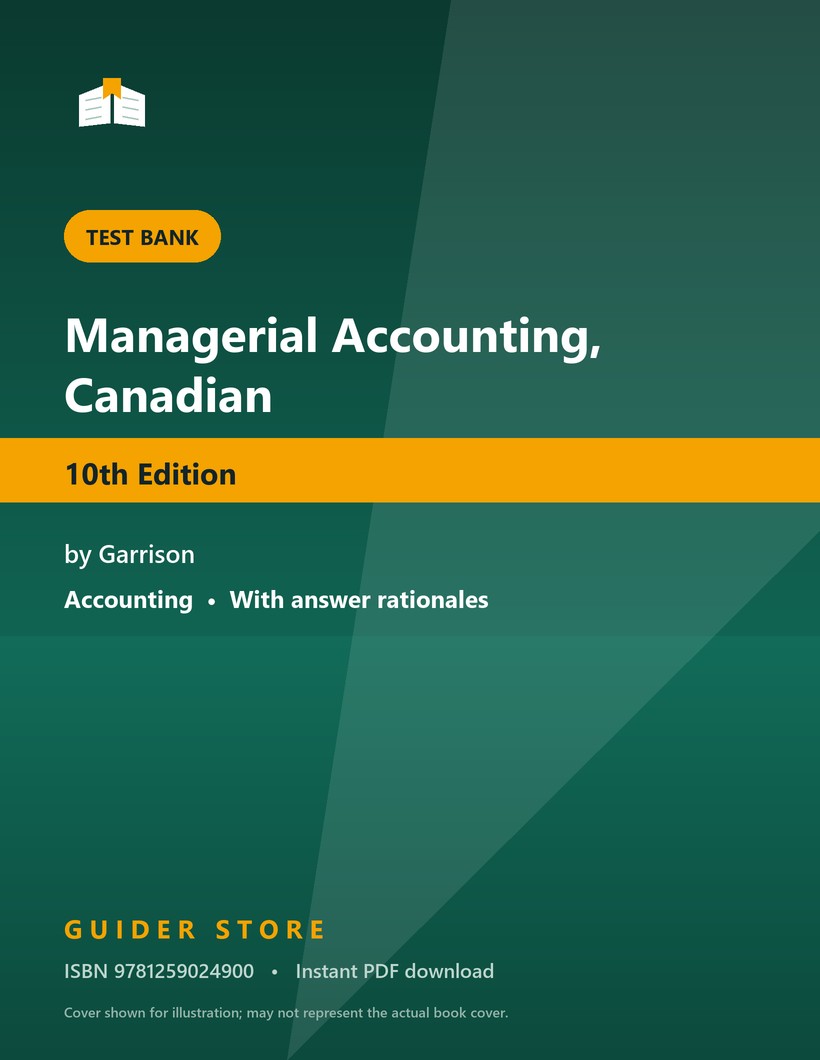
Managerial accounting frustrates students who arrive from financial accounting expecting one right answer, because here the correct figure depends entirely on the decision being made. Managerial Accounting, 10th Canadian Edition by Garrison teaches costs as tools: the same $40,000 of overhead is relevant to one question and irrelevant to the next, absorbed into inventory under one method and expensed under another. Exams exploit that constantly. A question about dropping a product line is not testing whether you can add costs, it is testing whether you can spot which of them actually disappear.
Why this test bank helps
The trap in this course is arithmetic that works perfectly on the wrong set of costs. Every question here has a written rationale explaining which costs belong in the analysis and why the others were excluded — why a sunk cost is ignored, why a fixed cost stays after a segment closes, why absorption and variable costing disagree when production and sales differ. That is the reasoning that distinguishes a good answer from a plausible one, and it transfers directly to the short-answer and case-style questions that make up much of the marking.
What’s inside
- Questions following the book’s chapter order, so each topic has its own defined practice block.
- Multiple choice, true/false and computational items, including schedule and variance calculations.
- A written rationale under every question, identifying the relevant costs and the assumption behind the method.
- Full coverage from cost behaviour through budgeting, variances and capital budgeting decisions.
- One organized PDF, ready to download the moment checkout completes.
Topics covered
- Cost terms and behaviour — variable, fixed and mixed costs, the high-low method and the contribution format.
- Job-order costing — predetermined overhead rates, applied overhead and the disposition of under- or over-applied amounts.
- Process costing — equivalent units, cost per equivalent unit and the production report.
- Activity-based costing — cost pools, activity drivers and how product cost shifts against a plantwide rate.
- Cost-volume-profit analysis — contribution margin, break-even, target profit, margin of safety and operating leverage.
- Variable versus absorption costing — the treatment of fixed overhead and the reconciliation of the two profit figures.
- Budgeting and variance analysis — the master budget, flexible budgets, and price, quantity and efficiency variances.
- Relevant costs and capital budgeting — make or buy, special orders, dropping a segment, payback and net present value.
Who it’s for
Canadian business and accounting students taking an introductory or intermediate managerial accounting course from this edition, plus commerce students who need managerial accounting as a required subject and want practice aimed at the decision questions rather than the definitions.
How to use it (the right way)
Read the chapter and work its exhibits first, then attempt a question block closed-book and time it, because most managerial exams are tight rather than difficult. For each computational item, state which costs you treated as relevant before you check the rationale. This is a study aid, to be used in line with your institution’s academic-integrity policy — as preparation and self-testing, never as a replacement for assigned coursework or as material taken into a graded assessment.
Sample question (shows the format — your download contains the full set)
Q. A product sells for $40 per unit with variable costs of $28 per unit, and fixed costs are $180,000 per year. How many units must be sold to earn a target profit of $60,000?
- A. 15,000 units
- B. 20,000 units
- C. 6,000 units
- D. 8,571 units
Answer: B. The contribution margin is $12 per unit, so covering $180,000 of fixed cost plus $60,000 of target profit requires $240,000 of contribution, or 20,000 units. A is the break-even volume and ignores the profit target. C divides the target profit alone by the contribution margin and forgets the fixed costs. D divides by the $28 variable cost rather than the contribution margin, which measures nothing meaningful.
Edition & format
- Matches: Managerial Accounting, 10th Canadian Edition, by Garrison (ISBN 9781259024900).
- Format: Digital PDF, delivered instantly after checkout.
- Access: Lifetime — re-download from your account at any time.
Canadian and US editions differ in chapter order and examples. Please confirm the edition and ISBN above match your course outline before purchase.
Frequently asked questions
Is this the current edition? This set is prepared against the 10th Canadian Edition. If your syllabus names another edition, or the US edition, choose that listing instead.
How do I receive it? The download appears on your confirmation page and in your account immediately after checkout, with nothing shipped and no delay.
Do all the questions include rationales? Yes. Every item is explained, including which costs were treated as relevant and why the alternatives fail.
Is using a test bank allowed? As revision material it works like any other practice resource. Follow your institution’s academic-integrity policy and never take it into a graded assessment.
More course titles are listed in Accounting Test Banks.



Reviews
There are no reviews yet.