
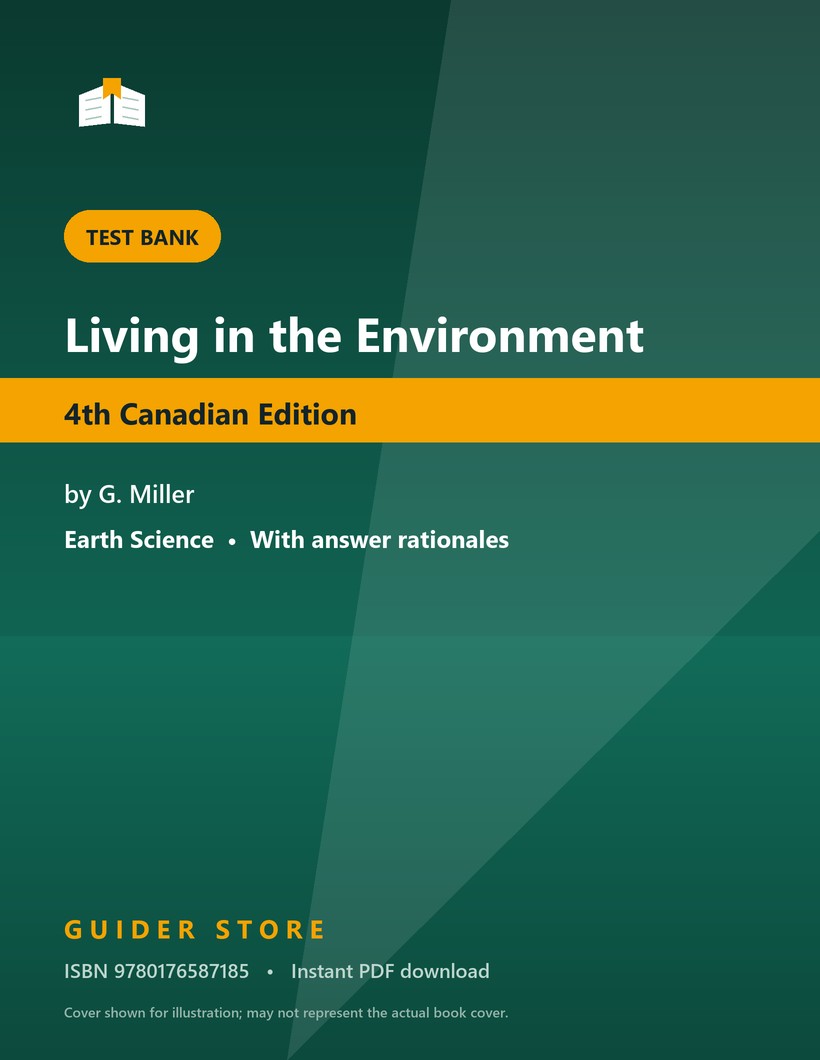


Environmental science asks students to hold ecology, chemistry, economics and policy in the same answer, which is why it feels harder than any one of them. Living in the Environment, 4th Canadian Edition by G. Miller organizes that breadth around sustainability and natural capital, and it grounds the examples in Canadian systems — boreal forest, fisheries, freshwater and energy resources — so the case material is regional even where the principles are general.
Why this test bank helps
Questions in this course usually connect a principle to a consequence: energy loss between trophic levels to the shape of a food web, nutrient loading to an algal bloom, a subsidy to a pattern of resource use. The rationale under each item makes that chain explicit rather than leaving it implied, which is what turns a memorized definition into an answer that holds up in the short-answer and case sections of the paper.
What’s inside
- Questions that follow the book chapter by chapter, so a week of reading maps to a defined block of practice.
- Mixed formats — multiple choice, true/false, matching and short written items.
- A written rationale under every question, so a wrong attempt tells you which idea you misread.
- Coverage that keeps the Canadian case material in view alongside the general principles the chapters develop.
- One organized PDF, ready to download the moment checkout completes.
Topics covered
- Sustainability and natural capital — renewable and nonrenewable resources, ecological footprints and the tragedy of the commons
- Ecosystem structure and energy flow — trophic levels, food webs, primary productivity and energy loss between levels
- Biogeochemical cycles — carbon, nitrogen, phosphorus and water cycles and the human alterations to each
- Biodiversity and species interactions — keystone species, succession, habitat loss and endangered species protection
- Population dynamics — exponential and logistic growth, carrying capacity and human population trends
- Food, soil and water — agricultural systems, soil degradation, irrigation, groundwater depletion and water pollution
- Energy resources — fossil fuels, nuclear power, renewables and the trade-offs among them
- Climate, waste and policy — greenhouse gases, air pollution, solid and hazardous waste, and environmental law and economics
Who it’s for
Students in an introductory environmental science course using the Canadian edition, including non-majors satisfying a science requirement and environmental studies students beginning the major.
How to use it (the right way)
Read the chapter and work through the book’s own examples first; practice questions diagnose understanding, they do not create it. Then attempt a block closed-book, flag every item you were unsure of even when you got it right, and read the rationale for all of them. This is a study aid. Use it in line with your institution’s academic-integrity policy — as preparation and self-testing, never as a substitute for the coursework or as material taken into a graded assessment.
Sample question (shows the format — your download contains the full set)
Q. Producers in an ecosystem capture 10,000 units of energy. Applying the usual rule of thumb for energy transfer between trophic levels, roughly how much is available to secondary consumers?
- A. 1,000 units
- B. 100 units
- C. 10 units
- D. 10,000 units
Answer: B. About ten percent of the energy at one trophic level is incorporated into the next, so primary consumers receive roughly 1,000 units and secondary consumers roughly 100. A is what primary consumers, one level up, would receive. C applies one transfer too many, giving the tertiary level. D assumes no loss at all, which the second law of thermodynamics rules out, since most energy leaves each level as metabolic heat.
Edition & format
- Matches: Living in the Environment, 4th Canadian Edition, by G. Miller.
- Format: Digital PDF, delivered instantly after checkout.
- Access: Lifetime — re-download from your account whenever you need it.
Coverage shifts from one edition to the next. Confirm the edition and ISBN your instructor listed match this one before you order.
Frequently asked questions
Is this the current edition? This set is prepared against the 4th Canadian Edition specifically, ISBN 9780176587185. If your syllabus names a different edition, choose that listing instead, because chapter numbering shifts between editions.
When do I get the file? Right away. A download link is issued the moment checkout finishes, and it stays available in your account afterwards.
Are explanations included throughout? They are. No question is left as a bare answer key; each one is explained in writing.
Is a test bank permitted? As preparation, yes, in the same way as any practice set. It is not a substitute for the coursework, and it must not be carried into a graded assessment.
More titles for this course are in Earth & Environmental Science Test Banks.


Reviews
There are no reviews yet.