
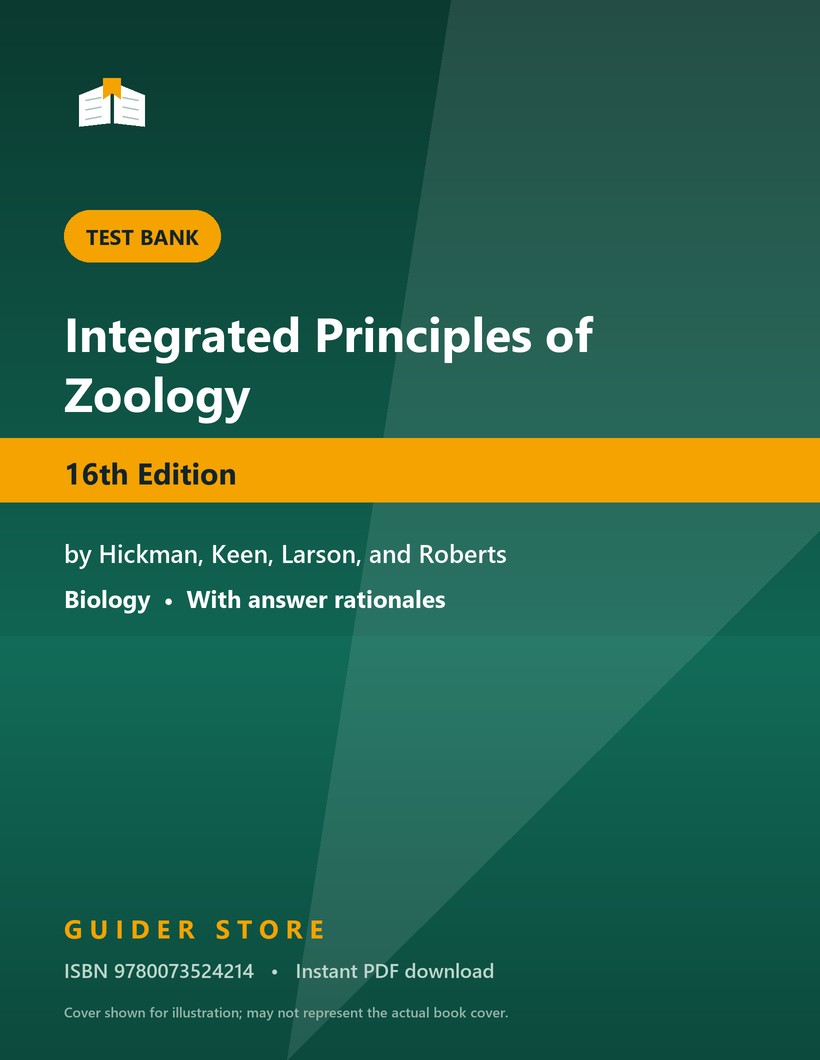


Zoology is a memory problem with a logic problem hidden inside it. Thirty-odd animal phyla, each with its own body plan, and an exam that asks which characteristics group two of them together and which are convergent. Integrated Principles of Zoology, 16th Edition by Hickman, Keen, Larson and Roberts organizes that diversity around shared derived features, so questions from it usually reward relationships over lists.
Why this test bank helps
A list of phyla can be memorized and lost within a fortnight. What lasts is the reasoning: this animal is a deuterostome because of what its blastopore becomes, this one is an ecdysozoan because it molts a cuticle. Each question here is explained in those structural terms, which is also how comparative questions on the exam are constructed.
What’s inside
- Chapter-aligned questions following the 16th edition, from animal architecture through the vertebrate classes.
- Multiple choice, matching and diagram-style items on body plans, life cycles and phylogeny.
- An explanation under every question that names the defining character and why the alternatives fail it.
- Concentrated practice on the invertebrate phyla, where most of the marks and most of the confusion sit.
- A single searchable PDF, downloadable as soon as checkout completes.
Topics covered
- Animal architecture: symmetry, germ layers, body cavities and segmentation.
- Classification, systematics and reading phylogenetic trees built on shared derived characters.
- Protozoan groups and the origins of multicellularity.
- Sponges, cnidarians and the acoelomate flatworms, including parasitic life cycles.
- Molluscs, annelids and the arthropods, with their major classes and adaptations.
- Echinoderms, hemichordates and the deuterostome route to chordate origins.
- Fishes, amphibians, non-avian reptiles, birds and mammals, and the transitions between them.
- Comparative physiology: respiration, circulation, osmoregulation, digestion and nervous control.
- Reproduction, development, animal behavior and the ecology of animal populations.
Who it’s for
Biology, zoology, wildlife and pre-veterinary students taking a general zoology or animal diversity course, and anyone facing a comparative anatomy or invertebrate zoology exam built on this text.
How to use it (the right way)
Learn each phylum against a fixed set of headings, symmetry, cavity, digestive plan, respiration, reproduction, and answer the questions closed-book against those headings rather than against your notes. When a comparative item catches you out, add the distinguishing feature to the heading it belongs under. Review earlier phyla weekly, since they are the ones the final will still expect. This is a study aid supporting your own study, used within your university’s academic-integrity policy.
Sample question (shows the format — your download contains the full set)
Q. In animals with deuterostome development, what does the blastopore become?
- A. The mouth
- B. The anus
- C. The coelom
- D. The notochord
Answer: B. Deuterostome means second mouth: the blastopore, the first opening formed during gastrulation, becomes the anus, and the mouth forms later as a second opening. This is one of the characters that groups echinoderms and chordates together. Option A describes protostome development, seen in molluscs, annelids and arthropods, where the blastopore becomes the mouth. Option C confuses an opening with a cavity, since the coelom in deuterostomes forms by enterocoely from outpocketings of the archenteron. Option D names a chordate structure that arises from dorsal mesoderm and is unrelated to the fate of the blastopore.
Edition & format
- Matches: Integrated Principles of Zoology, 16th Edition by Hickman, Keen, Larson and Roberts (ISBN 9780073524214)
- Format: Digital PDF, delivered instantly after checkout
- Access: Lifetime access, re-download anytime
Please confirm the edition and ISBN above match the book your course lists before ordering, since chapter order and taxonomy are updated between editions.
Frequently asked questions
Which edition does this follow? The 16th edition and the ISBN shown above. Check your syllabus first, as classification and chapter numbering are revised between editions.
When is the file available? Immediately after checkout. The link appears on screen and is emailed to you, so nothing has to be shipped.
Are rationales included? Yes. Every question is explained by naming the defining character behind the answer and why each other option does not satisfy it.
Is using a test bank permitted? It is a study aid for revision and self-testing, to be used in line with your institution’s academic-integrity policy. Ask your instructor if your course sets particular rules.
Explore more zoology and organismal biology study aids in Biology Test Banks.

Reviews
There are no reviews yet.