
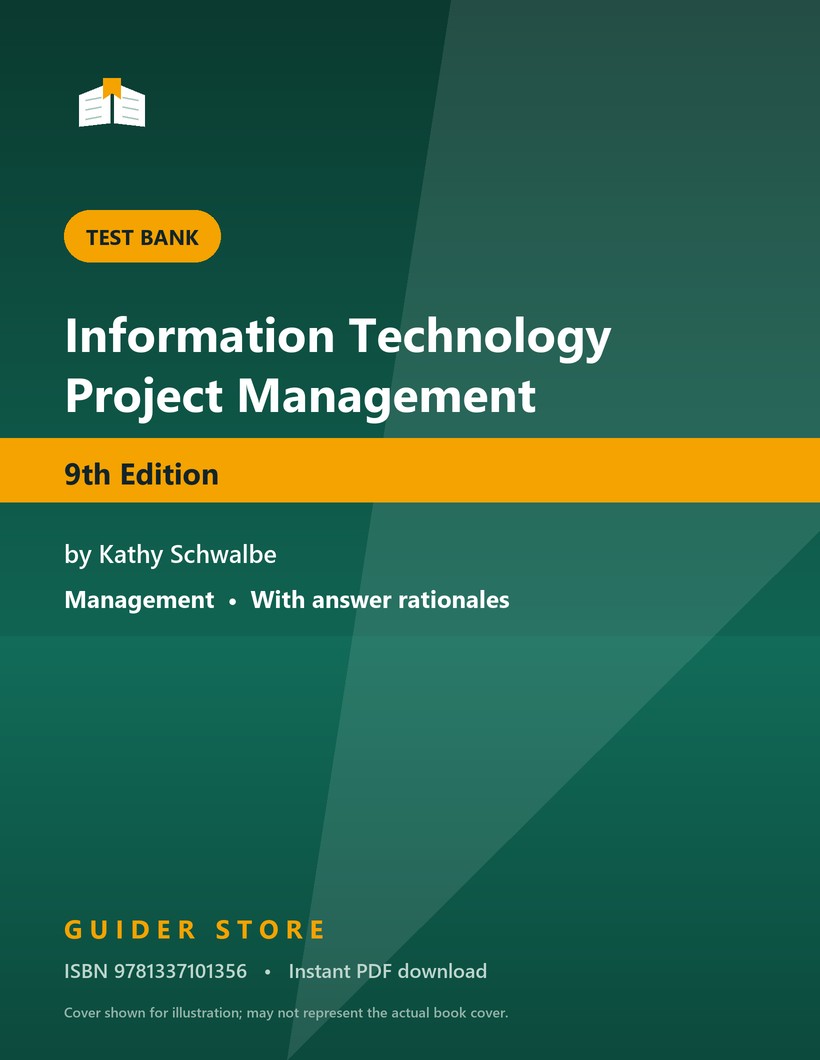


By the ninth edition this course had to teach two things at once, and students feel the strain. Information Technology Project Management, 9th Edition by Kathy Schwalbe keeps the full predictive framework — charters, work breakdown structures, network diagrams, earned value — while adding agile and hybrid approaches that answer the same questions differently. Assessment items exploit exactly that overlap, describing a situation and asking which approach the facts call for, or asking for a calculation whose interpretation changes depending on the delivery model.
Why this test bank helps
When two frameworks share vocabulary, recognition stops working and reasoning has to take over. The rationale beneath each question here separates them explicitly — what a performance index actually measures, when an iterative approach is a response to uncertain requirements rather than a preference, why a change request follows one route in a plan-driven project and another in an adaptive one. That distinction is the recurring theme of the paper.
What’s inside
- Questions following the ninth edition chapter by chapter, including the agile and hybrid material.
- Multiple choice, true/false and calculation items spanning schedule, cost and risk analysis.
- A rationale under every question, showing the working or naming the process the answer comes from.
- Balanced treatment of predictive and adaptive approaches, rather than the predictive half alone.
- One organized PDF, ready to download the moment checkout completes.
Topics covered
- Predictive, agile and hybrid approaches — when each is appropriate and how the roles differ.
- The business case and project integration — charter development, the plan and integrated change control.
- Scope management — requirements, the work breakdown structure, and backlog-based alternatives.
- Schedule management — dependencies, critical path analysis, buffers and iteration planning.
- Cost management and earned value — budgeting, cost and schedule performance indexes and forecasting.
- Quality management — quality standards, testing strategy and the cost of poor quality in IT work.
- Resource and team management — team development, virtual teams and resource loading.
- Communications and stakeholder engagement — reporting, escalation and managing expectations.
- Risk and procurement — risk registers, response strategies, contract types and vendor selection.
Who it’s for
Students taking IT project management from the ninth edition at undergraduate or graduate level, and information systems and business analytics students whose program requires a project unit with both traditional and agile content.
How to use it (the right way)
Read the chapter, then work a block closed-book, calculating every index by hand and stating which delivery approach the scenario implies before choosing. Review every rationale, and keep a note of items where you applied the right formula to the wrong quantity. This is a study aid. Use it in line with your institution’s academic-integrity policy — for preparation and self-assessment, never as a substitute for the coursework or as material used in a graded assessment.
Sample question (shows the format — your download contains the full set)
Q. At a status review, a project reports an earned value of $180,000, an actual cost of $200,000 and a planned value of $210,000. What do the cost and schedule performance indexes indicate?
- A. CPI is 0.90 and SPI is about 0.86, so the project is over budget and behind schedule
- B. CPI is 1.11 and SPI is about 1.17, so the project is ahead on both measures
- C. CPI is 0.90 and SPI is about 1.17, so the project is over budget but ahead of schedule
- D. Neither index can be computed without the budget at completion
Answer: A. The cost performance index is earned value divided by actual cost, $180,000 over $200,000, which is 0.90, and the schedule performance index is earned value divided by planned value, $180,000 over $210,000, which is about 0.86. Any index below 1.0 signals underperformance, so this project is both over budget and behind schedule. B inverts both ratios. C divides planned value by earned value for the schedule measure, reversing its meaning. D confuses these indexes with the estimate at completion, which is the calculation that needs the budget at completion.
Edition & format
- Matches: Information Technology Project Management, 9th Edition, by Kathy Schwalbe (ISBN 9781337101356).
- Format: Digital PDF, delivered instantly after checkout.
- Access: Lifetime access — the file stays in your account for repeat download.
The agile chapters and the running case differ from earlier editions of this text. Please confirm the edition and ISBN above match the book your course assigned before you buy.
Frequently asked questions
Which edition does this cover? The ninth edition, ISBN 9781337101356. The eighth edition has a different chapter structure and less agile content, and is listed separately.
How do I receive it? It downloads immediately once checkout completes and stays in your account for later use.
Do all the questions include rationales? Yes. Every item is explained, with full working shown on the earned value and schedule calculations.
Is using a test bank allowed? As a study aid it works like any other practice resource. Follow your institution’s academic-integrity policy, and never take it into a graded assessment.
Browse the rest of the subject in Management Test Banks.





Reviews
There are no reviews yet.